
Minnesota Administrative Rules
CHAPTER 7511, FIRE CODE
DEPARTMENT OF LABOR AND INDUSTRY AND
DEPARTMENT OF PUBLIC SAFETY
| Part | Title |
|---|---|
| 7511.0010 | PURPOSE. |
| 7511.0020 | SCOPE. |
| 7511.0090 | CODES AND STANDARDS INCORPORATED BY REFERENCE. |
| 7511.0101 | SECTION 101, GENERAL. |
| 7511.0102 | SECTION 102, APPLICABILITY. |
| 7511.0104 | SECTION 104, GENERAL AUTHORITY AND RESPONSIBILITIES. |
| 7511.0105 | SECTION 105, PERMITS. |
| 7511.0106 | [Repealed, 40 SR 1437] |
| 7511.0108 | [Renumbered 7511.0109] |
| 7511.0109 | [Renumbered 7511.0110] |
| 7511.0109 | SECTION 109, BOARD OF APPEALS. |
| 7511.0110 | SECTION 110, VIOLATIONS. |
| 7511.0201 | SECTION 201, GENERAL. |
| 7511.0202 | SECTION 202, GENERAL DEFINITIONS. |
| 7511.0304 | SECTION 304, COMBUSTIBLE WASTE MATERIAL. |
| 7511.0307 | SECTION 307, OPEN BURNING AND RECREATIONAL FIRES. |
| 7511.0308 | SECTION 308, OPEN FLAMES. |
| 7511.0315 | SECTION 315, GENERAL STORAGE. |
| 7511.0316 | [Renumbered 7511.0319] |
| 7511.0318 | SECTION 318, LAUNDRY CARTS. |
| 7511.0319 | [Renumbered 7511.0320] |
| 7511.0320 | SECTION 320, CLEARANCE OF VEGETATION FROM STRUCTURES. |
| 7511.0321 | SECTION 321, COVERED MALL BUILDINGS. |
| 7511.0401 | SECTION 401, UNPLANNED EVACUATION. |
| 7511.0403 | SECTION 403, EMERGENCY PREPAREDNESS REQUIREMENTS. |
| 7511.0405 | SECTION 405, EMERGENCY EVACUATION DRILLS. |
| 7511.0408 | [Renumbered 7511.0321] |
| 7511.0503 | SECTION 503, FIRE APPARATUS ACCESS ROADS. |
| 7511.0506 | SECTION 506, KEY BOXES. |
| 7511.0507 | SECTION 507, FIRE PROTECTION WATER SUPPLIES. |
| 7511.0508 | [Renumbered 7511.0507, subp 2] |
| 7511.0510 | SECTION 510, EMERGENCY RESPONDER RADIO COVERAGE. |
| 7511.0601 | SECTION 601, GENERAL. |
| 7511.0603 | SECTION 603, FUEL-FIRED APPLIANCES. |
| 7511.0604 | SECTION 604, ELECTRICAL EQUIPMENT, WIRING, AND HAZARDS. |
| 7511.0605 | [Repealed, 44 SR 610] |
| 7511.0606 | SECTION 606, ELEVATOR OPERATION, MAINTENANCE, AND FIRE SERVICE KEYS. |
| 7511.0607 | [Repealed, 40 SR 1437] |
| 7511.0607 | SECTION 607, COMMERCIAL KITCHEN HOODS. |
| 7511.0610 | [Repealed, 40 SR 1437] |
| 7511.0610 | SECTION 610, PEDESTRIAN WALKWAYS AND PEDESTRIAN TUNNELS. |
| 7511.0611 | [Renumbered 7511.0610] |
| 7511.0701 | SECTION 701, GENERAL. |
| 7511.0704 | [Repealed, 40 SR 1437] |
| 7511.0705 | [Repealed, 40 SR 1437] |
| 7511.0705 | SECTION 705, DOOR AND WINDOW OPENINGS. |
| 7511.0706 | SECTION 706, DUCT AND AIR TRANSFER OPENINGS. |
| 7511.0801 | SECTION 801, GENERAL. |
| 7511.0806 | SECTION 806, DECORATIVE VEGETATION IN NEW AND EXISTING BUILDINGS. |
| 7511.0807 | SECTION 807, DECORATIVE MATERIALS AND ARTIFICIAL DECORATIVE VEGETATION IN NEW AND EXISTING BUILDINGS. |
| 7511.0901 | SECTION 901, GENERAL. |
| 7511.0903 | SECTION 903, AUTOMATIC SPRINKLER SYSTEMS. |
| 7511.0904 | SECTION 904, ALTERNATIVE AUTOMATIC FIRE-EXTINGUISHING SYSTEMS. |
| 7511.0905 | SECTION 905, STANDPIPE SYSTEMS. |
| 7511.0906 | SECTION 906, PORTABLE FIRE EXTINGUISHERS. |
| 7511.0907 | SECTION 907, FIRE ALARM AND DETECTION SYSTEMS. |
| 7511.0908 | [Repealed, 44 SR 610] |
| 7511.0909 | SECTION 909, SMOKE CONTROL SYSTEMS. |
| 7511.0910 | SECTION 910, SMOKE AND HEAT REMOVAL. |
| 7511.0912 | SECTION 912, FIRE DEPARTMENT CONNECTIONS. |
| 7511.0915 | SECTION 915, CARBON MONOXIDE DETECTION. |
| 7511.1001 | SECTION 1001, ADMINISTRATION. |
| 7511.1002 | [Repealed, 40 SR 1437] |
| 7511.1006 | SECTION 1006, NUMBER OF EXITS AND EXIT ACCESS DOORWAYS. |
| 7511.1007 | [Repealed, 44 SR 610] |
| 7511.1008 | [Renumbered 7511.1010] |
| 7511.1009 | [Renumbered 7511.1011] |
| 7511.1009 | SECTION 1009, ACCESSIBLE MEANS OF EGRESS. |
| 7511.1010 | SECTION 1010, DOORS, GATES AND TURNSTILES. |
| 7511.1011 | SECTION 1011, STAIRWAYS. |
| 7511.1013 | [Renumbered 7511.1015] |
| 7511.1014 | [Renumbered 7511.1017] |
| 7511.1015 | [Repealed, 44 SR 610] |
| 7511.1015 | SECTION 1015, GUARDS. |
| 7511.1017 | [Renumbered 7511.1018] |
| 7511.1018 | [Renumbered 7511.1020] |
| 7511.1018 | SECTION 1018, AISLES. |
| 7511.1019 | [Repealed, 40 SR 1437] |
| 7511.1020 | SECTION 1020, CORRIDORS. |
| 7511.1022 | [Renumbered 7511.1023] |
| 7511.1023 | [Renumbered 7511.1024] |
| 7511.1023 | SECTION 1023, INTERIOR EXIT STAIRWAYS AND RAMPS. |
| 7511.1024 | SECTION 1024, EXIT PASSAGEWAYS. |
| 7511.1025 | Repealed by subpart |
| 7511.1026 | [Repealed, 40 SR 1437] |
| 7511.1027 | [Repealed, 40 SR 1437] |
| 7511.1028 | [Renumbered 7511.1030] |
| 7511.1028 | [Renumbered 7511.1029] |
| 7511.1029 | [Renumbered 7511.1030] |
| 7511.1029 | SECTION 1029, ASSEMBLY. |
| 7511.1030 | [Renumbered 7511.1031] |
| 7511.1030 | SECTION 1030, EMERGENCY ESCAPE AND RESCUE. |
| 7511.1031 | SECTION 1031, MAINTENANCE OF THE MEANS OF EGRESS. |
| 7511.1101 | SECTION 1101, GENERAL. |
| 7511.1103 | SECTION 1103, FIRE SAFETY REQUIREMENTS FOR EXISTING BUILDINGS. |
| 7511.1104 | SECTION 1104, MEANS OF EGRESS FOR EXISTING BUILDINGS. |
| 7511.1105 | SECTION 1105, SEPARATION OF OCCUPANCIES AND HAZARDOUS AREAS. |
| 7511.1106 | [Renumbered 7511.1105] |
| 7511.1203 | SECTION 1203, EMERGENCY AND STANDBY POWER SYSTEMS. |
| 7511.1204 | SECTION 1204, SOLAR PHOTOVOLTAIC POWER SYSTEMS. |
| 7511.1408 | [Renumbered 7511.3308] |
| 7511.2007 | SECTION 2007, HELISTOPS AND HELIPORTS. |
| 7511.2206 | [Renumbered 7511.2306] |
| 7511.2210 | [Renumbered 7511.2310] |
| 7511.2306 | [Renumbered 7511.3206] |
| 7511.2306 | SECTION 2306, FLAMMABLE AND COMBUSTIBLE LIQUID MOTOR FUEL-DISPENSING FACILITIES. |
| 7511.2307 | [Repealed, 44 SR 610] |
| 7511.2310 | SECTION 2310, MARINE MOTOR FUEL-DISPENSING FACILITIES. |
| 7511.2404 | SECTION 2404, SPRAY FINISHING. |
| 7511.2701 | [Renumbered 7511.5001] |
| 7511.2703 | Repealed by subpart |
| 7511.3006 | [Renumbered 7511.5306] |
| 7511.3201 | [Renumbered 7511.5501] |
| 7511.3206 | SECTION 3206, GENERAL FIRE PROTECTION AND LIFE SAFETY FEATURES. |
| 7511.3301 | [Renumbered 7511.5601] |
| 7511.3308 | [Renumbered 7511.5608] |
| 7511.3308 | SECTION 3308, OWNER'S RESPONSIBILITY FOR FIRE PROTECTION. |
| 7511.3401 | [Repealed, 40 SR 1437] |
| 7511.3402 | [Repealed, 40 SR 1437] |
| 7511.3404 | [Renumbered 7511.5704] |
| 7511.3405 | [Repealed, 40 SR 1437] |
| 7511.3406 | [Renumbered 7511.5706] |
| 7511.3800 | [Repealed, 40 SR 1437] |
| 7511.4500 | [Repealed, 40 SR 1437] |
| 7511.4600 | [Renumbered 7511.8100] |
| 7511.5001 | [Repealed, 44 SR 610] |
| 7511.5003 | SECTION 5003, GENERAL REQUIREMENTS. |
| 7511.5306 | SECTION 5306, MEDICAL GASES. |
| 7511.5501 | [Repealed, 44 SR 610] |
| 7511.5601 | SECTION 5601, GENERAL. |
| 7511.5608 | SECTION 5608, FIREWORKS DISPLAY. |
| 7511.5609 | SECTION 5609, TEMPORARY STORAGE OF FIREWORKS. |
| 7511.5704 | SECTION 5704, STORAGE. |
| 7511.5706 | SECTION 5706, SPECIAL OPERATIONS. |
| 7511.5707 | SECTION 5707, ON-DEMAND MOBILE FUELING OPERATIONS. |
| 7511.6101 | CHAPTER 61, LIQUEFIED PETROLEUM GASES. |
| 7511.7900 | AMENDMENTS TO APPENDICES OF INTERNATIONAL FIRE CODE. |
| 7511.8000 | [Renumbered 7511.8400] |
| 7511.8000 | REFERENCED STANDARDS. |
| 7511.8010 | [Renumbered 7511.8410] |
| 7511.8020 | [Renumbered 7511.8420] |
| 7511.8030 | [Renumbered 7511.8430] |
| 7511.8040 | [Renumbered 7511.8440] |
| 7511.8100 | CHAPTER 81 - ADULT DAY SERVICES CENTERS, RESIDENTIAL HOSPICE FACILITIES AND SUPERVISED LIVING FACILITIES. |
| 7511.8400 | PURPOSE AND SCOPE. |
| 7511.8410 | PRESSURIZED FLAMMABLE GAS. |
| 7511.8420 | WARNING SYMBOL REQUIRED. |
| 7511.8430 | SYMBOL DESIGN. |
| 7511.8440 | SYMBOL PLACEMENT. |
| 7511.8500 | [Repealed, 36 SR 1479] |
| 7511.8510 | [Repealed, 36 SR 1479] |
| 7511.8520 | [Repealed, 36 SR 1479] |
| 7511.8530 | [Repealed, 36 SR 1479] |
| 7511.8540 | [Repealed, 36 SR 1479] |
| 7511.8550 | [Repealed, 36 SR 1479] |
| 7511.8560 | [Repealed, 36 SR 1479] |
| 7511.8570 | [Repealed, 36 SR 1479] |
7511.0010 PURPOSE.
The purpose of this chapter is to adopt uniform fire safety standards consistent with nationally recognized good practice for the safeguarding to a reasonable degree of life and property from the hazards of fire and explosion arising from the storage, handling and use of hazardous substances, materials and devices, and from conditions hazardous to life or property in the use or occupancy of buildings or premises.
Statutory Authority:
MS s 299F.011
History:
32 SR 10
Published Electronically:
October 11, 2007
7511.0020 SCOPE.
The scope of this chapter is intended to be consistent with Minnesota Statutes, section 299F.011.
Statutory Authority:
MS s 299F.011
History:
32 SR 10
Published Electronically:
October 11, 2007
7511.0090 CODES AND STANDARDS INCORPORATED BY REFERENCE.
Subpart 1.
International Fire Code.
For purposes of this chapter, "IFC" means the 2018 edition of the International Fire Code as promulgated by the International Code Council, Inc., Washington, D.C. The IFC is incorporated by reference and made a part of Minnesota Rules pursuant to statutory authority, subject to the alterations and amendments in this chapter. Portions of this chapter reproduce text and tables from the IFC. The IFC is not subject to frequent change and is available at the office of the commissioner of the Department of Labor and Industry and at the State Law Library, 25 Rev. Dr. Martin Luther King Jr. Blvd., St. Paul, Minnesota 55155. The IFC is copyright 2017 by the International Code Council, Inc. All rights reserved.
History:
32 SR 10; 36 SR 1479; 40 SR 1437; 44 SR 610
Published Electronically:
April 16, 2020
7511.0101 SECTION 101, GENERAL.
Subpart 1.
IFC Section 101.1.
IFC Section 101.1 is amended to read:
101.1 Title. This code shall be known as the Minnesota State Fire Code, may be cited as such, and will be referred to herein as "Fire Code" or "this code."
Subp. 2.
IFC Section 101.
IFC Section 101 is amended by adding sections to read:
101.6 Local government amendments to Chapter 1. Any jurisdiction that adopts this code is authorized to make amendments to Chapter 1 of this code to provide a system for enforcement and administration within the jurisdiction. These amendments shall be equal to, in addition to, or more stringent than this code. None of the existing provisions of Chapter 1 shall be changed nor shall any amendment be made that interferes with the intent of the existing provisions nor the state fire marshal's duties and powers thereunder.
101.6.1 Local government rules. Any jurisdiction that adopts this code is authorized to adopt rules for the prevention and control of fires and fire hazards as may be necessary from time to time, to carry out the intent of this code, and that may be more restrictive than this code when the rules are necessary to protect life or property in the community. The governing body may adopt this code by ordinance. One certified copy of the ordinance containing the rules shall be filed with the clerk of the jurisdiction and shall be in effect immediately thereafter, and additional copies shall be kept in the office of the fire department for distribution to the public.
Statutory Authority:
MS s 299F.011
History:
32 SR 10
Published Electronically:
October 11, 2007
7511.0102 SECTION 102, APPLICABILITY.
Subpart 1.
IFC section 102.1.
IFC section 102.1 is amended, and sections added, to read:
102.1 Construction and design provisions. The construction and design provisions of this code shall apply to:
1. Structures, facilities, and conditions arising after the adoption of this code.
2. Existing structures, facilities, and conditions when identified in specific sections of this code.
3. Existing structures, facilities, and conditions that, in the opinion of the code official, constitute a distinct hazard to life and property.
102.1.1 Existing building features - application. Existing construction and design features that exceed the requirements for existing structures or facilities but are equal to or less than the requirements for new structures or facilities shall not be further diminished. Existing construction and design features that exceed the requirements for new structures or facilities are allowed to be removed. (See Section 901.6 concerning maintenance of fire protection systems.)
Subp. 2.
IFC section 102.2.
IFC section 102.2 is amended by adding a section to read:
102.2.1 Operational provisions - defined. The operational provisions of this code are those operations defined in Sections 105.6.1 through 105.6.50.
Subp. 3.
IFC section 102.7.3.
IFC section 102.7 is amended by adding a section to read:
102.7.3 References to ICC codes. The references to the codes and standards promulgated by the International Code Council (listed under ICC in Chapter 80) are modified as follows:
1. Wherever this code references the ICC Electrical Code, it means the Electrical Code, Minnesota Rules, chapter 1315.
2. Wherever this code references the International Building Code, it means the Minnesota Building Code, Minnesota Rules, chapter 1305.
3. Wherever this code references the International Fuel Gas Code, it means the Minnesota Mechanical Code, Minnesota Rules, chapter 1346.
4. Wherever this code references the International Mechanical Code, it means the Minnesota Mechanical Code, Minnesota Rules, chapter 1346.
5. Wherever this code references the International Plumbing Code, it means the Minnesota Plumbing Code, Minnesota Rules, chapter 4714.
6. Wherever this code references the International Residential Code, it means the Minnesota Residential Code, Minnesota Rules, chapter 1309.
7. Wherever this code references the International Existing Building Code, it means the Minnesota Conservation Code for Existing Buildings, Minnesota Rules, chapter 1311.
Subp. 4.
IFC section 102.
IFC section 102 is amended by adding sections to read:
102.13 Standards for existing Group I occupancies. The provisions of protection in existing Group I-2 occupancies, and in existing Group I-3 occupancies used as detention and correctional facilities, shall be in accordance with the applicable provisions of the Life Safety Code, ANSI/NFPA 101, referred to as Standard No. 101, published by the National Fire Protection Association (Quincy, Massachusetts, 2012). Standard No. 101 is incorporated by reference, is not subject to frequent change and is available at the State Law Library, 25 Rev. Dr. Martin Luther King Jr. Blvd., Saint Paul, Minnesota 55155.
Construction provisions of Standard No. 101 that are more restrictive than those found in the Building Code shall not be applicable. For the purposes of Section 102.13, construction provisions shall include those relating to type of construction, automatic fire-extinguishing and standpipe systems, fire alarm and detection systems, vertical opening protection, escape windows, exits, smoke barriers, accessibility for persons with disabilities, and hazardous area separations.
102.13.1 Standard 101 modified. Sections 23.3.7 through 23.3.7.3 of Standard No. 101 are deleted.
102.14 Mixed occupancies. Where a building is occupied for two or more uses not included in the same occupancy, the building or portion thereof shall be classified as a mixed occupancy. The mixed occupancy shall be further classified as either nonseparated uses or separated uses according to the Building Code. Areas of Group H shall only be as separated uses as permitted by the Building Code.
102.14.1 Separated uses. Each portion of the building shall be individually classified as to use. Each fire area shall comply with the Fire Code based on the use of that space. Provisions for egress between different occupancies shall be in accordance with Chapter 10.
102.14.2 Nonseparated uses. Each portion of the building shall be individually classified as to use. The most restrictive provisions of the Fire Code shall apply to the nonseparated uses. Provisions for egress between different occupancies shall be in accordance with Chapter 10.
History:
L 2005 c 56 s 2; 32 SR 10; L 2007 c 140 art 4 s 61; art 13 s 4; 40 SR 71; 40 SR 1437; 44 SR 610
Published Electronically:
April 16, 2020
7511.0104 SECTION 104, GENERAL AUTHORITY AND RESPONSIBILITIES.
IFC section 104.9 is amended by adding sections to read:
104.9.3 Performance-based fire and life safety design. The code official is authorized to approve performance-based fire and life safety designs where the code official finds that the proposed design has been conducted by an approved method. Approved performance-based designs shall be deemed as evidence of compliance with the intent of this code. Approvals under the authority herein contained shall be subject to the approval of the building code official whenever the design involves matters regulated by the Building Code. Sections 104.9.3.1 through 104.9.3.4 shall apply to performance-based designs.
104.9.3.1 Goals, objectives and acceptance criteria. Design goals, objectives and performance criteria shall be approved by the code official prior to the submission of a performance-based design report, calculations or analysis results. As a minimum, an approved performance-based design shall address the following objectives: life safety of occupants, firefighter safety, property protection, continuity of operations and safeguarding of the environment.
104.9.3.2 Peer review. To determine the acceptability of the performance-based design, the code official is authorized to request technical assistance in accordance with Section 104.7.2.
104.9.3.3 Engineer of record. Performance-based designs shall be prepared by, and bear the stamp of, a licensed design professional competent in the area of work. The design professional shall provide written confirmation to the code official before a certificate of occupancy is issued that the performance-based design has been properly implemented, that the operation or use of the building is within the limitations of the design and that adequate controls are in place to maintain compliance with the conditions of the design throughout the life of the building.
104.9.3.4 Annual recertification of performance-based design. Where a performance-based design has been approved and used, the property owner shall annually certify that the design features and systems have been maintained in accordance with the approved original performance-based design and assumptions and any subsequent approved changes or modifications to the original performance-based design.
History:
32 SR 10; 40 SR 1437
Published Electronically:
May 12, 2016
7511.0105 SECTION 105, PERMITS.
IFC section 105.7.21 is deleted.
Statutory Authority:
MS s 326B.02
History:
40 SR 1437; 44 SR 610
Published Electronically:
April 16, 2020
7511.0106
[Repealed, 40 SR 1437]
Published Electronically:
October 23, 2020
7511.0108
[Renumbered 7511.0109]
Published Electronically:
October 23, 2020
7511.0109
[Renumbered 7511.0110]
7511.0109 SECTION 109, BOARD OF APPEALS.
Subpart 1.
IFC section 109.1.
IFC section 109.1 is amended to read:
SECTION 109
APPEALS
109.1 Appeals to state fire marshal. As outlined in Minnesota Statutes, section 299F.011, subdivisions 5 and 5b, any person may appeal an order issued to them by the state fire marshal or action taken by the local governing body on issues regulated by this code. Appeals can be made to determine the suitability of alternate materials and types of construction, to provide for reasonable interpretations of the provisions of this code, and to grant variances from orders issued by representatives of the state fire marshal. Persons wishing to present matters for appeal shall do so in writing and, in the case of persons who have received written orders, applications for variances shall be made prior to the expiration of the orders. Orders shall not be considered to be expired until any time extensions granted by the state fire marshal have elapsed. The state fire marshal shall not accept applications for variances after criminal action for noncompliance has been initiated pursuant to Minnesota Statutes, section 299F.011, subdivision 6.
History:
32 SR 10; 44 SR 610
Published Electronically:
October 23, 2020
7511.0110 SECTION 110, VIOLATIONS.
IFC section 110.4 is amended to read:
110.4 Violation penalties. A person who violates a provision of this code shall be guilty of a misdemeanor.
(Subsection 110.4.1 remains unchanged.)
Statutory Authority:
MS s 326B.02
History:
44 SR 610
Published Electronically:
April 16, 2020
7511.0201 SECTION 201, GENERAL.
IFC section 201.4 is amended to read:
201.4 Terms not defined. When terms are not defined, they shall have their ordinary accepted meanings within the context with which they are used. The Merriam-Webster Collegiate Dictionary, available on the Internet at www.merriam-webster.com, shall be considered as providing ordinarily accepted meanings. The dictionary is incorporated by reference, is subject to frequent change, and is available through the Minitex interlibrary loan system.
History:
32 SR 10; 44 SR 610
Published Electronically:
April 16, 2020
7511.0202 SECTION 202, GENERAL DEFINITIONS.
IFC section 202 is amended by adding or amending definitions to read:
ADULT DAY CARE CENTER OR ADULT DAY SERVICES CENTER. A facility, licensed by the Department of Human Services under Minnesota Rules, parts 9555.9600 to 9555.9730, that provides a program of adult day care services to functionally impaired adults for periods of less than 24 hours per day in a setting other than a participant's home or the residence of the facility's operator.
AERIAL LUMINARIES. Aerial luminaries, sky lanterns, and similar devices are an unmanned type of balloon made from lightweight materials, which require a flame, candle, fuel cell, or other open flame to develop lift and propel them. When released, there is no way to control the flight path, altitude, or landing area.
AMBULATORY CARE FACILITY. Buildings or portions of buildings used to provide medical, surgical, psychiatric, nursing, or similar care on a less than 24-hour basis to individuals who are rendered incapable of self-preservation by the services provided. For the purposes of this chapter, federally certified end-stage renal disease facilities (kidney dialysis facilities) located on the level of exit discharge shall not be considered ambulatory care facilities.
AISLE. That portion of an exit that connects an aisle accessway to an exit access doorway, corridor, or an exit.
APPROVED. "Approved" means approval by the fire code official, pursuant to the Minnesota State Fire Code, by reason of:
A. inspection, investigation, or testing;
B. accepted principles;
C. computer simulations;
D. research reports; or
E. testing performed by either a licensed engineer or by a locally or nationally recognized testing laboratory.
AUTHORITY HAVING JURISDICTION. Any municipal fire code official serving within their appointed jurisdiction or the state fire marshal or any of their authorized representatives.
AUTOMOTIVE MOTOR-FUEL-DISPENSING FACILITY. That portion of property where flammable or combustible liquids or gases used as motor fuels are stored and dispensed from fixed equipment into the fuel tanks of motor vehicles. For purposes of this definition, a motor vehicle is any self-propelled vehicle that: (1) conveys an operator, such as an automobile, truck, motorcycle, recreational vehicle, camper, all-terrain vehicle, snowmobile, lawn care vehicle, tractor, or dozer; and (2) is used for personal, commercial, recreational, maintenance, or construction purposes.
BUILDING CODE. The Minnesota Building Code, Minnesota Rules, chapter 1305.
CARE FACILITY. Occupancies used as care facilities shall be classified into the occupancy group category identified in the following table.
Table 202.1
Care Facility Classifications
| Type of Licensed Facility | Number or Type of Care Recipients | IBC Occupancy Classification | |
| Child Care (Day Care) | Family Child Care Home | 10 occupants maximum with ≤ 6 below school age1 | R-3 Dwelling Unit |
| Group Child Care Home < 24 hours per day |
11-14 occupants maximum | R-3 Dwelling Unit |
|
| Child Care Center < 24 hours per day |
> 5 but ≤ 100 children ≤ 2.5 years of age and each room at, and with, an exit at the level of exit discharge | E | |
| Child Care Center < 24 hours per day |
More than 5 children > 2.5 years of age | E | |
| Child Care Center < 24 hours per day |
More than 5 children ≤ 2.5 years of age and not classified as E | I-4 | |
| Adult Day Care (Day Services) | Family Adult Day Services (located in caregiver's primary residence) | ≤ 8 care recipients age 13 and older | R-3 Dwelling Unit |
| Adult Day Services Center < 24 hours per day |
6 or more care recipients, age 13 and older, all may or may not be capable of self-preservation without assistance | I-4 Unless meets criteria for E below |
|
| Adult Day Services Center < 24 hours per day |
6 or more care recipients, age 13 and older, all capable of self-preservation without assistance | E | |
| Adult Day Services Center < 24 hours per day |
6 or more care recipients, age 13 and older, where at least one care recipient but no more than 50 percent of the care recipients require assistance for self-preservation | I-4 E if meets all conditions for classification as E under definition of Occupancy Classification, Classification as Group E |
|
| Day Training and Habilitation | Program participants age 13 and older | Classified by primary use/training function | |
| Supervised Living Facilities | Class A-1 | 6 or fewer residents all of whom are capable of self-preservation without assistance | R-3 Dwelling Unit |
| Class A-2 | 7 to 16 residents all of whom are capable of self-preservation without assistance | R-4 Condition 1 | |
| Class A-2 | More than 16 residents all of whom are capable of self-preservation without assistance | I-1 Condition 1 | |
| Class B-1 | 6 or fewer residents all of whom may not be capable of self-preservation without assistance | R-3 | |
| Class B-2 | 7 to 16 residents of which some may require limited assistance for self-preservation | R-4 Condition 2 | |
| Class B-3 | More than 16 residents all of whom may not be capable of self-preservation without assistance | I-2 Condition 1 | |
| Hospice | Residential Hospice Facility | 1-5 terminally ill persons | R-3 |
| Residential Hospice Facility | 6-12 terminally ill persons | R-4 Condition 2 | |
| Adult Foster Care | Adult Foster Care Home | 1-5 impaired adults | R-3 Dwelling Unit |
| Child Foster Care | Foster Care | 1-6 foster children without severe disability or assisted medical technology | R-3 Dwelling Unit |
| Foster Care | 1-4 foster children with medical or special care services | R-3 Dwelling Unit |
|
| Housing with Services Establishment | Housing with Services Establishment Housing with Services Establishment Providing Assisted Living Services |
1-5 adult residents ≥ 80 percent 55 years of age or older unless registered under MN Statutes, section 144D.025 | R-3 Dwelling Unit |
| Housing with Services Establishment Housing with Services Establishment Providing Assisted Living Services |
6-16 adult residents ≥ 80 percent 55 years of age or older unless registered under MN Statutes, section 144D.025 | R-4 Condition 2 | |
| Housing with Services Establishment Housing with Services Establishment Providing Assisted Living Services |
> 16 adult residents ≥ 80 percent 55 years of age or older unless registered under MN Statutes, section 144D.025 | I-1 Condition 2 | |
| Boarding Care | Boarding Care Home | ≤ 5 residents | R-3 Dwelling Unit |
| Boarding Care Home | 6-16 residents all of whom are capable of self-preservation without assistance | R-4 Condition 1 | |
| Boarding Care Home | > 16 residents all of whom are capable of self-preservation without assistance | I-1 Condition 1 | |
| Boarding and Lodging | Boarding and Lodging | ≤ 16 residents in sleeping rooms or ≤ 2 dwelling units in one building | R-3 |
| Boarding and Lodging | > 16 residents in sleeping rooms or > 2 dwelling units in one building all of whom are capable of self-preservation without assistance | R-2 | |
| Boarding and Lodging < 30 days |
Lodging facilities with 6 or more sleeping units Boarding houses with > 10 occupants |
R-1 | |
| Boarding and Lodging < 30 days |
Lodging facilities with 5 or fewer sleeping units Boarding houses with ≤ 10 occupants |
R-3 Dwelling Unit |
|
| Senior Housing | Senior Housing (See IBC 310) | More than 2 dwelling units in one building | R-2 |
| Senior Housing (See IBC 310) | 2 family dwelling units in one building | R-3 | |
| Senior Housing (See IBC 310) | 1 dwelling unit | R-3 Dwelling Unit |
|
| Congregate Residence | Congregate Residence | ≤ 16 residents | R-3 |
| Congregate Residence | 17 or more residents | R-2 | |
| Chemical Dependency and Mental Health Treatment Programs | Chemical Dependency and Mental Health Treatment Programs - Outpatient (< 24 hrs.) | Not regulated | B |
| Chemical Dependency and Mental Health Treatment Programs - Residential | ≤ 5 residents | R-3 Dwelling Unit |
|
| Chemical Dependency and Mental Health Treatment Programs - Residential | 6-16 residents all of whom may not be capable of self-preservation without assistance | R-4 Condition 2 | |
| Chemical Dependency and Mental Health Treatment Programs - Residential | > 16 residents all of whom may not be capable of self-preservation without assistance | I-1 Condition 2 | |
| Ambulatory Care Facility | Nursing and medical care for < 24 hours | Includes skilled medical care, emergency care, surgery, obstetrics, or patient stabilization for psychiatric or detox | B |
| Nursing Home | Nursing and medical care for > 24 hours | Does NOT include: emergency care, surgery, obstetrics, or in-patient stabilization for psychiatric or detox | I-2 Condition 1 |
| Hospital | Nursing and medical care for > 24 hours | Includes skilled medical care, emergency care, surgery, obstetrics, or in-patient stabilization for psychiatric or detox | I-2 Condition 2 |
1 "School age" means the age of a "school-age child" as defined in Minnesota Statutes 2018, section 245A.02, subdivision 16.
CHIEF. See FIRE CHIEF.
CORRIDOR. An interior passageway having a length at least three times its width, having walls, partitions, or other obstructions to exit travel over 6 feet (1,829 mm) in height on two opposing sides and having openings from rooms or similar spaces.
DECORATIVE MATERIALS. Combustible materials used for decorative effects such as curtains; draperies; streamers; surface coverings applied over building interior finishes for decorative, acoustical, or other effect; cloth; cotton batting; paper; plastics; vegetation; hay; split bamboo; straw; vines; leaves; trees; moss; and similar materials used for decorative effect. Decorative materials do not include educational materials that are displayed in an approved manner, ordinary window shades, floor coverings, interior finish materials used as surface coverings (See Chapter 8 for regulations of such materials) and materials 1/28 inch (0.9 mm) or less in thickness applied directly to a noncombustible backing.
FAMILY ADULT DAY SERVICES. A program providing services for up to eight functionally impaired adults for less than 24 hours per day in the license holder's primary residence in accordance with Minnesota Statutes, section 245A.143. This includes programs located in residences licensed by the Department of Human Services for adult foster care, provided not more than eight adults, excluding staff, are present in the residence at any time.
FAMILY DAY CARE HOME. A residence, licensed by the Department of Human Services under Minnesota Rules, parts 9502.0315 to 9502.0445, in which no more than ten children at any one time receive care, maintenance, and supervision by other than their relatives or legal guardians for less than 24 hours per day.
FIRE CHIEF. The chief officer of the fire department serving the jurisdiction or the chief's authorized representatives.
FIRE CODE OFFICIAL. The state fire marshal, the state fire marshal's authorized representative, fire chief, fire department representatives authorized by the fire chief, or other authority specifically designated by ordinance or regulation that is charged with the administration and enforcement of the code. The appointing authority shall ensure that the fire code official is competent by virtue of certification as a fire inspector, training, or experience in fire prevention inspections and enforcement.
FIRE DEPARTMENT. A regularly organized fire department, fire protection district, or fire company regularly charged with the responsibility of providing firefighting or fire protection services to the state or a political subdivision.
FLEET VEHICLE MOTOR-FUEL-DISPENSING FACILITY. That portion of a commercial, industrial, governmental, or manufacturing property where liquids used as fuels are stored and dispensed into the fuel tanks of motor vehicles that are used in connection with such businesses, by persons within the employ of such businesses. For purposes of this definition, a motor vehicle is any self-propelled vehicle that: (1) conveys an operator, such as an automobile, truck, motorcycle, recreational vehicle, camper, all-terrain vehicle, snowmobile, lawn care vehicle, tractor, or dozer; and (2) is used for personal, commercial, recreational, maintenance, or construction purposes.
GENERAL EVACUATION SIGNAL. "General evacuation signal" means a fire alarm occupant notification system in accordance with Section 907.5.
GROUP DAY CARE HOME. A residence, licensed by the Department of Human Services under Minnesota Rules, parts 9502.0315 to 9502.0445, in which at least 11 but not more than 14 children receive care, maintenance, and supervision by other than their relatives or legal guardians for less than 24 hours per day.
GUEST ROOM. A room or a group of rooms used or intended to be used for purposes of lodging by guests.
INTERMEDIATE BULK CONTAINER. A storage container meeting the requirements of and containing products authorized by the United States Department of Transportation Hazardous Materials Regulations, Code of Federal Regulations, title 49, or by Part 6 of the United Nations Recommendations on the Transport of Dangerous Goods for classes 31H1, 31H2, and 31HZ1.
INTERNATIONAL BUILDING CODE (IBC). The Minnesota Building Code, Minnesota Rules, chapter 1305.
INTERNATIONAL FUEL GAS CODE. The Minnesota Mechanical Code, Minnesota Rules, parts 1346.5050 to 1346.6014.
INTERNATIONAL MECHANICAL CODE. The Minnesota Mechanical Code, Minnesota Rules, parts 1346.0050 to 1346.1606.
INTERNATIONAL RESIDENTIAL CODE (IRC). The Minnesota Residential Code, Minnesota Rules, chapter 1309.
MECHANICAL CODE. The Minnesota Mechanical Code, Minnesota Rules, parts 1346.0050 to 1346.1606.
MINNESOTA BUILDING CODE. Minnesota Rules, chapter 1305.
MINNESOTA MECHANICAL CODE. Minnesota Rules, parts 1346.0050 to 1346.1606.
MINNESOTA RESIDENTIAL CODE. Minnesota Rules, chapter 1309.
MUNICIPALITY. Any statutory or home rule charter city, county, or town meeting the requirements of Minnesota Statutes, section 368.01, subdivision 1, the University of Minnesota, or the state for public buildings.
NFPA. National Fire Protection Association.
OCCUPANCY CLASSIFICATION. Except as modified by this part, for the purposes of this code, certain occupancies and uses are defined. All other subdefinitions in the IFC definition of "occupancy classification" that are not modified in this definition still apply:
Institutional Group I.
Group I-1. This occupancy shall include buildings, structures, or portions thereof for more than 16 persons who reside, on a 24-hour basis, in a supervised environment and receive custodial care services. Examples of this group include the following:
Alcohol and drug centers
Assisted living
Boarding care homes
Congregate care facilities
Convalescent facilities
Group homes
Halfway houses
Housing with services establishment
Residential board and care facilities
Social rehabilitation facilities
Supervised living facilities Class A-2
Occupancy conditions. Buildings of Group I-1 shall be classified as one of the following conditions:
Condition 1. This occupancy condition includes buildings in which all persons receiving custodial care, without any assistance, are capable of responding to an emergency situation to complete building evacuation.
Condition 2. This occupancy condition includes buildings in which there are any persons receiving custodial care who require limited verbal or physical assistance while responding to an emergency situation to complete building evacuation.
Six to 16 persons receiving custodial care. A facility housing at least six and not more than 16 persons receiving custodial care, all of whom are capable of self-preservation, shall be classified as Group R-4, Condition 1.
Five or fewer persons receiving custodial care. A facility with five or fewer persons receiving custodial care shall be classified as Group R-3.
Group I-2. This occupancy shall include buildings and structures used for medical care on a 24-hour basis for more than five persons who are incapable of self-preservation. Examples of this group include the following:
Detoxification facilities
Foster care facilities
Hospitals
Nursing homes
Psychiatric hospitals
Supervised living facilities Class B-3
Occupancy conditions. Buildings of Group I-2 shall be classified as one of the following occupancy conditions:
Condition 1. This occupancy condition includes facilities that provide nursing and medical care but do not provide emergency care, surgery, obstetrics, or in-patient stabilization units for psychiatric or detoxification, including but not limited to nursing homes and foster care facilities.
Condition 2. This occupancy condition includes facilities that provide nursing and medical care and could provide emergency care, surgery, obstetrics, or in-patient stabilization units for psychiatric or detoxification, including but not limited to hospitals.
Five or fewer persons receiving care. A facility with five or fewer persons receiving care consistent with Group I-2 occupancies shall be classified as Group R-3.
Group I-4, Day care and day services facilities. This group includes buildings and structures occupied by more than five persons of any age who receive custodial care for less than 24 hours per day by persons other than parents or guardians, relatives by blood, marriage, or adoption, and in a place other than the home of the person receiving care. This group shall include, but not be limited to, the following:
Adult day services
Child day care
Classification as Group E. Day care and day services uses are classified as Group E occupancies in accordance with the following:
Adult day services centers serving only persons capable of self-preservation. Adult day services centers serving only persons who, without assistance, are capable of self-preservation under emergency conditions are classified as Group E.
Adult day services centers serving both persons capable and persons not capable of self-preservation. Adult day services centers are classified as Group E where all of the following conditions apply:
1. At least one person served but not more than 50 percent of persons served require assistance with self-preservation under emergency conditions.
2. The rooms in which the adults are cared for are located on the level of exit discharge serving such rooms, with all exits discharging directly to grade without intervening stairs. Each exit discharge shall provide an accessible route, without stairs, to the public way or safe dispersal area in accordance with the exception to Section 1028.5.
3. The day services center is protected with an automatic fire alarm system consisting of automatic smoke detection in all corridors and at the top of all stairways, and automatic fire detection in boiler and furnace rooms, kitchens, storage rooms, custodial closets, laundry and soiled linen rooms, and other hazardous areas.
4. The center shall demonstrate the ability to evacuate the entire population of the center within three minutes.
Child day care. A child day care facility shall be classified as Group E where all of the following conditions apply:
1. The facility provides care for more than five but not more than 100 children 2-1/2 years of age or less.
2. The rooms in which the children are cared for are located on the level of exit discharge serving such rooms.
3. Each room providing day care has an exit door directly to the exterior.
Within a place of religious worship. Rooms and spaces within places of religious worship providing such care during religious functions shall be classified as part of the primary occupancy.
Five or fewer occupants receiving care. A facility having five or fewer persons receiving custodial care shall be classified as part of the primary occupancy.
Five or fewer occupants receiving care in a dwelling unit. Adult day services or child day care within a dwelling unit and having five or fewer persons receiving custodial care shall be classified as a Group R-3 occupancy. Where the adult day services or child day care is located in a one- or two-family dwelling or townhouse, the dwelling: (1) shall be constructed in accordance with either the Building Code or the Minnesota Residential Code; and (2) shall be equipped with an automatic sprinkler system when required by Section 903.2.8.
Residential Group R.
Residential Group R includes, among others, the use of a building or structure, or a portion thereof, for sleeping purposes when not classified as an Institutional Group I.
Exception: Group R-3 and R-4 occupancies located in a one- or two-family dwelling or townhouse and classified as a "dwelling unit" in Table 202.1: (1) shall be constructed in accordance with either the Building Code or the Minnesota Residential Code; and (2) shall be equipped with an automatic sprinkler system when required by Section 903.2.8.
Residential occupancies shall be classified according to the following:
Residential Group R-1. Residential occupancies containing sleeping units where the occupants are primarily transient in nature, including:
Boarding houses (transient) with more than ten occupants
Congregate living facilities (transient) with more than ten occupants
Hotels (transient)
Lodging houses with six or more guest rooms or more than ten occupants
Motels (transient)
Residential Group R-2. Residential occupancies containing sleeping units or more than two dwelling units where the occupants are primarily permanent in nature, including:
Apartment houses
Congregate living facilities (nontransient) with more than sixteen occupants
Boarding houses
Convents
Dormitories
Fraternities and sororities
Monasteries
Hotels (not transient)
Motels (not transient)
Vacation time-share properties
Residential Group R-3. Residential occupancies where the occupants are primarily permanent in nature and not classified as R-1, R-2, R-4, or I, including:
Assisted living
Buildings that do not contain more than two dwelling units
Boarding care homes
Care facilities that provide accommodations for five or fewer persons receiving care
Congregate living facilities (nontransient) with 16 or fewer occupants
Boarding houses (nontransient)
Dormitories
Fraternities and sororities
Convents
Monasteries
Congregate living facilities (transient) with ten or fewer occupants
Boarding houses (transient)
Dwelling units (two or fewer) in mixed occupancy buildings
Family adult foster home
Foster care
Housing with services establishment
Lodging houses (transient) with five or fewer guest rooms and 10 or fewer occupants
Residential hospice with five or fewer occupants
Lodging houses. Owner-occupied lodging houses with five or fewer guest rooms and 10 or fewer total occupants shall be permitted to be constructed in accordance with the Minnesota Residential Code.
Residential Group R-4. This occupancy shall include buildings, structures or portions thereof for more than five but not more than 16 persons, excluding staff, who reside on a 24-hour basis in a supervised residential environment and receive custodial care. This group shall include the following:
Alcohol and drug centers
Assisted living
Boarding care homes
Congregate care facilities
Group homes
Halfway houses
Housing with services establishment (including those that provide assisted living)
Residential board and care facilities
Residential hospice with twelve or fewer occupants
Social rehabilitation facilities
Group R-4 occupancies shall meet the requirements for construction as defined for Group R-3, except as otherwise provided for in this code.
Occupancy conditions. Buildings of Group R-4 shall be classified as one of the following occupancy conditions:
Condition 1. This occupancy condition includes buildings in which all persons receiving custodial care, without any assistance, are capable of responding to an emergency situation to complete building evacuation.
Condition 2. This occupancy condition includes buildings in which there are any persons receiving custodial care who require limited verbal or physical assistance while responding to an emergency situation to complete building evacuation.
OUTPATIENT CLINIC. Buildings or portions thereof used to provide medical care on a less than 24-hour basis to persons who are not rendered incapable of self-preservation by the services provided, including federally certified end-stage renal disease facilities (kidney dialysis facilities) not classified as an ambulatory care facility.
PERFORMANCE-BASED DESIGN. An engineering approach to design elements of a building based on agreed-upon performance goals and objectives, engineering analysis, and quantitative assessment of alternatives against the design goals and objectives using accepted engineering tools, methodologies, and performance criteria.
POWER TAP. A device that is connected to an electrical receptacle, has built-in overcurrent protection and allows connection of one or more electrical plugs to supply electricity to other devices and equipment.
REQUIRED BY THE FIRE CHIEF. Determined by the fire chief to be directly related to safeguarding life and property from the hazards of fire, and uniform for each class or kind of building, structure, or property covered.
RESIDENTIAL HOSPICE FACILITY. A facility located in a residential area that directly provides 24-hour residential and support services in a home-like setting for not more than 12 persons who have been diagnosed as terminally ill with a probable life expectancy of under one year.
ROOM. A space or area bounded by any obstructions over 6 feet in height which at any time enclose more than 80 percent of the perimeter of the area. In computing the unobstructed perimeter, openings less than 3 feet in clear width and less than 6 feet 8 inches high shall not be considered. Aisles and corridors shall not be construed to form rooms.
SMALL HOSE CONNECTION. "Small hose connection" means a 1-1/2-inch (38 mm) connection supplied inside of a building for firefighting overhaul operations in sprinkler-protected structures.
STANDPIPE SYSTEM, CLASSES OF. "Classes of standpipe system" means the following:
Class I system. "Class I system" means a system providing 2-1/2 inch (64 mm) and 1-1/2 inch (38 mm) hose connections to supply water for use by fire departments and those trained in handling heavy fire streams.
Class II system. "Class II system" means a system providing 1-1/2 inch (38 mm) hose stations to supply water for use primarily by the building occupants or by the fire department during initial response.
STATE FIRE MARSHAL. The Minnesota state fire marshal or the state fire marshal's authorized representatives.
SUPERVISED LIVING FACILITY. A facility in which supervision, lodging, meals, and, in accordance with the rules of the Department of Human Services and the Department of Health, counseling and developmental habilitative or rehabilitative services are provided to persons who are chemically dependent, adult mentally ill, or physically or developmentally disabled.
Class A-1 supervised living facility. A supervised living facility for six or fewer ambulatory or mobile disabled persons who are capable of taking appropriate action for self-preservation under emergency conditions as determined by program licensure provisions.
Class A-2 supervised living facility. A supervised living facility for more than six ambulatory or mobile disabled persons who are capable of taking appropriate action for self-preservation under emergency conditions as determined by program licensure provisions.
Class B-1 supervised living facility. A supervised living facility for six or fewer ambulatory or nonambulatory, mobile or nonmobile persons who are not mentally or physically capable of taking appropriate action for self-preservation under emergency conditions as determined by program licensure provisions.
Class B-2 supervised living facility. A supervised living facility for seven to 16 ambulatory or nonambulatory, mobile or nonmobile persons who are not mentally or physically capable of taking appropriate action for self-preservation under emergency conditions as determined by program licensure provisions.
Class B-3 supervised living facility. A supervised living facility for 17 or more ambulatory or nonambulatory, mobile or nonmobile persons who are not mentally or physically capable of taking appropriate action for self-preservation under emergency conditions as determined by program licensure provisions.
History:
L 2005 c 56 s 2; 32 SR 10; L 2007 c 140 art 4 s 61; art 13 s 4; 40 SR 1437; 44 SR 610
Published Electronically:
April 16, 2020
7511.0304 SECTION 304, COMBUSTIBLE WASTE MATERIAL.
Subp. 3.
IFC section 304.
IFC section 304 is amended by adding a section to read:
304.4 Clothes dryers. Clothes dryers and their exhaust systems shall be cleaned as necessary to keep lint traps, exhaust ducts, and mechanical and heating components free from excessive lint accumulation.
History:
32 SR 10; 40 SR 1437; 44 SR 610
Published Electronically:
April 16, 2020
7511.0307 SECTION 307, OPEN BURNING AND RECREATIONAL FIRES.
Subpart 1.
IFC sections 307.1 through 307.2.1 and 307.4 through 307.4.1.
IFC sections 307.1 through 307.2.1 and IFC sections 307.4 through 307.4.1 are deleted.
Subp. 2.
IFC section 307.3.
IFC section 307.3 is amended to read as follows:
307.3 Extinguishment authority. When open burning, a recreational fire or a portable outdoor fireplace creates or adds to a hazardous situation, or a required permit has not been obtained, the fire code official is authorized to order extinguishment.
History:
32 SR 10; 40 SR 1437
Published Electronically:
May 12, 2016
7511.0308 SECTION 308, OPEN FLAMES.
History:
32 SR 10; 40 SR 1437; 32 SR 10; 40 SR 1437; 44 SR 610
Published Electronically:
April 16, 2020
7511.0315 SECTION 315, GENERAL STORAGE.
Subpart 1.
IFC section 315.3.1.
IFC section 315.3.1 is amended to read:
315.3.1 Ceiling clearance. Storage shall be maintained 2 feet (610 mm) or more below the ceiling in nonsprinklered areas of buildings or a minimum of 18 inches (457 mm) below sprinkler head deflectors in sprinklered areas of buildings. Where more restrictive clearances between sprinkler head deflectors and storage are required by the sprinkler listing or NFPA 13, the more restrictive clearances shall apply.
Exceptions:
1. The 2-foot (610 mm) ceiling clearance is not required for storage along walls in nonsprinklered areas of buildings.
2. The 18-inch (457 mm) ceiling clearance is not required for storage along walls in areas of buildings equipped with an automatic sprinkler system in accordance with Section 903.3.1.1, 903.3.1.2, or 903.3.1.3.
Subp. 2.
IFC section 315.3.3.
IFC section 315.3.3 is amended, and sections added, to read:
315.3.3 Equipment rooms. Combustible storage in boiler rooms, mechanical rooms, electrical equipment rooms and elevator equipment rooms shall be in accordance with Sections 315.3.3.1 through 315.3.3.4. Storage not in conformance with these sections shall be removed or the condition abated. For purposes of Sections 315.3.3.1 through 315.3.3.4, storage does not include materials necessary for the construction, maintenance, or operation of the equipment.
315.3.3.1 Mechanical equipment, boiler, and furnace rooms. Storage in mechanical equipment rooms, boiler rooms, and furnace rooms shall be neat and orderly and arranged to provide immediate access to equipment. Clearances between equipment and storage shall be at least 36 inches, or as required by the manufacturer, whichever is greater. When in the opinion of the code official, the type, amount, arrangement, or location of storage creates a hazard, the code official is authorized to order its removal.
315.3.3.2 Electrical vaults and equipment rooms. Electrical vaults and rooms or areas solely dedicated to main electrical distribution equipment shall not contain storage.
315.3.3.3 Elevator equipment rooms. No combustible storage or any other type of storage shall be allowed in elevator equipment rooms or elevator machine rooms.
315.3.3.4 Shafts. No combustible storage shall be allowed in mechanical rooms such as penthouses with shafts open to multiple floors.
History:
32 SR 10; 40 SR 1437; 44 SR 610
Published Electronically:
April 16, 2020
7511.0316
[Renumbered 7511.0319]
Published Electronically:
May 12, 2016
7511.0318 SECTION 318, LAUNDRY CARTS.
IFC section 318 is deleted in its entirety.
Statutory Authority:
MS s 326B.02
History:
40 SR 1437
Published Electronically:
May 12, 2016
7511.0319
[Renumbered 7511.0320]
Published Electronically:
October 23, 2020
7511.0320 SECTION 320, CLEARANCE OF VEGETATION FROM STRUCTURES.
IFC chapter 3 is amended by adding a section to read:
SECTION 320
CLEARANCE OF VEGETATION FROM STRUCTURES
320.1 General. Land that is covered with grass, grain, brush, or forest, whether privately or publicly owned, which is so situated or is of such inaccessible location that a fire originating upon the land would present an abnormally difficult job of suppression or would result in great and unusual damage through fire or resulting erosion, shall comply with Section 320.2.
320.2 Fire breaks. Persons owning, leasing, controlling, operating, or maintaining buildings or structures in, upon, or adjoining land covered with grass, grain, brush, or forest, and persons owning, leasing, or controlling land adjacent to such buildings or structures, shall comply at all times with all of the following requirements:
1. Maintain an effective fire break by removing and clearing away flammable vegetation and combustible growth from areas within 30 feet (9,144 mm) of such buildings or structures.
Exception: Single specimens of trees, ornamental shrubbery, or similar plants used as ground covers, provided they do not form a means of rapidly transmitting fire from the native growth to any structure.
2. Maintain additional fire protection or firebreak by removing brush, flammable vegetation, and combustible growth located from 30 feet to 100 feet (9,144 mm to 30, 480 mm) from such buildings or structures, when required by the fire chief because of extrahazardous conditions causing a firebreak of only 30 feet (9,144 mm) to be insufficient to provide reasonable fire safety.
Exception: Grass and other vegetation located more than 30 feet (9,144 mm) from buildings or structures and less than 18 inches (457 mm) in height above the ground need not be removed where necessary to stabilize the soil and prevent erosion.
3. Remove portions of trees that extend within 10 feet (3,048 mm) of the outlet of a chimney.
4. Maintain trees adjacent to or overhanging a building free of deadwood.
5. Maintain the roof of a structure free of leaves, needles, or other dead vegetative growth.
History:
32 SR 10; 40 SR 1437; 44 SR 610
Published Electronically:
April 16, 2020
7511.0321 SECTION 321, COVERED MALL BUILDINGS.
Subp. 3.
IFC section 321.
IFC chapter 3 is amended by adding a section and subsections to read as follows:
SECTION 321
COVERED MALL BUILDINGS
321.1 Egress. The minimum egress width in covered mall buildings shall be maintained in conformance with the Building Code.
321.2 Kiosks. Kiosks and similar structures, whether temporary or permanent, located in covered mall buildings shall be constructed, protected, and located in conformance with the Building Code.
History:
32 SR 10; 44 SR 610
Published Electronically:
April 16, 2020
7511.0401 SECTION 401, UNPLANNED EVACUATION.
IFC section 401.7 is deleted.
Statutory Authority:
MS s 326B.02
History:
40 SR 1437
Published Electronically:
May 12, 2016
Statutory Authority:
MS s 326B.02
History:
44 SR 610
Published Electronically:
April 16, 2020
7511.0405 SECTION 405, EMERGENCY EVACUATION DRILLS.
IFC Section 405.7 is amended by adding an exception to read:
Exception: In Group A and R-1 occupancies where only employees are required to participate in drills as specified in Table 405.2.
Statutory Authority:
MS s 299F.011
History:
32 SR 10
Published Electronically:
October 11, 2007
7511.0408
[Renumbered 7511.0321]
Published Electronically:
October 23, 2020
7511.0503 SECTION 503, FIRE APPARATUS ACCESS ROADS.
Subpart 1.
IFC section 503.1.1.
IFC section 503.1.1 is amended to read as follows:
503.1.1 Buildings and facilities. Approved fire apparatus access roads shall be provided for every facility, building, or portion of a building hereafter constructed or moved into or within the jurisdiction. The fire apparatus access road shall comply with the requirements of this section and shall extend to within 150 feet (45,720 mm) of all portions of the facility and all portions of the exterior walls of the first story of the building as measured by an approved route around the exterior of the building or facility.
Exception: Fire apparatus access roads need not be provided where there are two or fewer Group R-3 or Group U occupancy buildings.
503.1.1.1 Increases allowed. The 150-foot distance shall be permitted to be increased for the following:
1. When the building is equipped throughout with an approved automatic sprinkler system installed in accordance with Section 903.3.1.1, 903.3.1.2, or 903.3.1.3.
2. For Group R occupancies equipped throughout with an approved automatic sprinkler system installed in accordance with Section 903.3.1.1, 903.3.1.2, or 903.3.1.3, the fire apparatus access road shall extend to within 600 feet (183 m).
3. Where fire apparatus access roads cannot be installed because of location on property, topography, waterways, nonnegotiable grades, or other similar conditions, and an approved alternative means of fire protection is provided, the fire apparatus access road shall extend to within 300 feet (91.4 m).
Subp. 2.
IFC section 503.2.1.
IFC section 503.2.1 is amended by adding an exception as follows:
Exception: Where the road serves Group R buildings that are equipped throughout with an approved automatic sprinkler system installed in accordance with Section 903.1.1, 903.1.2, or 903.1.3, the minimum unobstructed width can be reduced to 16 feet (4,877 mm).
Subp. 3.
IFC section 503.2.5.
IFC section 503.2.5 is amended by adding an exception as follows:
Exception: Where the dead-end road serves Group R buildings that are equipped throughout with an approved automatic sprinkler system installed in accordance with Section 903.3.1.1, 903.3.1.2, or 903.3.1.3, the maximum dead-end length distance is permitted to be increased up to 300 feet (91.4 m).
Statutory Authority:
MS s 326B.02
History:
40 SR 1437
Published Electronically:
May 12, 2016
7511.0506 SECTION 506, KEY BOXES.
IFC section 506.1 is amended to read:
506.1 Where required. Where access to or within a structure or an area is unduly difficult because of secured openings or where immediate access is necessary for life-saving or firefighting purposes, the fire code official is authorized to require a key box to be installed in an approved location. The key box shall be of an approved type and shall contain keys to gain necessary access as required by the fire code official.
Exception: One- and two-family dwellings need not be provided with lock boxes.
Statutory Authority:
MS s 326B.02
History:
40 SR 1437
Published Electronically:
May 12, 2016
7511.0507 SECTION 507, FIRE PROTECTION WATER SUPPLIES.
Subpart 1.
IFC section 507.3.
IFC section 507.3 is amended and sections added to read:
507.3 Fire flow. Fire flow requirements for buildings or portions of buildings and facilities shall be determined by an approved method. If no municipal water supply exists, the minimum water flow and duration requirements for new buildings, portions of buildings hereafter constructed, or buildings moved into or within the jurisdiction shall be as specified in Table 507.3.
507.3.1 Fire flow for Group R-3 or Group U occupancies. No minimum fire flows are required for Group R-3 occupancies or Group U occupancies with less than 5,000 square feet of floor area (465 m2).
TABLE 507.3
MINIMUM FIRE FLOW REQUIREMENTS
| Hazard Classification [Note 1] | Sprinklered Building [Note 2] | Unsprinklered or partially sprinklered building | Duration (minutes) |
| Light Hazard | 100 gpm available for fire department use | 250 gpm available for fire department use | 30 |
| Ordinary Hazard | 250 gpm available for fire department use | 500 gpm available for fire department use | 60 |
| Extra Hazard | 500 gpm available for fire department use | 750 gpm available for fire department use | 90 |
| High Piled Combustible Storage | Hose stream demand from sprinkler installation standard (NFPA 13) or 500 gpm, whichever is larger | 1,000 gpm available for fire department use | 120 |
| Other Group H Occupancies | Hose stream demand from sprinkler installation standard (NFPA 13, MSFC Chapter 57, etc.) or 500 gpm, whichever is larger | 1,000 gpm available for fire department use | 120 |
[Note 1: Light, ordinary, and extra hazard are as defined in NFPA 13, Standard for the Installation of Automatic Sprinkler Systems.]
[Note 2: In sprinklered buildings, when a fixed water supply is used for the sprinklers, the hose stream available for fire department need not come from the fixed source (i.e. tank).]
Subp. 2.
IFC section 507.5.1.
IFC section 507.5.1 is amended to read:
507.5.1 Where required. Where a portion of the facility or building hereafter constructed or moved into or within the jurisdiction is more than 300 feet (91.5 m) from a hydrant on a fire apparatus access road, as measured by an approved route around the exterior of the facility or building, on-site fire hydrants and mains shall be provided where required by the fire code official.
Exceptions:
1. For Group R-3 and Group U occupancies, the distance requirement shall be 400 feet (122 m).
2. For buildings equipped throughout with an approved automatic sprinkler system installed in accordance with Section 903.3.1.1 or 903.3.1.2, the threshold for requiring on site fire hydrants and mains shall be increased to 400 feet (122 m).
3. For Group R-3 buildings equipped throughout with an automatic sprinkler system installed in accordance with Section 903.3.1.1, 903.3.1.2, or 903.3.1.3, the threshold for requiring on site fire hydrants and mains shall be increased to 600 feet (183 m).
History:
32 SR 10; 40 SR 1437
Published Electronically:
May 12, 2016
7511.0508
[Renumbered 7511.0507, subp 2]
Published Electronically:
May 12, 2016
7511.0510 SECTION 510, EMERGENCY RESPONDER RADIO COVERAGE.
IFC section 510 is deleted entirely.
Statutory Authority:
MS s 326B.02
History:
40 SR 1437
Published Electronically:
May 12, 2016
7511.0601 SECTION 601, GENERAL.
IFC section 601.2 is amended to read as follows:
601.2 Permits. Permits shall be obtained for refrigeration systems and battery systems, as set forth in Sections 105.6 and 105.7.
Statutory Authority:
MS s 326B.02
History:
40 SR 1437
Published Electronically:
May 12, 2016
7511.0603 SECTION 603, FUEL-FIRED APPLIANCES.
Subpart 1.
IFC section 603.5.
IFC section 603.5 is amended, and sections added, to read:
603.5 Heating appliances. Heating appliances shall be listed and shall comply with this section.
Exception: Unlisted appliances may be installed where permitted by the fire code official, provided clearance from combustibles is maintained in accordance with the Mechanical Code.
603.5.1 Guard against contact. The heating element or combustion chamber shall be permanently guarded so as to prevent accidental contact by persons or material.
603.5.2 Heating appliance installation and maintenance. Heating appliances shall be installed and maintained in accordance with the manufacturer's instructions and the Minnesota State Building Code.
603.5.3 Heating appliance clearance to combustible materials. Clearances between heat-producing appliances and combustibles shall be in accordance with this section. Where specific manufacturer's instructions or listings allow a reduction from the distances specified in this section, those distances are allowed. Clearance reductions permitted by the Mechanical Code are allowed.
603.5.3.1 Gas or fuel-oil heaters. A minimum of 18 inches (457 mm) shall be maintained between gas or fuel-oil heat-producing appliances and combustible materials.
603.5.3.2 Solid fuel-burning heaters. A minimum of 36 inches (914 mm) shall be maintained between solid fuel-burning appliances and combustible materials.
History:
32 SR 10; 40 SR 1437
Published Electronically:
May 12, 2016
7511.0604 SECTION 604, ELECTRICAL EQUIPMENT, WIRING, AND HAZARDS.
History:
32 SR 10; 40 SR 1437; 44 SR 610
Published Electronically:
April 16, 2020
7511.0605
[Repealed, 44 SR 610]
Published Electronically:
April 16, 2020
7511.0606 SECTION 606, ELEVATOR OPERATION, MAINTENANCE, AND FIRE SERVICE KEYS.
IFC section 606.2.3 is amended to read as follows:
606.2.3 Two or more elevators. Where two or more elevators are controlled by a common operating system, all elevators shall automatically transfer to standby power within 60 seconds after failure of normal power where the standby power source is of sufficient capacity to operate all elevators at the same time. Where the standby power source is not of sufficient capacity to operate all elevators at the same time, the elevators shall operate according to ASME A17.1/CSA B44-2016 Section 2.27.2.
Statutory Authority:
MS s 326B.02
History:
44 SR 610
Published Electronically:
April 16, 2020
7511.0607
[Repealed, 40 SR 1437]
7511.0607 SECTION 607, COMMERCIAL KITCHEN HOODS.
IFC section 607.3 is amended to read:
607.3 Operations and maintenance. Commercial cooking systems shall be operated and maintained in accordance with Sections 607.3.1 through 607.3.4, and NFPA 96.
(Sections 607.3.1 through 607.3.4 remain unchanged.)
Statutory Authority:
MS s 326B.02
History:
44 SR 610
Published Electronically:
April 16, 2020
7511.0610
[Repealed, 40 SR 1437]
7511.0610 SECTION 610, PEDESTRIAN WALKWAYS AND PEDESTRIAN TUNNELS.
IFC Chapter 6 is amended by adding a section 610 to read:
SECTION 610
PEDESTRIAN WALKWAYS, PEDESTRIAN TUNNELS, AND MEZZANINES
610.1 Installation and maintenance. New pedestrian walkways and tunnels shall be constructed and maintained in conformance with the Building Code. Existing pedestrian walkways and pedestrian tunnels shall comply with the following:
1. Unless all buildings connected to them are protected throughout by approved automatic fire-extinguishing systems, pedestrian walkways and pedestrian tunnels shall, at a minimum, be separated from the interior of buildings by walls and self-closing doors constructed to form a barrier to limit the transfer of smoke.
2. The unobstructed width of pedestrian walkways and pedestrian tunnels shall not be less than 44 inches (1,118 mm).
3. Combustible materials or decorations shall not be located in pedestrian walkways or pedestrian tunnels. Interior wall, ceiling, and floor finishes shall comply with Chapter 8.
4. Pedestrian walkways and pedestrian tunnels that serve as required means of egress from attached buildings shall comply with Sections 1031 and 1104.
5. Pedestrian walkways and pedestrian tunnels exceeding 400 feet (122 m) in length shall be provided with means of egress so arranged that the maximum length of exit access travel to reach an exit does not exceed 200 feet (60,960 mm).
6. Means of egress from pedestrian walkways and pedestrian tunnels shall not be locked unless provisions for emergency egress are provided.
610.2 Mezzanines. Mezzanines in buildings shall conform to the requirements of the Building Code.
History:
32 SR 10; 44 SR 610
Published Electronically:
April 16, 2020
7511.0611
[Renumbered 7511.0610]
Published Electronically:
October 23, 2020
7511.0701 SECTION 701, GENERAL.
IFC section 701.1 is amended by adding an exception to read:
Exception: This exception applies to the following elements that exceed the requirements for new structures or facilities: existing fire-resistance-rated construction, existing construction to resist the passage of smoke, and existing opening protectives. When approved by the fire code official: (1) maintenance of these elements is not required; and (2) removal of these elements is permitted as long as any decommissioned equipment is clearly labeled as such.
Statutory Authority:
MS s 326B.02
History:
44 SR 610
Published Electronically:
April 16, 2020
7511.0704
[Repealed, 40 SR 1437]
Published Electronically:
May 12, 2016
7511.0705
[Repealed, 40 SR 1437]
7511.0705 SECTION 705, DOOR AND WINDOW OPENINGS.
IFC section 705.2 is amended by adding an exception to read:
Exception: Periodic testing and inspection in accordance with NFPA 80 and NFPA 105 is not required for swinging fire door and smoke door assemblies. Swinging fire door and smoke door assemblies shall be maintained in an operable condition in accordance with NFPA 80 and NFPA 105. Damaged or defective swinging fire door and smoke door assemblies shall be repaired or replaced.
Statutory Authority:
MS s 326B.02
History:
44 SR 610
Published Electronically:
April 16, 2020
7511.0706 SECTION 706, DUCT AND AIR TRANSFER OPENINGS.
IFC section 706.1 is amended by adding an exception to read:
Exception: When approved by the fire code official, periodic testing and inspection in accordance with NFPA 80 and NFPA 105 is not required for inaccessible fire dampers, inaccessible smoke dampers, and inaccessible combination fire and smoke dampers. Inaccessible fire dampers, inaccessible smoke dampers, and inaccessible combination fire and smoke dampers shall be maintained in accordance with NFPA 80 and NFPA 105 and repaired or replaced where damaged or defective.
Statutory Authority:
MS s 326B.02
History:
44 SR 610
Published Electronically:
April 16, 2020
7511.0801 SECTION 801, GENERAL.
IFC Section 801.1 is amended by adding a section to read:
801.1.1 Newly installed interior finish. Newly installed interior floor, wall and ceiling finishes shall be in accordance with the Building Code.
Statutory Authority:
MS s 299F.011
History:
32 SR 10
Published Electronically:
October 11, 2007
7511.0806 SECTION 806, DECORATIVE VEGETATION IN NEW AND EXISTING BUILDINGS.
IFC section 806.1 and its subsections are deleted entirely and replaced with the following:
806.1 Natural cut trees and natural decorative vegetation. Natural cut trees and natural decorative vegetation shall comply with Sections 806.1.1 through 806.1.4.
806.1.1 Natural or resin-bearing trees. The use, display, or storage of natural or resin-bearing trees for use or decoration inside buildings shall be in accordance with Sections 806.1.1.1 through 806.1.1.5.
806.1.1.1 Group R occupancies. The use and display of natural or resin-bearing trees inside dwelling units of Group R-2 and R-3 occupancies is permitted.
806.1.1.2 Sprinkler protected areas. Trees located in areas protected by an approved automatic sprinkler system installed in accordance with Section 903.3.1.1 or 903.3.1.2 are permitted in all occupancies except Group I and ambulatory care facilities.
806.1.1.3 Where allowed. Trees without open flames or electric lights are allowed in Group A used for worship purposes, Group B, E, and M occupancies.
806.1.1.4 Restricted. Trees used inside buildings for other occupancies or conditions are not allowed.
806.1.1.5 Location. The use and display of natural or resin-bearing trees shall not be placed in a location that would obstruct egress, fire protection systems and equipment, and shall not be allowed to accumulate inside a building. In buildings where more than one tree is located, they shall be separated by at least 20 feet as measured from the tree branches.
806.1.2 Support devices. The support device that holds the tree in an upright position shall be of a type that is stable and that meets all of the following criteria:
1. The device shall hold the tree securely and be of adequate size to avoid tipping over of the tree.
2. The device shall be capable of containing a minimum two-day supply of water.
3. The water level, when full, shall cover the tree stem at least 2 inches (51 mm). The water level shall be maintained above the fresh cut and checked at least once daily.
806.1.3 Dryness. The tree shall be removed from the building whenever the needles or leaves fall off readily when a tree branch is shaken or if the needles are brittle and break when bent between the thumb and index finger. The tree shall be checked daily for dryness.
806.1.4 Decorative natural vegetation. The use, display, or storage of wreaths, hay bales, corn stalks, and other cut natural decorative vegetation shall be in accordance with Sections 806.1.4.1 through 806.1.4.4.
806.1.4.1 Occupancies. Limited quantities of cut natural decorative vegetation shall be permitted where the fire code official determines that adequate safeguards are provided based on the quantity and nature of the combustible vegetation.
806.1.4.2 Group I occupancies. Cut, natural, decorative vegetation is not permitted in Group I occupancies.
806.1.4.3 Group M occupancies. The use and display of decorative natural vegetation for resale in Group M occupancies is permitted.
806.1.4.4 Location. The use and display of cut natural decorative vegetation shall not obstruct aisles, egress, or exit paths, block access to fire protection systems or equipment, and shall not accumulate inside a building.
Statutory Authority:
MS s 326B.02
History:
40 SR 1437; 44 SR 610
Published Electronically:
April 16, 2020
7511.0807 SECTION 807, DECORATIVE MATERIALS AND ARTIFICIAL DECORATIVE VEGETATION IN NEW AND EXISTING BUILDINGS.
Subpart 1.
IFC section 807.2.
IFC section 807.2 is amended and a subsection is added to read as follows:
807.2 Combustible decorative materials. In dormitories in Group R-2 and in Groups A, B, E, I, M, and R-1, curtains, draperies, fabric hangings, and similar combustible decorative materials suspended from walls or ceilings shall comply with Section 807.3 and shall not exceed 20 percent of the specific wall or ceiling area to which such materials are attached.
Exceptions:
1. In auditoriums in Group A, the permissible amount of curtains, draperies, fabric hangings, and similar combustible decorative materials suspended from walls or ceilings shall not exceed 75 percent of the aggregate wall area where the building is equipped throughout with an approved automatic sprinkler system in accordance with Section 903.3.1.1 and where the material is installed in accordance with IBC Section 803.15.
2. In existing Group A occupancies, the permissible amount of curtains, draperies, fabric hangings, and similar combustible decorative materials suspended from walls or ceilings shall not be limited where such materials comply with Section 807.3.
3. In Group R-2 dormitories, within sleeping units and dwelling units, the permissible amount of curtains, draperies, fabric hangings, and similar decorative materials suspended from walls or ceilings shall not exceed 50 percent of the aggregate wall areas where the building is equipped throughout with an approved automatic sprinkler system installed in accordance with Section 903.3.1.
4. In Group A, B, E, and M occupancies, the amount of combustible fabric partitions suspended from the ceiling and not supported by the floor shall comply with Section 807.3 and shall not be limited.
5. The 20 percent limit shall not apply to curtains, draperies, fabric hangings, and similar combustible decorative materials used as window coverings.
807.2.1 Fixed or movable walls and partitions, paneling, and wall pads and crash pads. Fixed or movable walls and partitions, paneling, wall pads and crash pads applied structurally or for decoration, acoustical correction, surface insulation, or other purposes covering more than 10 percent of the wall or ceiling area shall be considered interior finish, shall comply with Section 803, and shall not be considered to be decorative materials or furnishings.
Exception: In existing buildings, fixed or movable walls and partitions, paneling, wall pads and crash pads applied structurally or for decoration, acoustical correction, surface insulation, or other purposes shall not be considered interior finish unless covering more than 20 percent of the wall or ceiling area, provided the room or area is protected with an approved automatic fire sprinkler system installed in accordance with Section 903.3.1.
Subp. 3.
IFC section 807.5.2.1.
IFC section 807.5.2.1 is amended by modifying exceptions 1 and 2 to read as follows:
1. Corridors protected by an approved automatic sprinkler system installed in accordance with Section 903.3.1.1, provided the minimum required egress width is maintained.
2. Buildings provided with an approved fire alarm system and equipped with corridor smoke detection, provided the minimum required egress width is maintained.
(Exception 3 still applies)
Subp. 3a.
IFC section 807.5.2.2.
IFC section 807.5.2.2 is amended by adding an exception to read:
Exception: Artwork and teaching materials shall not exceed 50 percent of the wall area when the building is protected throughout with an approved automatic sprinkler system in accordance with Section 903.3.1.1.
Subp. 3b.
IFC section 807.5.2.3.
IFC section 807.5.2.3 is amended to read:
807.5.2.3 Artwork in classrooms. Artwork and teaching materials shall be limited on walls of classrooms to not more than 50 percent of the total aggregate wall area of the room.
Subp. 3c.
IFC section 807.5.3.4.
IFC section 807.5.3.4 is amended to read as follows:
807.5.3.4 Other areas in Groups I-1 and I-2. In Groups I-1 and I-2 occupancies, in areas not equipped throughout with an approved automatic sprinkler system, combustible decorations shall be prohibited unless one or more of the following criteria are met:
1. the decorations are flame-retardant or are treated with approved fire-retardant coating that is listed and labeled for application to the material to which it is applied;
2. the decorations meet the requirements of NFPA 701, Standard Methods of Fire Tests for Flame Propagation of Textiles and Films;
3. the decorations exhibit a heat release rate not exceeding 100 kW when tested in accordance with NFPA 289, Standard Method of Fire Test for Individual Fuel Packages, using the 20 kW ignition source; or
4. decorations, such as photographs and paintings, are in such limited quantities that a hazard of fire development or spread is not present.
Subp. 4.
IFC Section 807.5.5.1.
IFC Section 807.5.5.1 is amended by modifying exceptions 1 and 2 to read as follows:
1. Corridors protected by an approved automatic sprinkler system installed in accordance with Section 903.3.1.1, provided the minimum required egress width is maintained.
2. Buildings provided with an approved fire alarm system and equipped with corridor smoke detection, provided the minimum required egress width is maintained.
(Exception 3 still applies)
Subp. 5.
IFC section 807.5.5.2.
IFC section 807.5.5.2 is amended by adding an exception to read as follows:
Exception: Artwork and teaching materials shall not exceed 50 percent of the wall area when the building is protected throughout with an approved automatic sprinkler system in accordance with Section 903.3.1.1.
History:
32 SR 10; 40 SR 1437; 44 SR 610
Published Electronically:
April 16, 2020
7511.0901 SECTION 901, GENERAL.
Subpart 1.
IFC section 901.6.1.
IFC section 901.6.1 is amended by adding an exception to read:
Exception: Fire alarm and water-based automatic fire-extinguishing systems shall be inspected and tested annually. Inspections and testing shall be conducted in accordance with the procedures specified in the referenced standards listed in Table 901.6.1. As part of the annual inspections covered under this exception, all weekly, monthly, quarterly, semiannual, and annual inspections, tests, and maintenance requirements in the listed standards shall be conducted and any problems observed shall be noted.
Subp. 2.
IFC section 901.11.
IFC section 901 is amended by adding sections to read:
901.11 Fire sprinklers and fire detectors - ceilings. In buildings protected by automatic sprinklers or automatic fire detectors, suspended or removable ceiling tiles shall be maintained in place to prevent the delay in sprinkler or detector activation.
Exception: When additional sprinklers or detectors are installed in the space above the suspended ceiling.
901.11.1 Open-grid ceilings. Open-grid ceilings shall not be installed beneath sprinklers.
Exception: Open-grid ceilings are allowed when the requirements of NFPA 13 for open-grid ceilings are met.
901.11.2 Drop-out ceilings. Drop-out ceilings shall be permitted to be installed beneath sprinklers when all requirements of NFPA 13 for drop-out ceilings have been met.
History:
32 SR 10; 40 SR 1437; 44 SR 610
Published Electronically:
April 16, 2020
7511.0903 SECTION 903, AUTOMATIC SPRINKLER SYSTEMS.
Subpart 1.
IFC section 903.2.3.
IFC section 903.2.3 is amended to read as follows:
903.2.3 Group E. An automatic sprinkler system shall be provided for Group E occupancies as follows:
1. Throughout all Group E fire areas greater than 12,000 square feet (1,115 m2) in area.
2. Whenever the Group E fire area is located on a floor other than a level of exit discharge serving such occupancies.
Exception: In buildings where every classroom has not fewer than one exterior exit door at a level of exit discharge, an automatic sprinkler system is not required in any area below the lowest level of exit discharge serving that area.
3. Whenever the Group E fire area has an occupant load of 300 or more.
Subp. 1a.
IFC section 903.2.8.
IFC section 903.2.8 and its subsections are amended to read as follows:
903.2.8 Group R. An automatic sprinkler system shall be installed throughout all buildings with a Group R fire area in accordance with Section 903.3.
Exceptions:
1. A Group R-1, R-2, or combined R-1 and R-2 building where less than 4,500 square feet of the building area consists of R-1 fire area, R-2 fire area, or a combination of R-1 and R-2 fire areas.
2. A Group R-3 dwelling unit with less than 4,500 square feet of building area, excluding garages, unless the Group R-3 dwelling unit contains a state licensed care facility that is required to be provided with an automatic sprinkler system as a condition of the license.
3. An automatic fire sprinkler system shall not be required if additions or alterations are made to existing Group R-3 or R-4 buildings or a portion thereof that do not have an automatic sprinkler system installed, unless required by a Minnesota license.
4. Group R-1 multiunit resort buildings, as defined in Minnesota Statutes, section 157.15, and licensed by the Department of Health, with less than 9,250 square feet of building area.
903.2.8.1 Group R-3. Where required by Section 903.2.8, Group R-3 occupancies shall be provided with an automatic sprinkler system that complies with Section 903.3.1.1, 903.3.1.2, or 903.3.1.3.
903.2.8.2 Group R-4. Where required by Section 903.2.8, Group R-4 occupancies shall be provided with an automatic sprinkler system that complies with Section 903.3.1.1 or 903.3.1.2.
Exception: Group R-4 Condition 1 occupancies equipped with an automatic sprinkler system that complies with Section 903.3.1.3.
903.2.8.3 State licensed facilities. Group R-3 or R-4 occupancies containing facilities licensed by Minnesota shall be provided with an automatic sprinkler system as required by the applicable licensing provisions or this section, whichever is more restrictive.
903.2.8.4 Residential hospice facilities. An automatic sprinkler system installed in accordance with NFPA 13 shall be provided throughout all buildings with a Group R-3 or R-4 fire area containing a residential hospice facility.
Exception: An automatic sprinkler system installed in accordance with Section 903.3.1.2 or 903.3.1.3 is permitted if all habitable spaces and closets are protected by an automatic sprinkler system.
Subp. 1b.
IFC section 903.2.9.
IFC section 903.2.9 is amended and a subsection added to read as follows:
903.2.9 Group S-1. An automatic sprinkler system shall be provided throughout all buildings containing a Group S-1 occupancy where one of the following conditions exists:
1. A Group S-1 fire area exceeds 12,000 square feet (1,115 m2).
2. A Group S-1 fire area is located more than three stories above grade plane.
3. The combined area of all Group S-1 fire areas on all floors, including any mezzanines, exceeds 24,000 square feet (2,230 m2).
4. A Group S-1 fire area is used for the storage of commercial motor vehicles where the fire area exceeds 5,000 square feet (464 m2).
(Subsections 903.2.9.1 and 903.2.9.2 remain unchanged.)
903.2.9.3 Group S-1 upholstered furniture and mattresses. An automatic sprinkler system shall be provided throughout a Group S-1 fire area used for the storage of upholstered furniture or mattresses that exceeds 2,500 square feet (232 m2).
Exception: Self-service storage facilities (mini-storage) no greater than one story above grade plane where all storage spaces can be accessed directly from the exterior.
Subp. 2.
IFC section 903.2.11.4.
IFC section 903.2.11.4 is amended by deleting the section in its entirety and replacing it with the following:
903.2.11.4 Fire protection for exhaust systems. Where required by the Minnesota Mechanical Code, automatic sprinklers shall be provided in ducts having a cross-sectional area of 75 square inches (480 cm2) or more and that: (1) convey flammable or combustible components; or (2) have the potential for combustible residue buildup on the inside. When sprinkler protection is installed, means shall be provided to prevent water accumulation in the duct and the flow of water back to a process where the application of water constitutes a serious life or fire hazard.
Subp. 2a.
IFC section 903.3.1.
IFC section 903.3.1 is amended as follows:
903.3.1 Standards. Sprinkler systems shall be designed and installed in accordance with Section 903.3.1.l, unless otherwise permitted by Sections 903.3.1.2 and 903.3.1.3 and other chapters of this code, as applicable. Automatic sprinkler systems installed in state-licensed or state-registered facilities shall be installed in accordance with this code and the applicable licensing or registration provisions of other Minnesota state agencies.
Subp. 2b.
IFC section 903.3.1.1.1.
IFC section 903.3.1.1.1 is amended by adding a new item 7 to the list of exempt locations to read as follows:
7. Sprinkler protection shall not be installed in elevator shafts, elevator pits, or elevator machine rooms.
Exception to #7: Health care occupancies that: (1) are required to have NFPA 13 systems; (2) are licensed by the Minnesota Department of Health; and (3) participate in Title XVIII (Medicare) or Title XIX (Medicaid) of the Social Security Act.
Subp. 3.
IFC Section 903.3.1.2.1.
IFC Section 903.3.1.2.1 is amended to read:
903.3.1.2.1 Protection of decks and balconies. Decks and balconies greater than 6 feet (1.8 m) above grade, greater than 4 feet (1.2 m) deep, with an area greater than 40 square feet (3.72 m2), and attached to new Group R-1 or R-2 occupancy buildings protected in accordance with Section 903.3.1.2 that are three or more stories in height and with 30 or more units, shall be protected with sprinklers under the balcony or deck framing and under attic eaves when both of the following two conditions exist:
1. the building has an unsprinklered attic; and
2. the building has combustible siding.
Subp. 4.
IFC section 903.3.1.
IFC section 903.3.1 is amended by adding sections to read:
903.3.1.4 Buildings of undetermined use. When fire sprinkler systems are required in buildings of undetermined use, they shall be designed and installed to have a sprinkler density of not less than that required for an Ordinary Hazard Group 2 use with a minimum design area of 3,000 square feet (279 m2). Use is considered undetermined if not specified at the time a permit is issued. Where a subsequent occupancy requires a system with greater capability, it shall be the responsibility of the owner to upgrade the system to the required density for the new hazard, use or occupancy.
903.3.1.5 Special sprinkler design criteria. When fire sprinkler systems are required in areas containing the following uses, they shall be designed and installed to have a sprinkler density of not less than that required for an Ordinary Hazard Group 2 use:
1. chemistry labs; or
2. wrestling rooms or gymnastic rooms.
903.3.1.6 Modifications to sprinkler standards. The sprinkler installation standards as referenced in Sections 903.3.1.1, 903.3.1.2, and 903.3.1.3 are modified as follows:
903.3.1.6.1 Hose stream requirements. When, in the opinion of the fire chief, an adequate alternate water supply for hose stream requirements is provided or available, the water supply requirements for the sprinkler system hose stream demands may be modified.
903.3.1.6.2 Elevator shafts and equipment. Sprinkler protection shall not be installed in elevator shafts, elevator pits, or elevator machine rooms.
Exception: Health care occupancies that: (1) are required to have NFPA 13 systems; (2) are licensed by the Minnesota Department of Health; and (3) participate in Title XVIII (Medicare) or Title XIX (Medicaid) of the Social Security Act.
903.3.1.6.3 Swimming pools. Sprinkler protection need not be provided on the ceiling of rooms containing swimming pools when the pool area is used exclusively for swimming purposes and when sprinklers are provided around the perimeter of the pool area.
903.3.1.6.4 NFPA 13 modifications. Sections 8.15.8.2, 8.17.2.5, and 23.2.1.1 of NFPA 13 are amended to read:
8.15.8.2 Linen closets and pantries. Sprinklers are not required in linen closets and pantries within dwelling units that meet the following conditions:
1. the area of the space does not exceed 12 square feet (1.1 m2);
2. the least dimension does not exceed 3 feet (0.9 m);
3. the walls and materials are surfaced with noncombustible or limited combustible materials; and
4. the closet or pantry contains no mechanical equipment, electrical equipment, or electrical appliances.
8.17.2.5 Valves.
8.17.2.5.1 Fire department connection. A listed check valve shall be installed in each fire department connection.
8.17.2.5.1.1 Maximum pipe length. There shall be a maximum of 25 feet (7.6 m) of pipe between the check valve and the fire department connection inlet.
Exception: This maximum shall not apply to the check valve serving a free-standing fire department connection.
8.17.2.5.1.2 Check valve location. The check valve shall be located to minimize freezing potential.
23.2.1.1 Water supply capacity information. Where a waterflow test is used for the purposes of system design, the test shall be conducted no more than 36 months prior to the working plan submittal.
903.3.1.6.5 Vestibules. Sprinkler protection is not required in vestibules that meet all of the following conditions:
1. the vestibule is 225 square feet or less in floor area;
2. the vestibule is of noncombustible or limited combustible construction;
3. the vestibule has glazing allowing vision into vestibule;
4. the vestibule's only purpose is ingress and egress; and
5. the vestibule contains no fueled equipment, flammable or combustible liquids, or furniture. Incidental combustible storage in the vestibule is limited to five cubic feet of material.
903.3.1.6.6 NFPA 13D sprinkler systems. Automatic sprinkler systems installed in townhouses and Groups R-3 and R-4, Condition 1 occupancies shall be permitted to be installed throughout in accordance with NFPA 13D. Attached garages in townhouse buildings are required to have one dry head sprinkler located within 5 linear feet of each door installed in the common wall separating the dwelling unit and the attached garage.
Subp. 4a.
IFC section 903.3.9.
IFC section 903.3 is amended by adding a section to read:
903.3.9 Sprinkler system design pressure safety margin. For new sprinkler systems or additions to existing sprinkler systems, the available water supply shall exceed the sprinkler system demand, including the hose stream requirements, by 5 psi (0.34 bars) or more.
Exception: NFPA 13D systems installed in accordance with Section 903.3.1.3.
Subp. 6.
IFC Section 903.4.
IFC Section 903.4 is amended by adding an exception to read:
8. For existing sprinkler systems, monitoring is required when the number of sprinklers is 100 or more.
Subp. 6a.
IFC section 903.4.2.
IFC section 903.4.2 is amended to read as follows:
903.4.2 Alarms. An approved audible alarm and an approved visible alarm are required on the exterior of the building in an approved location. These alarms can be part of the same device or separate devices. The alarms shall be connected to each automatic sprinkler system. The alarms shall be located above the fire department connection and visible from the street or nearest point of fire department vehicle access, or as otherwise approved by the fire code official. Such sprinkler water-flow alarms shall be activated by water flow equivalent to the flow of a single sprinkler of the smallest orifice size installed in the system. Where a fire alarm system is installed, actuation of the automatic sprinkler system shall actuate the building fire alarm system.
Subp. 7.
IFC Section 903.4.4.
IFC Section 903.4 is amended by adding a section to read:
903.4.4 Valve security. All valves controlling water supplies for automatic sprinklers shall be locked or secured in the open position.
Exception: Valves located in a room or space when access is limited to essential personnel only.
History:
32 SR 10; 36 SR 1479; 40 SR 1437; 44 SR 610
Published Electronically:
April 16, 2020
7511.0904 SECTION 904, ALTERNATIVE AUTOMATIC FIRE-EXTINGUISHING SYSTEMS.
Subpart 1.
IFC section 904.1.1.
IFC section 904.1.1 is amended to read:
904.1.1 Certification of service personnel for fire-extinguishing equipment. Service personnel installing, providing, or conducting maintenance on automatic fire-extinguishing systems, other than automatic sprinkler systems, shall possess a valid certificate issued by an approved organization for the type of system and work performed.
History:
32 SR 10; 40 SR 1437; 44 SR 610
Published Electronically:
April 16, 2020
7511.0905 SECTION 905, STANDPIPE SYSTEMS.
Subpart 1.
IFC section 905.2.
IFC section 905.2 is amended by adding subsections to read:
905.2.1 Modification to standards. In buildings other than high rise that are equipped throughout with an automatic sprinkler system installed in accordance with Section 903.3.1.1 or 903.3.1.2, and a Class I standpipe system, the pipe shall be sized to meet the pressure and flow requirements for the sprinkler system. Such systems shall comply with Sections 905.2.1.1 through 905.2.1.4.
905.2.1.1 System pipe size. Pipe sizes for combined portions of the sprinkler and standpipe systems shall not be less than 4 inches (101.6 mm).
905.2.1.2 System design flow and pressure. The standpipe shall provide a minimum pressure of 100 psi (6.9 bar) at the uppermost outlet and a minimum flow rate of 250 gpm (946 L/min.) at the two hydraulically most remote hose connections on the standpipe when the standpipe system is supported through the fire department connection. The hydraulic calculations shall be performed between the hydraulically most demanding standpipe hose connection and the fire department connection.
905.2.1.3 Design pressure. A maximum design pressure of 150 psi (10.3 bars) is permitted at the fire department connection when the standpipe is supported by local fire department apparatus.
905.2.1.4 Automatic sprinkler system demand. The automatic sprinkler system demand, including the inside and outside hose stream demands from NFPA 13, is to be provided by the municipal water supply system without requiring fire department pumping into the system.
Subp. 1a.
IFC section 905.3.
IFC section 905.3 is amended to read as follows:
905.3 Required installations. Standpipe systems shall be installed where required by Sections 905.3.1 through 905.3.10. Standpipe systems are allowed to be combined with automatic sprinkler systems.
Exception: Standpipe systems are not required in Group R-3 occupancies.
Subp. 1b.
IFC section 905.3.1.
IFC section 905.3.1 is amended to read as follows:
905.3.1 Height. Class I wet standpipe systems shall be installed throughout buildings where any of the following conditions exist:
1. Four or more stories are above or below grade plane.
2.The floor level of the highest story is located more than 30 feet (9,144 mm) above the lowest level of the fire department vehicle access.
3. The floor level of the lowest story is located more than 30 feet (9,144 mm) below the highest level of fire department vehicle access.
Exception: Class I manual, automatic, or semiautomatic dry standpipes are allowed in buildings that are subject to freezing temperatures, provided that the hose connections are located as required for Class II standpipes in accordance with Section 905.5.
905.3.1.1 Lowest level. In determining the lowest level of fire department vehicle access, the following areas should not be considered:
1. recessed loading docks for four vehicles or less; and
2. areas where topography makes access from the fire department vehicle to the building impractical or impossible.
Subp. 2.
IFC section 905.3.2.1.
IFC section 905.3.2 is amended by adding a subsection to read:
905.3.2.1 Group A exhibition. Class I automatic standpipes shall be provided in Group A-3 occupancies where the floor area used for exhibition exceeds 12,000 square feet (1,115 m2).
Subp. 3.
IFC sections 905.3.4, 905.3.4.1.
IFC sections 905.3.4 and 905.3.4.1 are deleted and replaced with the following:
905.3.4 Stages. Stages are not required to be equipped with standpipe systems.
Subp. 3a.
IFC section 905.3.6.
IFC section 905.3.6 is amended to read as follows:
905.3.6 Helistops and heliports. Each building with a rooftop helistop or heliport shall be equipped with a Class I standpipe system extended to the roof level on which the helistop or heliport is located in accordance with Section 2007.5.
Subp. 4.
IFC section 905.3.
IFC section 905.3 is amended by adding sections to read:
905.3.9 Detention and correctional facilities. Regardless of the height of the building or number of stories, every building in a Group I-3 detention and correctional facility, where 50 or more persons are under restraint or security under Occupancy Condition 3, 4, or 5, shall be provided with a Class I automatic wet or semiautomatic dry standpipe system.
Exception: Combined systems meeting the provisions of Section 905.2 may be used.
When acceptable to the fire chief, fire department connections may be located inside all security walls or fences on the property.
Standpipes shall be located in accordance with Section 905. In addition, standpipes shall be located so that it will not be necessary to extend hose lines through smoke barriers. When located in cell complexes, standpipes may be located in secured pipe chases.
905.3.10 Group R-2 occupancies; small hose connections. Small hose connections shall be installed in Group R-2 occupancies three or more stories in height where any portion of the building's interior area is more than 200 feet (60,960 mm) of travel, vertically or horizontally, from the nearest point of fire department vehicle access. Small hose connections required by this section shall comply with the following:
1. Supply one 1-1/2-inch (38 mm) fire hose valve at each floor level or intermediate stair landing in each required and enclosed stairway.
2. The water for the small hose connections shall be supplied separately from the sprinkler system protecting that area so that the small hose connections are still functional if the water supply to the sprinkler system is shut down following fire extinguishment.
3. The piping shall be a minimum of 1-1/2-inch (38 mm).
4. The water shall be supplied from a wet-pipe sprinkler system only.
5. The piping shall be comprised of metallic piping and hose valve connections.
Permanent signage shall be required which reads "Fire Department Overhaul Hose Connection" at each connection in the building. If a separate standpipe system is provided, a sign shall also be provided at the exterior fire department connection.
History:
32 SR 10; 40 SR 1437; 44 SR 610
Published Electronically:
March 19, 2026
7511.0906 SECTION 906, PORTABLE FIRE EXTINGUISHERS.
Subpart 1.
IFC section 906.1.
IFC section 906.1 is amended to read:
906.1 Where required. Portable fire extinguishers shall be installed in the following locations:
1. In all Group A, B, E, F, H, I, M, R-1, R-2, R-4, and S occupancies.
Exception: In Group E occupancies equipped throughout with an approved automatic sprinkler system installed in accordance with Section 903.3.1.1, fire extinguishers shall be required only in laundry and soiled linen rooms, boiler and furnace rooms, mechanical and electrical rooms, garages, stages, projection booths, shops, laboratories, kitchens, locker rooms, custodial closets, trash-collection rooms, storage rooms greater than 100 square feet, and similar areas.
2. Within 30 feet (9,144 mm) distance of travel from commercial cooking equipment and from domestic cooking equipment in Group I-1; I-2, Condition 1; and R-2 congregate living facilities.
3. In areas where flammable or combustible liquids are stored, used, or dispensed.
4. On each floor of structures under construction, except Group R-3 occupancies, in accordance with Section 3315.1.
5. Where required by the sections indicated in Table 906.1.
6. Special-hazard areas, including but not limited to laboratories, computer rooms and generator rooms, where required by the fire code official.
7. R-3 occupancies used as family day care, group family day care, foster care, adult family day services, and residential hospices.
Subp. 2.
IFC section 906.2.
IFC section 906.2 is amended to read:
906.2 General requirements. Portable fire extinguishers shall be selected, installed, and maintained in accordance with this section and NFPA 10. Section 7.1.2 of NFPA 10 is deleted.
(The exceptions are unchanged and still apply.)
Subp. 3.
IFC section 906.2.
IFC section 906.2.1 is amended to read:
906.2.1 Certification of service personnel for portable fire extinguishers. Service personnel providing or conducting maintenance on portable fire extinguishers shall possess a valid certificate issued by an approved organization for the type of work performed.
History:
32 SR 10; 40 SR 1437; 44 SR 610
Published Electronically:
April 16, 2020
7511.0907 SECTION 907, FIRE ALARM AND DETECTION SYSTEMS.
Subp. 1a.
IFC section 907.1.2.
IFC section 907.1.2 is amended to read as follows:
907.1.2 Fire alarm shop drawings. Shop drawings for fire alarm systems shall be submitted for review and approval before system installation, and shall include all of the following where applicable to the system being installed:
1. A floor plan that indicates the use of all rooms.
2. Locations of alarm-initiating devices.
3. Locations of alarm notification appliances, including candela ratings for visible alarm notification appliances.
4. Design minimum audibility level for occupant notification.
5. Maximum sound pressure.
6. Location of fire alarm control unit, transponders, and notification power supplies.
7. Annunciators.
8. Power connections.
9. Battery calculations.
10. Conductor type and size.
11. Voltage drop calculations.
12. Manufacturers' data sheets indicating model numbers and listing information for equipment, devices, and materials.
13. Details of ceiling height and construction.
14. The interface of fire safety control functions.
15. Classification of the supervising station.
Subp. 2.
IFC section 907.2.
IFC section 907.2 is amended to read:
907.2 Where required in new buildings and occupancies. An approved manual, automatic, or manual and automatic fire alarm system shall be provided in new buildings and occupancies in accordance with Sections 907.2.1 through 907.2.24.2 and NFPA 72. For the purposes of Sections 907.2.1 through 907.2.24.2, fire barrier walls or fire walls shall not define separate buildings. In buildings containing mixed occupancies that are designed as separated uses (see Section 102.14), fire alarm and detection systems need only be installed in those occupancies where required by this section.
Exception: In areas protected by an approved, supervised automatic sprinkler system installed in accordance with Section 903.3.1.1 or 903.3.1.2, automatic fire detectors required by Section 907.2 need not be provided. Where Section 907.2 requires smoke detectors, such protection shall be installed.
Subp. 3.
IFC section 907.2.1.
IFC section 907.2.1 is amended, and sections added, to read:
907.2.1 Group A, general. A fire alarm system shall be installed in accordance with Sections 907.2.1 through 907.2.1.3 in Group A occupancies having an occupant load of 300 or more.
Exceptions:
1. Assembly areas used solely for worship purposes.
2. A fire alarm system is not required in buildings with an occupant load less than 1,000 when an approved automatic fire sprinkler system is installed throughout the building.
3. Assembly uses located inside Group E occupancies shall have alarms as required for the Group E occupancy.
4. Group A-5 occupancies.
907.2.1.1 Initiation. Initiation of the fire alarm system shall be by automatic means. Approved automatic fire detectors shall be installed in laundry rooms, boiler and furnace rooms, mechanical and electrical rooms, shops, kitchens, trash-collection rooms, storage rooms, and similar areas.
907.2.1.2 Notification. The required fire alarm system shall activate an audible and visible notification appliance at a constantly attended location within the building for the purposes of initiating emergency action. A presignal feature and positive alarm sequencing in accordance with NFPA 72 are permitted.
Occupant notification shall be by means of voice announcements, either live or prerecorded, initiated by the person in the constantly attended location.
Exception: Where no constantly attended location exists, an automatic fire alarm system providing a general evacuation signal or an approved emergency voice/alarm communications system is permitted.
907.2.1.3 System initiation in Group A occupancies with occupant load of 1,000 or more. Activation of the fire alarm system in Group A occupancies with an occupant load of 1,000 or more shall immediately initiate an approved prerecorded message announcement using an approved emergency voice/alarm communications system in accordance with NFPA 72.
Exception: Where approved, the prerecorded announcement is allowed to be manually deactivated for a period of time, not to exceed three minutes, for the sole purpose of allowing a live voice announcement from an approved, constantly attended location.
Subp. 4.
IFC section 907.2.2.
IFC section 907.2.2 is amended, and sections added, to read:
907.2.2 Group B, general. A fire alarm system shall be installed in accordance with Sections 907.2.2 through 907.2.2.3 in Group B occupancies if:
1. The building has an occupant load of 500 or more persons;
2. The building has an occupant load of more than 100 persons above or below the lowest level of exit discharge; or
3. The building contains an ambulatory care facility.
When automatic sprinkler systems or automatic fire detectors are installed in ambulatory care facilities, such systems or detectors shall be connected to the building fire alarm system.
Exception: In other than ambulatory care facilities, a fire alarm system is not required when an approved automatic fire-extinguishing system is installed throughout the building.
907.2.2.1 Initiation. Initiation of the fire alarm system shall be by automatic means. Approved automatic fire detectors shall be provided in boiler and furnace rooms, shops, kitchens, mechanical and electrical rooms, trash-collection rooms, storage rooms and similar areas. In ambulatory care facilities, initiation of the fire alarm system shall also be by manual means.
907.2.2.2 Notification. Activation of the fire alarm system shall initiate a general evacuation signal.
Exception: In lieu of audible notification appliances, visible notification appliances shall be permitted to be used in patient care areas.
907.2.2.3 Ambulatory care facilities. Corridors and rooms or spaces open to corridors within an ambulatory care facility shall be protected by an automatic smoke-detection system.
Subp. 5.
IFC section 907.2.3.
IFC section 907.2.3 is amended, and sections added, to read:
907.2.3 Group E, general. A fire alarm system shall be installed in accordance with Sections 907.2.3 through 907.2.3.3 in Group E occupancies having an occupant load of 50 or more.
907.2.3.1 Initiation. Initiation of the fire alarm system shall be by manual and automatic means. Approved automatic fire detectors shall be provided in laundry rooms, boiler and furnace rooms, mechanical and electrical rooms, shops, laboratories, kitchens, locker rooms, custodial closets, trash-collection rooms, storage rooms, lounges, and similar areas.
Exception: In buildings protected throughout by an approved automatic sprinkler system or having an approved fire alarm system equipped with corridor smoke detection, manual fire alarm boxes are only required in any main office and in any custodial area.
907.2.3.2 Travel through adjoining rooms. Where the only means of egress travel from an interior room or rooms having an aggregate occupant load of more than 10 occupants is through an adjoining or intervening room, automatic smoke detectors shall be installed throughout the common atmosphere through which the path of egress travel passes.
Exception: In buildings that are protected throughout by an approved automatic sprinkler system installed in accordance with Section 903.3.1.1, smoke detectors are not required in intervening or adjoining rooms.
907.2.3.3 Notification. Activation of the fire alarm system or automatic sprinkler system shall initiate an emergency voice/alarm communication system meeting the requirements of Section 907.5.2.2 and installed in accordance with Section 907.6.
Exception: An emergency voice/alarm communication system is not required in Group E occupancies with occupant loads of 100 or less, as long as the activation of the fire alarm system or automatic sprinkler system in those occupancies initiates a general evacuation signal.
Subp. 6.
IFC Section 907.2.4.
IFC Section 907.2.4 is amended, and sections added, to read:
907.2.4 Group F, general. A fire alarm system shall be installed in accordance with Sections 907.2.4 through 907.2.4.2 in Group F occupancies that are two or more stories in height and have an occupant load of 500 or more above or below the lowest level of exit discharge.
Exception: A fire alarm system is not required when an approved automatic fire-extinguishing system is installed throughout the building.
907.2.4.1 Initiation. Initiation of the fire alarm system shall be by manual and automatic means. Approved automatic fire detectors shall be provided in boiler and furnace rooms, trash-collection rooms, kitchens, mechanical and electrical rooms, and similar areas.
907.2.4.2 Notification. Activation of the fire alarm system shall initiate a general evacuation signal.
Subp. 7.
IFC section 907.2.5.
IFC section 907.2.5 is amended, and sections added, to read:
907.2.5 Group H, general. A fire alarm system shall be installed in accordance with Sections 907.2.5 through 907.2.5.2 in Group H-5 occupancies, occupancies used for the manufacture of organic coatings and, when required by Chapters 60, 62, and 63, at the following locations:
1. rooms or areas where highly toxic compressed gases are stored or used;
2. rooms or areas where Class I, II, or III organic peroxides are stored; and
3. liquid and solid oxidizer storage areas.
907.2.5.1 Initiation. Initiation of the fire alarm system in Group H-5 occupancies and in occupancies used for the manufacture of organic coatings shall be by manual means. Initiation of fire alarm systems installed for highly toxic gases, organic peroxides, and oxidizers shall be by automatic means, as specified in Chapters 60, 62, and 63.
907.2.5.2 Notification. Activation of the fire alarm system in Group H-5 occupancies and in occupancies used for the manufacture of organic coatings shall initiate a general evacuation signal. Activation of the automatic detection systems installed for highly toxic gases, organic peroxides, and oxidizers shall sound a local alarm.
Subp. 8.
IFC section 907.2.6.
IFC section 907.2.6 and all subsections are deleted in their entirety and replaced with the following:
907.2.6 Group I, general. A fire alarm system shall be installed in accordance with Sections 907.2.6.1 through 907.2.6.4.2 in Group I occupancies.
907.2.6.1 Group I-1 occupancies, general. A manual and automatic fire alarm system shall be installed in Group I-1 occupancies in accordance with Sections 907.2.6.1.1 through 907.2.6.1.3.
907.2.6.1.1 Initiation. Initiation of the fire alarm system shall be by manual and automatic means. Approved automatic fire detectors shall be installed in laundry and soiled linen rooms, boiler and furnace rooms, mechanical and electrical rooms, shops, laboratories, kitchens, locker rooms, custodial closets, trash-collection rooms, storage rooms, lounges, gift shops, and similar areas. Automatic smoke detectors shall be provided in corridors and areas that are open to corridors.
Exception: Manual fire alarm boxes in patient sleeping areas of Group I-1 occupancies shall not be required at exits if located at all nurses' stations or other constantly attended staff locations, provided such fire alarm boxes are visible and continuously accessible and provided that travel distances required by Section 907.4.2 are not exceeded.
907.2.6.1.2 Notification. Activation of the fire alarm system or automatic sprinkler system shall initiate a general evacuation signal. In addition, activation of the fire alarm system shall immediately transmit an alarm to an approved central station or remote station service.
Exceptions:
1. In lieu of audible notification appliances, visible notification appliances shall be allowed to be used in critical care areas.
2. Where occupants are incapable of evacuating themselves because of age, physical/mental disabilities or physical restraint, only the attendants or other personnel required to evacuate occupants from a zone, area, floor, or building shall be required to be notified. This notification shall include means to readily identify the zone, area, floor, or building in need of evacuation.
907.2.6.1.3 Sleeping room smoke alarms. Smoke alarms shall be installed in resident sleeping rooms in accordance with Section 907.2.10.2.
907.2.6.2 Group I-2 occupancies, general. A manual and automatic fire alarm system shall be installed in Group I-2 occupancies in accordance with Sections 907.2.6.2.1 through 907.2.6.2.4.
907.2.6.2.1 Initiation. Initiation of the fire alarm system shall be by manual and automatic means. Approved automatic fire detectors shall be installed in laundry and soiled linen rooms, boiler and furnace rooms, mechanical and electrical rooms, shops, laboratories, kitchens, locker rooms, custodial closets, trash-collection rooms, storage rooms, lounges, gift shops, and similar areas. Hospitals, nursing homes (both intermediate care and skilled nursing facilities), board and care homes, and detoxification facilities shall be provided with smoke detection throughout the corridor and areas open to the corridors, other than nurse's stations.
Exceptions:
1. Corridor smoke detection shall not be required where the sleeping room smoke detectors required in Section 907.2.6.2.3 are connected to an approved fire alarm system and activate a general evacuation signal.
2. Manual fire alarm boxes shall not be required at exits from patient sleeping areas if located at all nurses' stations or other constantly attended staff locations, provided such fire alarm boxes are visible and continuously accessible and provided that travel distances horizontally on the same floor shall not exceed 200 feet to reach a manual fire alarm box.
907.2.6.2.2 Notification. Activation of the fire alarm system or automatic sprinkler system shall initiate a signal that is distinctive from audible signals used for other purposes in the same building. Such signal is intended to notify staff and need not meet the minimum sound pressure levels required for general evacuation fire alarm notification. In addition, activation of the fire alarm system shall immediately transmit an alarm to an approved central station or remote station service.
Exceptions:
1. In lieu of audible notification appliances, visible notification appliances shall be allowed to be used in critical care areas.
2. Where occupants are incapable of evacuating themselves because of age, physical/mental disabilities, or physical restraint, only the attendants or other personnel required to evacuate occupants from a zone, area, floor, or building shall be required to be notified. This notification shall include means to readily identify the zone, area, floor, or building in need of evacuation.
3. Where total evacuation of occupants is impractical due to building configuration, only the occupants in the affected zones shall be initially notified. Provisions shall be made to selectively notify occupants in other zones to afford orderly evacuation of the entire building.
907.2.6.2.3 Patient room smoke detectors. Smoke detectors shall be installed in patient sleeping rooms of hospitals and nursing homes. Such detector's primary power shall be other than battery power. Actuation of such detectors shall cause a visual display on the corridor side of the room where the detector is located and shall cause a distinct audible and visual alarm at the nurse's station attending the room. Such detectors may be part of the facility's fire alarm system, nurse's call system, or a standalone system.
907.2.6.2.3.1 Integral smoke detectors for automatic door-closing devices. Integral smoke detectors for automatic door-closing devices on sleeping room doors can be installed only if they also meet all of the requirements in Section 907.2.6.2.3.
907.2.6.2.4 Sleeping room smoke alarms. For Group I-2 facilities, other than hospitals and nursing homes, single station smoke alarms shall be installed in resident sleeping rooms.
907.2.6.3 Group I-3 occupancies, general. A manual and automatic fire alarm system shall be installed in Group I-3 occupancies in accordance with Sections 907.2.6.3.1 through 907.2.6.3.4.
907.2.6.3.1 Initiation. Initiation of the fire alarm system shall be by manual and automatic means. Approved automatic fire detectors shall be installed in laundry and soiled linen rooms, boiler and furnace rooms, mechanical and electrical rooms, shops, laboratories, kitchens, locker rooms, custodial closets, trash-collection rooms, storage rooms, lounges, gift shops, commissaries, and similar areas. Actuation of an automatic fire-extinguishing system, a manual fire alarm box or a fire detector shall initiate an approved fire alarm signal, which automatically notifies staff. Presignal systems shall not be used.
907.2.6.3.2 Manual fire alarm boxes. Manual fire alarm boxes are not required to be located in accordance with Section 907.4 where the fire alarm boxes are provided at staff-attended locations having direct supervision over areas where manual fire alarm boxes have been omitted.
Manual fire alarm boxes are permitted to be locked in areas occupied by detainees, provided that staff members are present within the subject area and have keys readily available to operate the manual fire alarm boxes.
907.2.6.3.3 Smoke detectors. An approved automatic smoke-detection system shall be installed throughout resident housing areas, including sleeping areas and contiguous day rooms, group activity spaces, and other common spaces normally accessible to residents.
Exceptions:
1. Other approved smoke-detection arrangements providing equivalent protection, such as placing detectors in exhaust ducts from cells or behind protective grills, are allowed when necessary to prevent damage or tampering.
2. Smoke detectors are not required in sleeping rooms with four or fewer occupants in smoke compartments that are equipped throughout with an approved automatic sprinkler system.
907.2.6.3.4 Notification. Activation of the fire alarm system or automatic sprinkler system shall initiate a signal that is distinctive from audible signals used for other purposes in the same building. Such signal is intended to notify staff and need not meet the minimum sound pressure levels required for general evacuation fire alarm notification. In addition, activation of the fire alarm system shall immediately transmit an alarm to an approved central station or remote station service.
907.2.6.4 Group I-4 occupancies, general. A manual and automatic fire alarm system shall be installed in Group I-4 occupancies in accordance with Sections 907.2.6.4.1 through 907.2.6.4.2.
907.2.6.4.1 Initiation. Initiation of the fire alarm system shall be by manual and automatic means. Approved automatic fire detectors shall be installed in laundry and soiled linen rooms, boiler and furnace rooms, mechanical and electrical rooms, shops, laboratories, kitchens, locker rooms, custodial closets, trash-collection rooms, storage rooms, lounges, gift shops, and similar areas. Automatic smoke detectors shall be provided in corridors and areas that are open to corridors.
907.2.6.4.2 Notification. Activation of the fire alarm system or automatic sprinkler system shall initiate a general evacuation signal. In addition, activation of the fire alarm system shall immediately transmit an alarm signal to an approved central station or remote station service.
Subp. 9.
IFC Section 907.2.7.
IFC Section 907.2.7 and all subsections are deleted in their entirety.
Subp. 10.
IFC section 907.2.8.
IFC section 907.2.8 and all subsections are deleted in their entirety and replaced with the following:
907.2.8 Group R-1, general. A fire alarm system shall be installed in accordance with Sections 907.2.8.1 through 907.2.8.3 in Group R-1 occupancies.
Exceptions:
1. A fire alarm system is not required in buildings not over two stories in height where all individual sleeping units and contiguous attic and crawl spaces are separated from each other and public or common areas by at least one-hour fire partitions and each sleeping unit has an exit directly to a public way, exit court or yard.
2. Buildings containing five or fewer sleeping units shall be allowed to be equipped with approved multiple-station smoke alarms installed as required for Group R-3 occupancies. Installation shall be in accordance with Section 907.2.10.
907.2.8.1 Initiation. Initiation of the fire alarm system shall be by automatic means. Approved automatic fire detectors shall be provided in boiler and furnace rooms, shops, laundry and soiled linen rooms, mechanical and electrical rooms, trash-collection rooms, storage rooms, gift shops, kitchens, locker rooms, custodial closets, lounges, and similar areas. Automatic smoke detectors shall be provided in all common areas and interior corridors serving as required means of egress.
Exception: System fire and smoke detectors are not required when an approved automatic fire-extinguishing system is installed in accordance with Section 903.3.1.1 or 903.3.1.2 and a manual fire alarm box is provided at a constantly attended location. When a constantly attended location is not provided, the manual fire alarm box shall be provided at the main exit.
907.2.8.2 Notification. Activation of the fire alarm system or automatic sprinkler system shall initiate a general evacuation signal.
907.2.8.3 Sleeping unit smoke alarms. Sleeping unit smoke alarms required by Section 907.2.10 shall not be connected to a fire alarm system.
Exception: Connection of such alarms for annunciation only.
Subp. 11.
IFC section 907.2.9.
IFC section 907.2.9 and all subsections are deleted and replaced with the following:
907.2.9 Groups R-2 and R-4, general. Fire alarm systems and smoke alarms shall be installed in Group R-2 and Group R-4 occupancies. Group R-2 occupancies shall comply with Sections 907.2.9.1 through 907.2.9.1.3. Group R-4 occupancies shall comply with Sections 907.2.9.2 through 907.2.9.2.3.
907.2.9.1 Group R-2, general. A fire alarm system shall be installed in accordance with Sections 907.2.9.1 through 907.2.9.1.2 in Group R-2 occupancies where:
1. any sleeping unit or dwelling unit is located two or more stories above the story containing the lowest level of exit discharge;
2. any sleeping unit or dwelling unit is located more than one story below the highest level of exit discharge of exits serving the dwelling unit;
3. the building contains more than 16 dwelling units or sleeping units; or
4. the building is used as a congregate living facility, dormitory, convent, monastery, fraternity, sorority, group home, or shelter and has an occupant load of 20 or more.
Exception: A fire alarm system is not required in buildings not over two stories in height where all dwelling units and contiguous attic and crawl spaces are separated from each other and public or common areas by at least one-hour fire partitions and each dwelling unit has an exit directly to a public way, exit court, or yard.
907.2.9.1.1 Initiation. Initiation of the fire alarm system shall be by automatic means. Automatic fire detectors shall be provided in boiler and furnace rooms, trash-collection rooms, shops, laundry rooms, common kitchens, locker rooms, lounges, mechanical and electrical rooms, storage rooms, and similar areas. Automatic smoke detectors shall be provided in all common areas and interior corridors serving as a required means of egress.
Exception: System fire and smoke detectors are not required when an approved automatic fire-extinguishing system is installed throughout the building.
907.2.9.1.2 Notification. Activation of the fire alarm system or automatic sprinkler system shall initiate a general evacuation signal.
907.2.9.1.3 Dwelling unit smoke alarms. Dwelling unit smoke alarms required by Section 907.2.10 shall not be connected to the building fire alarm system.
Exception: Connection of such alarms for annunciation only.
907.2.9.2 Group R-4, general. A fire alarm system shall be installed in accordance with Sections 907.2.9.2.1 through 907.2.9.2.3 in Group R-4 occupancies.
Exceptions:
1. A fire alarm system is not required in buildings two stories or less in height where all individual sleeping units and attic and crawl spaces contiguous to those units are separated from each other and public or common areas by at least one-hour fire partitions and each sleeping unit room has an exit directly to a public way, exit court, or yard.
2. Buildings containing five or fewer sleeping units are permitted to be equipped with approved multiple-station smoke alarms installed as required for Group R-3 occupancies. Installation shall be in accordance with Section 907.2.10.
907.2.9.2.1 Initiation. Initiation of the fire alarm system shall be by automatic means. Approved automatic fire detectors shall be provided in boiler and furnace rooms, shops, laundry and soiled linen rooms, mechanical and electrical rooms, common kitchens, lounges, trash-collection rooms, storage rooms, gift shops, locker rooms, and similar areas. Automatic smoke detectors shall be provided in all common areas and interior corridors serving as required means of egress.
Exception: System fire and smoke detectors are not required when an approved automatic fire-extinguishing system is installed in accordance with section 903.3.1.1, 903.3.1.2, or 903.3.1.3.
907.2.9.2.2 Notification. Activation of the fire alarm system or automatic sprinkler system shall initiate a general evacuation signal.
907.2.9.2.3 Smoke alarms. Single and multiple-station smoke alarms shall be installed in accordance with Section 907.2.10.
Subp. 15.
IFC section 907.2.
IFC section 907.2 is amended by adding sections to read:
907.2.24 Residential hospices. A fire alarm system shall be installed in accordance with Sections 907.2.24.1 and 907.2.24.2 in residential hospices. When automatic sprinkler systems or automatic fire detectors are installed, such systems or detectors shall be connected to the building fire alarm system.
907.2.24.1 Initiation. Initiation of the fire alarm system shall be by manual and automatic means. Approved automatic fire detectors shall be provided in boiler and furnace rooms, kitchens, laboratories, shops, gift shops, commissaries, laundry and soiled linen rooms, mechanical and electrical rooms, locker rooms, storage rooms, custodial closets, trash-collection rooms, lounges, and similar areas. Automatic smoke detectors shall be provided in sleeping rooms, corridors, and spaces open to the corridors.
Exception: Manual fire alarm boxes are not required at exits if manual fire alarm boxes are located at all nurses' stations or other constantly attended staff locations, provided such fire alarm boxes are visible and continuously accessible and that travel distances required by Section 907.4.2 are not exceeded.
907.2.24.2 Notification. Activation of the fire alarm system or automatic sprinkler system shall initiate a general evacuation signal. In addition, the fire alarm system shall be monitored by an approved central station service in accordance with Section 903.4.1.
Exception: In lieu of audible notification appliances, visible notification appliances shall be allowed to be used in sleeping areas.
Subp. 15a.
IFC section 907.3.
IFC section 907.3 is amended and sections added to read:
907.3 Fire safety functions. Automatic fire detectors required by Section 907.2 and Chapter 11 are to activate notification appliances in accordance with those sections. When automatic fire detectors are installed for other fire safety functions, they shall perform the intended function upon activation. When automatic detectors are installed for fire safety functions and the building has a fire alarm system, the detectors shall activate supervisory signals at the fire alarm control panel or at a constantly attended location. When the building does not have a fire alarm system, the detectors shall activate a visual and audible supervisory signal at an approved location, which shall indicate the source of the signal.
907.3.1 Air distribution and air-handling systems. Smoke detectors installed to shut down the air distribution or air-handling system shall, upon activation, perform the intended function. Air distribution or air-handling equipment that is part of a smoke-control system shall switch to smoke-control mode upon activation of a detector.
907.3.1.1 Fire alarm system interface. Smoke detectors that are installed in air distribution or air-handling systems for shutdown purposes and that are connected to a fire alarm system shall not sound a general evacuation signal.
907.3.2 Elevator control functions. Smoke detectors that are installed to control or recall elevators or to control doors for elevators, elevator lobbies, or elevator shafts and that are connected to a fire alarm system shall not sound a general evacuation signal. Elevator recall and firefighter's emergency operation for elevators shall only be controlled by elevator smoke detectors and shall not initiate upon other building fire detectors or evacuation signals.
907.3.3 Door hold-open functions. Smoke detectors that are installed to hold open fire doors under nonemergency conditions and that are connected to a fire alarm system shall sound a general evacuation signal when the doors being held open are part of the means of egress corridor or stair system. Door hold-open smoke detectors are not required to activate a visual or audible signal.
(Section 907.3.4 still applies.)
Subp. 15b.
IFC section 907.5.2.1.2.
IFC section 907.5.2.1.2 is amended to read:
907.5.2.1.2 Maximum sound pressure. Fire alarm system audibility levels shall not exceed 35 dB above the average ambient sound level described in Section 907.5.2.1.1 or 35 dB above the peak ambient sound level. The maximum sound pressure level for audible alarm notification appliances shall be 110 dBA at the minimum hearing distance from the audible appliance. Where the average ambient noise is greater than 95 dBA, visible alarm notification appliances shall be provided in accordance with NFPA 72 and audible alarm notification appliances shall not be required.
Subp. 15c.
IFC section 907.6.6.
IFC section 907.6.6 is amended to read as follows:
907.6.6 Monitoring. Where provided, monitoring of fire alarm systems shall comply with Sections 907.6.6.1 and 907.6.6.2.
(The exceptions are removed. Subsections 907.6.6.1 and 907.6.6.2 remain unchanged.)
Subp. 25.
IFC section 907.8.2.
IFC section 907.8.2 is amended to read:
907.8.2 Testing. Fire alarm systems shall be inspected and tested at least annually in accordance with NFPA 72 or more frequently where required by the code official.
Exception: Devices or equipment that are inaccessible for safety considerations shall be tested during scheduled shutdowns where approved by the code official, but not less than every 18 months.
History:
32 SR 10; 36 SR 1479; 40 SR 1437; 44 SR 610
Published Electronically:
April 16, 2020
7511.0908
[Repealed, 44 SR 610]
Published Electronically:
April 16, 2020
7511.0909 SECTION 909, SMOKE CONTROL SYSTEMS.
Subp. 1a.
IFC section 909.1.
IFC section 909.1 is amended to read as follows:
909.1 Scope and purpose. This section applies to mechanical or passive smoke control systems when they are required for new buildings or portions thereof by provisions of this code or the Building Code. The purpose of this section is to establish minimum requirements for the design, installation, and acceptance testing of smoke control systems that are intended to provide a tenable environment for the evacuation or relocation of occupants and for fire suppression and overhaul efforts. These provisions are not intended for the preservation of contents or the timely restoration of operations.
Subp. 1b.
IFC section 909.4.6.
IFC section 909.4.6 is amended to read as follows:
909.4.6 Duration of operations. All portions of the active or passive smoke control system shall be capable of continued operation after detection of the fire event for a period of not less than 20 minutes. System design shall be for 20 minutes; however fans shall continue to operate after 20 minutes and shall continue to operate automatically for smoke removal during fire suppression and overhaul efforts for a minimum of 5 minutes for every 10 feet vertically of protected space.
Subp. 1c.
IFC section 909.4.8.
IFC section 909.4 is amended by adding a section to read as follows:
909.4.8 Door opening force. With any of the design methods allowed by Section 909, the door opening force, latch release, and set-in-motion force shall comply with Section 1010.1.3 requirements when the system is in smoke control mode.
Subp. 1d.
IFC section 909.20.
IFC section 909.20 is amended and a section added to read:
909.20 Maintenance. Smoke control systems and post-fire smoke exhaust systems shall be maintained to ensure to a reasonable degree that the system is capable of controlling smoke for the duration required. The system shall be maintained in accordance with the manufacturer's instructions and Sections 909.20.1 through 909.20.7.
(Sections 909.20.1 to 909.20.6 remain unchanged.)
909.20.7 Qualifications. Special inspection agencies for smoke control shall have expertise in fire protection engineering, mechanical engineering, and certification as air balancers.
Subp. 2.
IFC section 909.22.
IFC section 909 is amended by adding a section to read:
909.22 High-rise and covered mall smoke-exhaust systems. High-rise buildings, not provided with a smoke control or a post-fire smoke exhaust system, shall be equipped with a smoke removal system installed and maintained in accordance with the Building Code. Covered mall buildings exceeding 50,000 square feet (4,645 m2) in floor area, excluding anchor stores, and not provided with a smoke control system, shall be equipped with a post-fire smoke exhaust system installed and maintained in accordance with the Building Code.
History:
32 SR 10; 40 SR 1437; 44 SR 610
Published Electronically:
April 16, 2020
7511.0910 SECTION 910, SMOKE AND HEAT REMOVAL.
Subpart 1.
IFC section 910.1.
IFC section 910.1 is amended by adding sections to read:
910.1.1 Required venting method. Required smoke and heat venting shall be accomplished with mechanical smoke exhaust according to Section 910.4.
Exceptions:
1. Calculated engineering design of mechanical smoke exhaust in accordance with Section 910.5 shall be permitted for buildings sprinklered throughout.
2. For non-sprinklered buildings, smoke and heat vents as specified in Section 910.3 shall be permitted.
3. Where approved by the fire code official, smoke and heat vents as specified in Section 910.3 shall be permitted in sprinklered buildings.
910.1.2 Listing. Smoke and heat vents and mechanical smoke exhaust fans shall be listed for the intended purpose.
910.1.3 Curtain boards. When mechanical smoke exhaust is provided in accordance with Section 910.4 or 910.5, curtain boards are only required at the separation between areas protected with early suppression fast response (ESFR) sprinklers and conventional sprinkler systems.
Subp. 2.
IFC section 910.4.
IFC section 910.4 is amended to read:
910.4 Mechanical smoke exhaust. Mechanical smoke exhaust shall be in accordance with Sections 910.4.1 through 910.4.7.
(Subsections 910.4.1 through 910.4.7 remain unchanged except as amended in subparts 2a and 3.)
Subp. 2a.
IFC section 910.4.3.1
IFC section 910.4.3.1 is amended to read:
910.4.3.1 Supply air. Supply air for exhaust fans shall be sized to provide a minimum of 50 percent of the required exhaust. Air velocity at each supply air opening shall not exceed an average of 200 feet per minute when measured 4 feet (1,219 mm) in front of the opening. Openings for supply air shall be uniformly distributed around the periphery of the area served and be located or ducted to a position not more than one-half the storage height above the floor. Supply air openings shall open automatically upon operation of the smoke exhaust system and shall not require a manual action at each supply opening for operation. Supply air openings shall be kept clear of storage or obstructions to airflow for at least 4 feet (1,219 mm) in front of the opening. Supply air openings shall be separated from exhaust fans and exterior combustibles to prevent introduction of smoke into the building.
Subp. 3.
IFC section 910.4.4.
IFC section 910.4.4 is amended to read:
910.4.4 Operation. Mechanical smoke exhaust fans shall be manually activated. Individual manual controls of each fan unit shall also be provided.
Subp. 5.
IFC section 910.5.
IFC section 910.5 is amended and subsections added to read as follows:
910.5 Calculated engineering design of mechanical smoke exhaust. Calculated engineering design of mechanical smoke exhaust shall be in accordance with Sections 910.5.1 through 910.5.5.
910.5.1 Methodology. Mechanical smoke exhaust systems shall be designed to remove smoke after a fire is extinguished and to assist the fire department during suppression operations or during marginal sprinkler control situations. They are not considered life safety systems and are not designed for occupant safety.
910.5.2 Calculation method. Volumetric flow rate calculations shall demonstrate that the system will provide at least three air changes per hour for the space required to be provided with smoke exhaust. When only a portion of a space is used for high-piled storage requiring smoke exhaust, the volume to be extracted shall be based on the ceiling height multiplied by the actual gross floor area for storage.
910.5.3 Operation. Mechanical smoke exhaust fans shall be manually activated. In addition, individual manual controls of each fan unit shall also be provided.
910.5.4 Supply air. Supply air for exhaust fans shall be sized to provide a minimum of 50 percent of the required exhaust. Air velocity at each supply air opening shall not exceed an average of 200 feet per minute when measured 4 feet (1,219 mm) in front of the opening. Openings for supply air shall be uniformly distributed around the periphery of the area served and be located or ducted to a position not more than one-half the storage height above the floor. Supply air openings shall open automatically upon operation of the smoke exhaust system and shall not require a manual action at each supply opening for operation. Supply air openings shall be kept clear of storage or obstructions to airflow for at least 4 feet (1,219 mm) in front of the opening. Supply air openings shall be separated from exhaust fans and exterior combustibles to prevent introduction of smoke into the building.
910.5.5 Equipment. Wiring and controls shall be as required in Sections 910.4.5 and 910.4.6. Interlock controls shall be as required in Section 910.4.7. Exhaust fans shall be uniformly spaced and each fan shall have a maximum individual capacity of 30,000 cfm (850 m3/min).
Subp. 6.
IFC section 910.6.
IFC section 910 is amended by adding a subsection to read as follows:
910.6 Testing and maintenance. Mechanical smoke exhaust systems shall be tested and maintained as required in Sections 910.6.1 through 910.6.4.
910.6.1 Acceptance testing. Mechanical smoke exhaust systems shall be acceptance tested as required by Sections 909.18 and 909.19.
910.6.1.1 Controls. For testing purposes, each smoke exhaust system equipped for automatic activation shall be put into operation by the actuation of the automatic initiating device. Control sequences shall be verified throughout the system, including verification of override from the firefighter's control panel when systems are equipped for automatic activation.
910.6.2 Special inspections. Special inspections for mechanical smoke exhaust shall be conducted according to Section 909.18.8.
910.6.3 Maintenance. Mechanical smoke exhaust systems, including exhaust fans, supply air openings and controls, shall be maintained and unobstructed.
910.6.4 Operational testing. Operational testing of the smoke exhaust system shall include all equipment such as initiating devices, fans, dampers, controls and supply air openings. Mechanical smoke exhaust systems shall be operated and tested under each control sequence at least annually.
Subp. 7.
IFC section 910.7.
IFC section 910 is amended by adding a section to read as follows:
910.7 Maintenance. Smoke and heat vents shall be maintained in an operative condition in accordance with NFPA 204. Fusible links shall be promptly replaced whenever fused, damaged, or painted. Smoke and heat vents shall not be modified.
History:
32 SR 10; 40 SR 1437; 44 SR 610
Published Electronically:
April 16, 2020
7511.0912 SECTION 912, FIRE DEPARTMENT CONNECTIONS.
IFC Section 912.2 is amended by adding a section to read:
912.2.3 Connection height. Newly installed fire department connections shall be located not less than 18 inches (457 mm) and not more than 4 feet (1.2 m) above the level of the adjacent grade or access level.
Statutory Authority:
MS s 299F.011
History:
32 SR 10
Published Electronically:
October 11, 2007
7511.0915 SECTION 915, CARBON MONOXIDE DETECTION.
Subpart 1.
IFC section 915.1.1.
IFC section 915.1.1 is amended by adding an exception to read:
Exception: In multifamily dwellings, approved and operational carbon monoxide alarms may be installed between 15 and 25 feet of carbon monoxide-producing central fixtures and equipment provided there is a centralized alarm system or other approved mechanism for responsible parties to hear the alarms at all times.
Subp. 2.
IFC section 915.2.
IFC section 915.2 and subsections 915.2.1 and 915.2.2 are amended to read as follows:
915.2 Locations. Where required by Section 915.1.1, carbon monoxide detection shall be installed in the locations specified in Sections 915.2.1 through 915.2.3.
915.2.1 Dwelling units. Carbon monoxide detection shall be installed in dwelling units outside of each separate sleeping area within 10 feet of the bedrooms. Where a fuel-burning appliance is located in a bedroom or its attached bathroom, carbon monoxide detection shall be installed within the bedroom.
915.2.2 Sleeping units. Carbon monoxide detection shall be installed in sleeping units.
Exception: Carbon monoxide detection shall be allowed to be installed outside of each separate sleeping area within 10 feet of the sleeping unit where the sleeping unit or its attached bedroom does not contain a fuel-burning appliance and is not served by a forced air furnace.
(Section 915.2.3 remains unchanged.)
Statutory Authority:
MS s 326B.02
History:
44 SR 610
Published Electronically:
April 16, 2020
7511.1001 SECTION 1001, ADMINISTRATION.
Subpart 1.
IFC section 1001.1.
IFC section 1001.1 is amended to read:
1001.1 General. Buildings or portions thereof shall be provided with a means of egress system as required by this chapter. The provisions of this chapter shall control the design, construction, and arrangement of means of egress components required to provide an approved means of egress from structures and portions thereof. Sections 1003 through 1031 shall apply to new construction. Sections 1001, 1002, 1031, and 1104 shall apply to existing buildings.
1001.1.1 Compliance options. Means of egress installed and maintained in accordance with the Minnesota Residential Code or Building Code, when applicable, shall be deemed to comply with this chapter.
Subp. 2.
IFC section 1001.3.
IFC section 1001 is amended by adding a section to read:
1001.3 Special exiting provisions for younger students. Rooms in Group E occupancies used by preschool, kindergarten, first- or second-grade pupils, latchkey, child care, early childhood family education, teen parent, or similar programs shall be located as required by the Building Code.
History:
32 SR 10; 40 SR 1437; 44 SR 610
Published Electronically:
April 16, 2020
7511.1002
[Repealed, 40 SR 1437]
Published Electronically:
May 12, 2016
7511.1006 SECTION 1006, NUMBER OF EXITS AND EXIT ACCESS DOORWAYS.
Subpart 1.
IFC Table 1006.2.1.
Table 1006.2.1 is amended to read as follows:
TABLE 1006.2.1
SPACES WITH ONE EXIT OR EXIT ACCESS DOORWAY
| Maximum Common Path of Egress Travel Distance (feet) | ||||
| Without Sprinkler System (feet) | ||||
| Maximum Occupant Load of Space | Occupant Load | With Sprinkler System (feet) | ||
| Occupancy | OL ≤ 30 | OL > 30 | ||
| Ac, E, M | 49 | 75 | 75 | 75a |
| B | 49 | 100 | 75 | 100a |
| F | 49 | 75 | 75 | 100a |
| H-1, H-2, H-3 | 3 | NP | NP | 25b |
| H-4, H-5 | 10 | NP | NP | 75b |
| I-1, I-2d | 10 | NP | NP | 75a |
| I-3 | 10 | NP | NP | 100a |
| I-4 | 10 | 75 | 75 | 75a |
| R-1 | 10 | 75 | 75 | 75a |
| R-2 | 20 | 75 | 75 | 125a |
| R-3 | 20 | 75 | 75 | 125a,f |
| R-4 | 20 | 75 | 75 | 125a,f |
| Se | 29 | 100 | 75 | 100a |
| U | 49 | 100 | 75 | 75a |
NP = Not Permitted
a Buildings equipped throughout with an automatic sprinkler system in accordance with Section 903.3.1.1 or 903.3.1.2. See Section 903 for occupancies where automatic sprinkler systems are permitted in accordance with Section 903.3.1.2.
b Group H occupancies equipped throughout with an automatic sprinkler system in accordance with Section 903.2.5.
c For a room or space used for assembly purposes having fixed seating, see Section 1029.8.
d For the travel distance limitations in Group I-2, see Section 407.4 of the Building Code.
e The common path of egress travel distance in a Group S-2 open parking garage shall not be more than 100 feet.
f For the travel distance limitations in Groups R-3 and R-4 equipped throughout with an automatic sprinkler system in accordance with Section 903.3.1.3, see Section 1006.2.2.6.
Subp. 2.
IFC section 1006.2.2.1.
IFC section 1006.2.2.1 is amended to read as follows:
1006.2.2.1 Boiler, incinerator, and furnace rooms. Two exit access doorways are required in boiler, incinerator, and furnace rooms where the area is over 500 square feet (46 m2) and any fuel-fired equipment exceeds 400,000 British thermal units (Btu) (422,000 kJ) input capacity. Where two exit access doorways are required, one is permitted to be a fixed ladder or an alternating tread device. Exit access doorways shall be separated by a horizontal distance equal to one-half the length of the maximum overall diagonal dimension of the room. The exit access path of travel shall not converge to a separation distance less than one-third the length of the maximum overall diagonal dimension of the room.
Subp. 3.
IFC section 1006.2.2.4.
IFC section 1006.2.2.4 is amended to read as follows:
1006.2.2.4 Group E and I-4 means of egress. Group E and I-4 facilities, rooms, or spaces where care is provided for more than 10 children that are 2-1/2 years of age or less shall have access to not less than two exits or exit access doorways.
Subp. 4.
IFC section 1006.2.2.7.
IFC section 1006.2.2 is amended by adding a subsection to read as follows:
1006.2.2.7 Educational occupancy laboratories and prep areas. Laboratories and prep areas containing hazardous materials shall be provided with not less than two means of egress when located in an E occupancy and the space is greater than 500 square feet.
Subp. 5.
IFC section 1006.3.3.
IFC section 1006.3.3 is amended to read as follows:
1006.3.3 Single exits. A single exit or access to a single exit shall be permitted from any story or occupied roof where one of the following conditions exists:
1. The occupant load, number of dwelling units or sleeping units, and common path of egress travel distance do not exceed the values in Table 1006.3.3(1) or 1006.3.3(2).
2. Rooms, areas, and spaces complying with Section 1006.2.1 with exits that discharge directly to the exterior at the level of exit discharge, are permitted to have one exit or access to a single exit.
3. Parking garages where the vehicles are mechanically parked shall be permitted to have one exit or access to a single exit.
4. Group R-3 and R-4 occupancies shall be permitted to have one exit or access to a single exit.
5. Individual single-story or multi-story dwelling units and sleeping units shall be permitted to have a single exit or access to a single exit from each dwelling unit or sleeping unit, provided that both of the following criteria are met:
5.1 Each dwelling unit and sleeping unit complies with Section 1006.2.1 as a space with one means of egress.
5.2 Each sleeping unit and dwelling unit either: (a) has an exit that discharges directly to the exterior at the level of exit discharge; or (b) has an exit access outside the entrance door that provides access to at least two approved independent exits.
(Subsection 1006.3.3.1 remains unchanged.)
Statutory Authority:
MS s 326B.02
History:
44 SR 610
Published Electronically:
April 16, 2020
7511.1007
[Repealed, 44 SR 610]
Published Electronically:
April 16, 2020
7511.1008
[Renumbered 7511.1010]
Published Electronically:
October 23, 2020
7511.1009
[Renumbered 7511.1011]
7511.1009 SECTION 1009, ACCESSIBLE MEANS OF EGRESS.
IFC section 1009.1 is amended by adding a new exception to read as follows:
3. Accessible means of egress is not required for alterations to existing buildings.
Statutory Authority:
MS s 326B.02
History:
44 SR 610
Published Electronically:
October 23, 2020
7511.1010 SECTION 1010, DOORS, GATES AND TURNSTILES.
Subpart 1.
IFC section 1010.1.5.
IFC section 1010.1.5 is amended by modifying exception 5 to read as follows:
5. Exterior decks, patios, or balconies that are part of Type B dwelling units, have impervious surfaces, and are not more than 2 inches (50 mm) below the finished floor level of the adjacent interior space of the dwelling unit.
Subp. 1a.
IFC section 1010.1.9.1.
IFC section 1010.1.9.1 is amended to read:
1010.1.9.1 Hardware. Except as permitted by Section 1010.1.9.4, door handles, pulls, latches, locks, and other operating devices on doors shall only require a single operation to release the door from the egress side.
Subp. 1b.
IFC section 1010.1.9.2.
The exception to IFC section 1010.1.9.2 is amended to read as follows:
Exception: The ingress side of access doors or gates in barrier walls and fences protecting pools, spas, and hot tubs shall be permitted to have operable parts of the latch release on self-latching devices at 54 inches (1,370 mm) maximum above the finished floor or ground, provided that the self-latching devices are not also self-locking devices operated by means of a key, electronic opener, or integral combination lock. All hardware shall comply with Section 1010.1.9.6.
Subp. 1c.
IFC section 1010.1.9.4.
IFC section 1010.1.9.4 is amended to read as follows:
1010.1.9.4 Locks and latches. Locks and latches shall be permitted to prevent operation of doors where any of the following exists:
1. Places of detention or restraint.
2. In buildings in occupancy Group A having an occupant load of 300 or less, in buildings in occupancy Groups B, F, M, and S and in places of religious worship, the main exterior door or doors are permitted to be equipped with key-operated locking devices from the egress side, provided:
2.1 The locking device is readily distinguishable as locked.
2.2 A readily visible durable sign is posted on the egress side on or adjacent to the door stating: THIS DOOR TO REMAIN UNLOCKED WHEN BUILDING IS OCCUPIED. The sign shall be in letters 1 inch (25 mm) high on a contrasting background.
2.3 The use of the key-operated locking device is revocable by the fire code official for due cause.
3. Where egress doors are used in pairs, approved automatic flush bolts shall be permitted to be used, provided that the door leaf having the automatic flush bolts has no doorknob or surface-mounted hardware.
4. Doors from individual dwelling or sleeping units of Group R occupancies having an occupant load of ten or less are permitted to be equipped with a night latch, dead bolt, or security chain, provided such devices are openable from the inside without the use of a key or tool.
5. Fire doors, after the minimum elevated temperature has disabled the unlatching mechanism in accordance with listed fire door test procedures.
6. Doors serving roofs not intended to be occupied shall be permitted to be locked preventing entry to the building from the roof.
7. Delayed egress locks, installed and maintained in conformance with Section 1010.1.9.8.
8. Controlled egress doors installed and maintained in conformance with Section 1010.1.9.7.
9. Electrically locked egress doors installed and maintained in conformance with Section 1010.1.9.9 or 1010.1.9.10.
10. In rooms, other than detention cells, where occupants are being restrained for safety or security reasons, special detention arrangements that comply with the requirements of Section 1010.1.11 are permitted.
11. Means of egress stairway doors, installed and maintained in conformance with Section 1010.1.9.12.
Subp. 1d.
IFC section 1010.1.9.7.
IFC section 1010.1.9.7 is amended to read:
1010.1.9.7 Controlled egress doors in Groups I-1, I-2, R-3, and R-4 occupancies. Controlled egress door locking systems, including electromechanical locking systems and electromagnetic locking systems, shall be permitted in Groups I-1, I-2, R-3, and R-4 occupancies when a person's clinical needs require their containment. Controlled egress doors shall be permitted in these occupancies when the building is equipped throughout with an approved automatic sprinkler system in accordance with Section 903.3.1.1 and an approved automatic smoke detection system installed in accordance with Section 907. Electric locking systems and controlled egress doors shall comply with the requirements in items 1 through 11 below.
1. The egress control locks shall unlock upon actuation of either the automatic sprinkler system or the automatic smoke detection system within the means of egress served by the locked area.
2. The egress control locks shall unlock upon loss of power controlling the lock or lock mechanism.
3. The egress control locking system shall have the capability of being unlocked by a signal or switch from the fire command center, a nursing station, or other approved location. The signal or switch shall directly break power to the lock.
4. A building occupant shall not be required to pass through more than one door equipped with a controlled egress lock before entering an exit.
5. The procedures for the operations of the unlocking system shall be described and approved as part of the emergency planning and preparedness required by Chapter 4.
6. All clinical staff shall have the keys, codes, or other means necessary to operate the controlled egress locking devices or systems.
7. Emergency lighting shall be provided at both sides of a door equipped with a controlled egress locking device.
8. 24-hour resident or patient supervision is provided within the secured area.
9. The controlled egress locking devices are designed to fail in the open position.
10. Floor levels within the building or portion of the building with controlled egress locking devices shall be divided into at least two compartments by smoke barriers meeting the requirements of the Minnesota Building Code.
11. The controlled egress door locking system units shall be listed in accordance with UL 294.
Exceptions to items 1 through 11:
1. Items 1 through 4 shall not apply to doors to areas occupied by persons who, because of clinical needs, require restraint or containment as part of the function of a psychiatric treatment area.
2. Items 1 through 4 shall not apply to doors to areas where a listed egress control system is utilized to reduce the risk of child abduction from nursery and obstetric areas of a Group I-2 hospital.
3. Item 10 shall not apply to existing Group R-3 or R-4, Condition 1 occupancies where all of the following conditions apply: (a) the construction of smoke barrier compartmentation is not practical; (b) existing sleeping rooms are provided with smoke-tight construction; and (c) existing sleeping rooms have an emergency escape and rescue opening complying with Section 1030.
Subp. 2.
IFC sections 1010.1.9.8 and 1010.1.9.8.1.
IFC sections 1010.1.9.8 and 1010.1.9.8.1 are amended to read:
1010.1.9.8 Delayed egress door locks. Delayed egress locking systems shall be permitted to be installed on doors serving the following occupancies in buildings that are equipped throughout with an automatic sprinkler system in accordance with Section 903.3.1.1 or an approved smoke detection system installed throughout the means of egress in accordance with Section 907:
1. Group B, F, I, M, R, S, and U occupancies.
2. Group E in locations where the means of egress does not serve an assembly use area.
Exception: Delayed egress locking systems shall be permitted to be installed on exit or exit access doors, other than the main exit or exit access door, serving a courtroom in buildings equipped throughout with an automatic sprinkler system in accordance with Section 903.3.1.1.
1010.1.9.8.1 Delayed egress locking system. The delayed egress locking system shall be installed and operated in accordance with one of the following:
1. The delay electronics of the delayed egress locking system shall deactivate upon actuation of the automatic sprinkler system or automatic fire detection system, allowing immediate free egress.
2. The delay electronics of the delayed egress locking system shall deactivate upon loss of power controlling the lock or lock mechanism, allowing immediate free egress.
3. The delayed egress locking system shall have the capability of being deactivated at the fire command center and other approved locations.
4. An attempt to egress shall initiate an irreversible process that shall allow egress in not more than 15 seconds when a physical effort to exit of not more than 15 pounds (67 N) is applied to the egress side door hardware for not more than one second. Initiation of the irreversible process shall activate an audible signal in the vicinity of the door. Once the delay electronics have been deactivated from an approved location, relocking the delay electronics shall be by manual means only.
Exception to item 4. Where approved, a delay of not more than 30 seconds is permitted on a delayed egress door.
5. The egress path from any point shall not pass through more than one delayed egress locking system.
Exceptions to item 5.
1. In Group I-2 or I-3 occupancies, the egress path from any point in the building shall pass through not more than two delayed egress locking systems provided that the combined delay does not exceed 30 seconds.
2. In Group I-1 or I-4 occupancies, the egress path from any point in the building shall pass through not more than two delayed egress locking systems provided that the combined delay does not exceed 30 seconds and the building is equipped throughout with an automatic sprinkler system in accordance with Section 903.3.1.1.
6. A sign shall be provided on the door and shall be located above and within 12 inches (305 mm) of the door exit hardware.
6.1 For doors that swing in the direction of egress, the sign shall read: PUSH UNTIL ALARM SOUNDS. DOOR CAN BE OPENED IN 15 [30] SECONDS.
6.2 For doors that swing in the opposite direction of egress, the sign shall read: PULL UNTIL ALARM SOUNDS. DOOR CAN BE OPENED IN 15 [30] SECONDS.
6.3 The sign shall comply with the visual character requirements in ICC A117.1.
Exception to item 6. Where approved, in Group I occupancies, the installation of a sign is not required where care recipients, because of clinical needs, require restraint or containment as part of the function of the treatment area.
7. Emergency lighting shall be provided on the egress side of the door.
8. The delayed egress locking system units shall be listed in accordance with UL 294.
Subp. 2a.
IFC section 1010.1.9.12.
IFC section 1010.1.9.12 is amended by revising exception 3 to read as follows:
3. In stairways serving not more than four stories, doors are permitted to be locked from the side opposite the egress side. The exit door is permitted to be locked but shall be openable from the egress side.
Subp. 3.
IFC section 1010.1.
IFC section 1010.1 is amended by adding subsections to read:
1010.1.11 Special detention arrangements. Special detention arrangements meeting the requirements of Sections 1010.1.11.1 through 1010.1.11.4 are permitted for rooms, other than cells, where the occupants are being restrained for safety or security reasons. The use of Sections 1010.1.11.1 through 1010.1.11.4 may be revoked by the fire code official for due cause.
1010.1.11.1 Locking hardware. Locking devices shall release upon any of the following conditions:
1. Activation of the automatic sprinkler system.
2. Activation of any automatic fire detection device.
3. Activation of an automatic fire alarm system.
4. Loss of electrical power to the locking device or the fire alarm system.
5. Activation of the fire alarm trouble signal.
6. Operation of a manual switch located in an approved location.
All locking devices shall be designed to fail in the open position. Following the release of the locking devices for any of the conditions specified in Items 1 through 6, relocking the devices shall be by manual means only at the door.
1010.1.11.2 Fire-extinguishing system. When special detention arrangements are used, the room or area being secured shall be protected with quick-response sprinklers.
1010.1.11.3 Fire alarm and detection. When special detention arrangements are used, the room or area and spaces between the room or area and an exterior exit door shall be protected with automatic smoke detection connected to the building's fire alarm system. If the walls of the room or area do not extend to the ceiling, automatic smoke detection can be provided in the adjacent room or area, provided that there are no substantial obstructions to delay activation of the smoke detection.
1010.1.11.4 Door swing. Doors separating detention rooms from other spaces must swing in the direction of egress travel from the detention room.
History:
32 SR 10; 40 SR 1437; 44 SR 610
Published Electronically:
April 16, 2020
7511.1011 SECTION 1011, STAIRWAYS.
Subpart 1.
IFC section 1011.14.
IFC section 1011.14 is amended to read:
1011.14 Alternating tread devices. Alternating tread devices are limited to an element of a means of egress in buildings of Groups F, H, and S from a mezzanine not more than 250 square feet (23 m2) in area and which serves not more than five occupants; and in buildings of Groups I-3 from a guard tower, observation station, or control room not more than 250 square feet (23 m2) in area and for access to unoccupied roofs. Access to mechanical equipment or appliances on a roof shall be in accordance with IBC Section 1208.3.1 and the Minnesota Mechanical Code.
(IFC sections 1011.14.1, 1011.14.2, and the exception still apply.)
Subp. 2.
IFC section 1011.15.
IFC section 1011.15 and all subsections are deleted in their entirety and replaced with the following:
1011.15 Ships ladders. Ships ladders constructed as required for permanent stairs in accordance with the Minnesota Mechanical Code shall be permitted to be used as a means of egress component at the following locations:
1. Ships ladders are permitted to be used in Group I-3 occupancies for means of egress at control rooms or elevated facility observation stations not more than 250 square feet (23 m2) in floor area.
2. Ships ladders are permitted to be used as a component for means of egress at recessed or elevated floors or platforms when the area served has an occupant load of five or fewer, and the space meets all of the following criteria:
2.1 access to the area served is limited to building facilities staff, maintenance staff, employees, or other authorized personnel;
2.2 required access to the area served is limited and periodic;
2.3 the area served is used for building maintenance service functions, or for equipment access or monitoring;
2.4 the area served is not required to have a second means of egress by other provisions of this code; and
2.5 the area served is not classified as a Group H occupancy.
3. Ships ladders are permitted to be used for access to unoccupied spaces in accordance with the Minnesota Mechanical Code.
History:
32 SR 10; 40 SR 1437; 44 SR 610
Published Electronically:
April 16, 2020
7511.1013
[Renumbered 7511.1015]
Published Electronically:
October 23, 2020
7511.1014
[Renumbered 7511.1017]
Published Electronically:
May 12, 2016
7511.1015
[Repealed, 44 SR 610]
7511.1015 SECTION 1015, GUARDS.
Subpart 1.
IFC section 1015.2 Where required.
IFC section 1015.2 is amended by adding item 8 to the exception as follows:
8. On bleachers 55 inches or less in height, in accordance with the Minnesota Bleacher Safety Act, Minnesota Statutes, section 326B.112.
Subp. 2.
IFC section 1015.3 Height.
IFC section 1015.3 is amended by modifying exception 4 to read as follows:
4. The guard height in assembly seating areas shall be in accordance with section 1029.17 and the Minnesota Bleacher Safety Act, Minnesota Statutes, section 326B.112.
Subp. 2a.
IFC section 1015.6 Mechanical equipment, systems, and devices.
IFC section 1015.6 is amended to read as follows:
1015.6 Mechanical equipment, systems, and devices. Guards shall be designed and installed in accordance with the Minnesota Mechanical Code.
Subp. 3.
IFC section 1015.8.
IFC section 1015.8 is amended to read:
1015.8 Window openings. In occupancy groups R-1, R-2, R-3, one- and two-family, multiple-family dwellings, and townhouses, where the lowest part of the opening of an operable window is located more than 72 inches (1,829 mm) above the finished grade or other surface below, the lowest part of the window opening shall be at a height not less than 36 inches (914 mm) above the finished floor surface of the room in which the window is located. Operable sections of windows shall not permit openings that allow passage of a 4-inch-diameter (102 mm) sphere where such openings are located within 36 inches (914 mm) of the finished floor.
Exceptions:
1. Operable windows where the lowest part of the opening is located more than 75 feet (22,860 mm) above the finished grade or other surface below and that are provided with window fall-prevention devices that comply with ASTM F 2006.
2. Windows whose openings will not allow a 4-inch-diameter (102 mm) sphere to pass through the opening when the window is in its largest opened position.
3. Openings that are provided with window fall-prevention devices that comply with ASTM F 2090.
4. Windows that are provided with window opening control devices that comply with section 1015.8.1.
5. Replacement windows for occupancy groups R-1, R-2, R-3, one- and two-family, multifamily dwellings, and townhouses located on or below the third story above grade plane.
(Subsection 1015.8.1 remains unchanged.)
Statutory Authority:
MS s 326B.02
History:
40 SR 1437; 44 SR 610
Published Electronically:
April 16, 2020
7511.1017
[Renumbered 7511.1018]
Published Electronically:
October 23, 2020
7511.1018
[Renumbered 7511.1020]
7511.1018 SECTION 1018, AISLES.
IFC section 1018 and all subsections are deleted in their entirety and replaced with the following:
SECTION 1018
AISLES
1018.1 Aisles and aisle accessways. Aisles and aisle accessways serving as a portion of the exit access in the means of egress system shall comply with the requirements of this section. Aisles and aisle accessways shall be provided from all occupied portions of the exit access. Aisles and aisle accessways serving assembly areas, other than seating at tables, shall comply with Section 1029. Aisles and aisle accessways serving reviewing stands, grandstands, and bleachers shall comply with Section 1029.
1018.2 Width determination. Where tables or counters are served by fixed seats, the width of the aisle or aisle accessway shall be measured from the back of the seat. Where seating is located at a table or counter and is adjacent to an aisle or aisle accessway, the measurement of required clear width of the aisle or aisle accessway shall be made to a line 19 inches (483 mm) away from and parallel to the edge of the table or counter. The 19-inch (483 mm) distance shall be measured perpendicular to the side of the table or counter. In the case of other side boundaries for aisle or aisle accessways, the clear width shall be measured to walls, tread edges, or other obstructions. The required width of aisles and aisle accessways shall be unobstructed.
Exception: Doors, when fully opened, and handrails shall not reduce the required width by more than 7 inches (178 mm). Doors in any position shall not reduce the required width by more than one-half. Other nonstructural projections, such as trim and similar decorative features are permitted to project into the required width 1.5 inches (38 mm) from each side.
1018.2.1 Minimum aisle accessway width. Aisle accessways not required to be accessible by the Minnesota Accessibility Code, Minnesota Rules, chapter 1341, shall provide a minimum 12 inches (305 mm) of width, plus 0.5 inch (12.7 mm) of width for each additional 1 foot (305 mm), or fraction thereof, beyond 12 feet (3, 658 mm) of aisle accessway length.
Exception: Portions of an aisle accessway having a length not exceeding 6 feet and used by a total of not more than four persons.
1018.2.2 Minimum aisle width. The minimum clear width shall be determined by Section 1005.1 for the occupant load served, but shall not be less than 36 inches (914 mm).
Exception: Nonpublic aisles serving fewer than 50 people, and that are not required to be accessible by the Minnesota Accessibility Code, Minnesota Rules, chapter 1341, need not exceed 28 inches (711 mm) in width.
1018.3 Length.
1018.3.1 Aisle accessway. The length of travel along the aisle accessway shall not exceed 30 feet ( 9,144 mm) to an aisle or exit access doorway.
1018.3.2 Aisle. The length of travel along an aisle or combination aisle accessway and aisle to a point where a person has a choice of two or more paths of egress travel to separate exits or exit access doorways shall not exceed that permitted by Section 1006.2.1 for common path of egress travel.
History:
32 SR 10; 40 SR 1437; 44 SR 610
Published Electronically:
October 23, 2020
7511.1019
[Repealed, 40 SR 1437]
Published Electronically:
May 12, 2016
7511.1020 SECTION 1020, CORRIDORS.
Subpart 1.
IFC Table 1020.1.
IFC Table 1020.1 is amended as follows:
TABLE 1020.1
CORRIDOR FIRE-RESISTANCE RATING
| REQUIRED FIRE-RESISTANCE RATING (hours) |
|||
| OCCUPANCY | OCCUPANT LOAD SERVED BY CORRIDOR | Without sprinkler system | With sprinkler systemc |
| H-1, H-2, H-3 | All | Not permitted | 1 |
| H-4, H-5 | Greater than 30 | Not permitted | 1 |
| A, B, E, F, M, S, U | Greater than 30 | 1 | 0 |
| R | Greater than 10 | 1 | 0.5c/1d |
| I-2a | All | Not permitted | 0 |
| I-1, I-3 | All | Not permitted | 1b |
| I-4 | All | 1 | 0 |
a For requirements for occupancies in Group I-2, see IBC Sections 407.2 and 407.3.
b For a reduction in the fire-resistance rating for occupancies in Group I-3, see IBC Section 408.8.
c Buildings equipped throughout with an automatic sprinkler system in accordance with Section 903.3.1.1 or 903.3.1.2, where allowed.
d Group R-3 and R-4 buildings equipped throughout with an automatic sprinkler system in accordance with Section 903.3.1.3. See Section 903.2.8 for occupancies where automatic sprinkler systems are permitted in accordance with Section 903.3.1.3.
Subp. 2.
IFC section 1020.6.
IFC section 1020.6 is amended by modifying the exceptions to read as follows:
Exceptions:
1. Foyers, lobbies, or reception rooms constructed as required for corridors shall not be construed as intervening rooms if the aggregate area of these spaces does not exceed 1,000 square feet per floor.
2. Foyers, lobbies, or reception rooms that are more than 1,000 square feet per floor in aggregate area and other rooms or spaces that are constructed as required for corridors shall not be construed as intervening rooms when the rooms or spaces meet the following:
(a) The spaces are not occupied as dwelling units, sleeping units, incidental uses or hazardous uses.
(b) The rooms, spaces, or corridors are protected by an automatic smoke detection system that initiates alarm notification devices in all normally occupied rooms or spaces that use the corridor for a means of egress.
(c) The room or space is arranged so that it does not obstruct access to the required exits.
(d) Group R occupancies shall be provided with an automatic sprinkler system throughout to allow the use of exception #2.
3. Enclosed elevator lobbies as permitted by Section 1016.2, item 1, shall not be constructed as intervening rooms.
Statutory Authority:
MS s 326B.02
History:
40 SR 1437; 44 SR 610
Published Electronically:
April 16, 2020
7511.1022
[Renumbered 7511.1023]
Published Electronically:
October 23, 2020
7511.1023
[Renumbered 7511.1024]
7511.1023 SECTION 1023, INTERIOR EXIT STAIRWAYS AND RAMPS.
IFC section 1023.5 is amended to read as follows:
1023.5 Penetrations. Penetrations into or through interior exit stairways and ramps are prohibited except for the following:
1. Equipment and ductwork necessary for independent ventilation or pressurization.
2. Fire protection systems.
3. Security systems that serve the exit stairway or ramp.
4. Wiring that serves the exit stairway or ramp.
5. Two-way communication systems that serve the exit stairway or ramp.
6. Electrical raceway for fire department communication systems.
7. Electrical raceway serving the interior exit stairway or ramp and terminating in a steel box not exceeding 16 square inches (0.010 m2).
Such penetrations shall be protected in accordance with Section 714 of the Building Code. There shall not be penetrations or communication openings, whether protected or not, between adjacent interior exit stairways and ramps or exit passageways.
(The exception to Section 1023.5 is deleted.)
Statutory Authority:
MS s 326B.02
History:
40 SR 1437; 44 SR 610
Published Electronically:
October 23, 2020
7511.1024 SECTION 1024, EXIT PASSAGEWAYS.
IFC section 1024.6 is amended to read as follows:
1024.6 Penetrations. Penetrations into or through an interior exit passageway are prohibited except for the following:
1. Equipment and ductwork necessary for independent ventilation or pressurization.
2. Fire protection systems.
3. Security systems that serve the exit passageway.
4. Wiring that serves the exit passageway.
5. Two-way communication systems that serve the exit passageway.
6. Electrical raceway for fire department communications systems.
7. Electrical raceway serving the exit passageway and terminating in a steel box not exceeding 16 square inches (0.010 m2).
Such penetrations shall be protected in accordance with Section 714 of the Building Code. There shall not be penetrations or communication openings, whether protected or not, between adjacent interior exit stairways and ramps or adjacent exit passageways.
(The exception to Section 1024.6 is deleted.)
Statutory Authority:
MS s 326B.02
History:
40 SR 1437; 44 SR 610
Published Electronically:
April 16, 2020
7511.1025
Published Electronically:
May 12, 2016
7511.1026
[Repealed, 40 SR 1437]
Published Electronically:
May 12, 2016
7511.1027
[Repealed, 40 SR 1437]
Published Electronically:
May 12, 2016
7511.1028
[Renumbered 7511.1030]
7511.1028
[Renumbered 7511.1029]
Published Electronically:
October 23, 2020
7511.1029
[Renumbered 7511.1030]
7511.1029 SECTION 1029, ASSEMBLY.
Subpart 1.
IFC section 1029.1.1.
IFC section 1029.1.1 is amended to read as follows:
1029.1.1 Bleachers. Bleachers, grandstands, and folding and telescopic seating, that are not building elements, shall comply with International Code Council (ICC) 300, with the following amendments to ICC 300:
a. ICC 300 Section 404.5 is amended by adding an exception as follows:
Exception: Aisles shall not be required to be more than 66 inches (1,676 mm) in width when the following are satisfied:
1. the seating area served by such aisles is composed entirely of bleachers;
2. the row-to-row dimension is 28 inches (71 cm) or less; and
3. front egress is not limited.
b. ICC 300 Section 405.1 is amended to read as follows:
405.1 Aisles. The minimum width of aisles shall be in accordance with Section 404.5, but not less than that required by this section. An aisle is not required in seating facilities where all of the following conditions exist:
1. Seats are without backrest.
2. The rise from row to row does not exceed 6 inches (152 mm) per row.
Exception: Bleachers 55 inches or less in height.
3. The row-to-row spacing does not exceed 28 inches (711 mm) unless the seat boards and footboards are at the same elevation.
4. The number of rows does not exceed 16 rows in height.
5. The first seat board is not more than 12 inches (305 mm) above the ground floor or a cross aisle.
Exception: Bleachers 55 inches or less in height.
6. Seat boards have a continuous flat surface.
7. Seat boards provide a walking surface with a minimum width of 11 inches (279 mm).
8. Egress from seating is not restricted by rails, guards, or other obstructions.
c. ICC 300 Section 405.6 is amended by adding an exception as follows:
3. Aisles serving bleachers in compliance with Section 404.5.
d. ICC 300 Section 408.1, item 1, is amended by modifying the exceptions to read as follows:
Exceptions:
1. Tiered seating is not required to have a guard if: (a) the tiered seating is located adjacent to a wall; and (b) the space between the wall and the tiered seating is less than 4 inches (102 mm).
2. In accordance with the Minnesota Bleacher Safety Act, Minnesota Statutes, section 326B.112:
(a) bleachers must have vertical perimeter guards or other approved guards that address climbability and are designed to prevent accidents; and
(b) guards are not required on bleachers 55 inches (1,397 mm) and less in height.
e. ICC 300 Section 408.3 is amended to read as follows:
408.3 Guard design. Guards and their attachment shall be designed to resist the loads indicated in Section 303. Bleachers must have vertical perimeter guards or other approved guards that address climbability and are designed to prevent accidents, in accordance with the Minnesota Bleacher Safety Act, Minnesota Statutes, section 326B.112.
f. ICC 300 Chapter 5 is deleted and replaced with the following:
All bleachers or bleacher open spaces over 55 inches (1,397 mm) above grade or the floor below, and all bleacher guardrails, if any part of the guardrail is over 30 inches (762 mm) above grade or the floor below, must be certified to conform with the safety requirements contained in Minnesota Statutes, section 326B.112.
(IFC Section 1029.1.1.1 still applies.)
Subp. 2.
IFC section 1029.6.
IFC section 1029.6 is amended by adding a section to read:
1029.6.4 Width of means of egress for bleacher facilities. Aisles for bleachers shall not be required to be more than 66 inches (167 cm) in width when calculated in accordance with Section 1029.6.1 or 1029.6.3 when the following conditions are satisfied:
1. the seating area served by such aisles is composed entirely of bleachers;
2. the row-to-row dimension is 28 inches (71 cm) or less; and
3. front egress is not limited.
Subp. 3.
IFC section 1029.9.5.
IFC section 1029.9.5 is amended by adding an exception to read:
5. Aisles serving bleachers in compliance with Section 1029.6.4.
Subp. 4.
IFC section 1029.17.
IFC section 1029.17 is amended by adding an exception to read:
Exception: In accordance with the Minnesota Bleacher Safety Act, Minnesota Statutes, section 326B.112:
1. guards are not required on bleachers 55 inches and less in height; and
2. bleachers must have vertical perimeter guards or other approved guards that address climbability and are designed to prevent accidents.
(Subsections 1029.17.1 through 1029.17.4 remain unchanged.)
History:
32 SR 10; L 2007 c 140 art 4 s 61; art 13 s 4; 40 SR 1437; 44 SR 610
Published Electronically:
October 23, 2020
7511.1030
[Renumbered 7511.1031]
7511.1030 SECTION 1030, EMERGENCY ESCAPE AND RESCUE.
Subpart 1.
IFC section 1030.1.
IFC section 1030.1 is amended to read as follows:
1030.1 General. In addition to the means of egress required by this chapter, emergency escape and rescue openings shall be provided in Group R occupancies as follows. Basements and sleeping rooms below the fourth story above grade plane shall have at least one exterior emergency escape and rescue opening in accordance with this section. Where basements contain one or more sleeping rooms, emergency escape and rescue openings shall be required in each sleeping room, but shall not be required in adjoining areas of the basement. Such openings shall open directly into a public way or to a yard or court that opens to a public way.
Exceptions:
1. Basements with a ceiling height of less than 80 inches (2,032 mm) and not used for purposes other than mechanical equipment or storage shall not be required to have emergency escape and rescue openings.
2. Emergency escape and rescue openings are not required from basements or sleeping rooms that have an exit door or exit access door that opens directly into a public way or to a yard, court, or exterior exit balcony that opens to a public way.
3. Basements without habitable spaces and having not more than 200 square feet (18.6 m2) in floor area shall not be required to have emergency escape and rescue openings.
4. Emergency escape and rescue openings shall not be required under the following conditions:
A. the building is equipped throughout with an approved automatic sprinkler system in accordance with Section 903.3.1.1 or 903.3.1.2; and
B. the means of egress system complies without utilizing Section 1006.3.3.
5. In other than Group R-3 occupancies, sleeping rooms provided with a door to a fire-resistance-rated corridor having access to two remote exits in opposite directions.
6. The emergency escape and rescue opening is permitted to open onto a balcony within an atrium in accordance with the requirements of IBC Section 404, provided the balcony provides access to an exit and the dwelling unit or sleeping unit has a means of egress that is not open to the atrium.
7. High-rise buildings in accordance with IBC Section 403.
8. Basements in Group R-3 occupancies used only to house mechanical equipment and not exceeding total floor area of 200 square feet (18.58 m2).
Statutory Authority:
MS s 326B.02
History:
40 SR 1437; 44 SR 610
Published Electronically:
October 23, 2020
7511.1031 SECTION 1031, MAINTENANCE OF THE MEANS OF EGRESS.
Subpart 1.
IFC section 1031.2.
IFC section 1031.2 and subsection 1031.2.1 are amended and subsection 1031.2.3 is added to read as follows:
1031.2 Reliability. Required exit accesses, exits, and exit discharges shall be continuously maintained free from obstructions or impediments to full instant use in the case of fire or other emergency.
1031.2.1 Security devices and egress locks. Security devices affecting means of egress shall be subject to approval of the fire code official. Security devices and locking arrangements in the means of egress that restrict, control, or delay egress shall be installed and maintained as required by this chapter or IFC Chapter 11, as amended.
(IFC section 1031.2.2 remains unchanged.)
1031.2.3 Inspection and testing. Locking arrangements in the means of egress that restrict, control, or delay egress, including locking arrangements and devices in accordance with Sections 1010.1.9.7 through 1010.1.9.10, shall be tested as follows:
1. The primary release functions shall be tested monthly for operability.
2. Fire alarm and sprinkler system interconnects and other failsafe release functions shall be tested at least annually for operability.
3. Testing shall be done by individuals who can demonstrate knowledge and understanding of the operating components of the door being tested.
4. Deficiencies shall be corrected without delay. Written records of inspection and testing shall be kept and available to the fire code official.
Subp. 2.
IFC section 1031.3.
IFC section 1031.3 is amended to read:
1031.3 Obstructions. A means of egress shall be free from obstructions that would prevent its use, including the accumulation of snow and ice. Means of egress shall remain free of any material or matter where its presence would obstruct or render the means of egress hazardous. No combustible storage is allowed in corridors or exit stairs.
Subp. 3.
IFC section 1031.7.
IFC section 1031.7 is amended to read:
1031.7 Emergency escape and rescue openings. Required emergency escape and rescue openings shall be operational from the inside of the room without the use of keys or tools. Bars, grilles, grates, or similar devices are allowed to be placed over emergency escape and rescue openings provided the minimum net clear opening size complies with this code and such devices shall be releasable or removable from the inside without the use of a key, tool, or force greater than that which is required for normal operation of the escape and rescue opening.
Exception: Window fall protection required by the building code.
Subp. 4.
IFC section 1031.10.2.
IFC section 1031.10.2 is amended to read:
1031.10.2 Power test. For battery-powered emergency lighting, a power test of the emergency lighting equipment shall be completed annually. The power test shall operate the emergency lighting for a minimum of 30 minutes. All emergency lighting shall remain sufficiently illuminated for the duration of the test.
History:
32 SR 10; 40 SR 1437; 44 SR 610
Published Electronically:
April 16, 2020
7511.1101 SECTION 1101, GENERAL.
IFC section 1101 is amended and sections added to read:
1101.1 Scope. The provisions of IFC Chapter 11, as amended, shall apply to existing buildings constructed prior to the adoption of this code.
1101.2 Intent. The intent of IFC Chapter 11, as amended, is to provide a minimum degree of fire and life safety to persons occupying existing buildings by providing minimum construction requirements.
1101.3 Permits. Permits shall be required as set forth in Sections 105.6 and 105.7.
1101.4 Owner notification. When a building is found to be in noncompliance with IFC Chapter 11, as amended, the code official shall duly notify the owner of the building. Upon receipt of such notice, the owner shall, subject to the following time limits, take necessary actions to comply with the provisions of this chapter.
1101.4.1 Construction documents. Construction documents necessary to comply with IFC Chapter 11, as amended, shall be completed and submitted within a time schedule approved by the code official.
1101.4.2 Completion of work. Work necessary to comply with IFC Chapter 11, as amended, shall be completed within a time schedule approved by the code official.
1101.4.3 Extension of time. The code official is authorized to grant necessary extensions of time when it can be shown that the specified time periods are not physically practical or pose an undue hardship. The granting of an extension of time for compliance shall be based on the showing of good cause and subject to the filing of an acceptable systematic plan of correction with the code official.
1101.5 Compliance option. Existing buildings that meet the requirements of NFPA 101 (Life Safety Code) or chapter 1309, the Minnesota Residential Code, or chapter 1305, the Minnesota Building Code, when applicable, shall be deemed as evidence of compliance with IFC Chapter 11, as amended.
1101.6 Previous codes. Protection features in existing buildings that comply with previous editions of the Fire Code or Building Code shall be considered as complying with IFC Chapter 11, as amended, unless the fire code official issues a written determination listing the conditions that constitute a distinct hazard to life.
Statutory Authority:
MS s 326B.02
History:
40 SR 1437
Published Electronically:
May 12, 2016
7511.1103 SECTION 1103, FIRE SAFETY REQUIREMENTS FOR EXISTING BUILDINGS.
Subpart 1.
IFC section 1103.1.
IFC section 1103.1 is amended to read:
1103.1 Required construction. Existing buildings shall comply with the minimum provisions specified in Sections 1103.2 through 1106.1.2.
Table 1103.1 is deleted.
Subp. 4.
IFC section 1103.4.
IFC section 1103.4 and all subsections are deleted entirely and replaced with the following:
1103.4 Vertical openings. Interior vertical shafts, including stairways, elevator hoistways, and service and utility shafts, that connect two or more stories of a building, shall be enclosed or protected as specified in Section 1103.4.1 and Table 1103.4.
1103.4.1 Fire-resistive-rated construction. Where one-hour fire-resistive rated construction is required by IFC Chapter 11, as amended, it includes equivalent ratings for openings in that construction. When openings are required to be protected, opening protectives shall be maintained self-closing or automatic-closing by smoke detection. Existing fusible-link-type automatic door-closing devices are permitted if the fusible link rating does not exceed 135° F (57° C).
TABLE 1103.4
VERTICAL OPENING PROTECTION REQUIRED
|
OCCUPANCY CLASSIFI- CATION |
CONDITIONS | PROTECTION REQUIRED |
| Group I | Vertical openings connecting two or more stories | 1-hour protection |
| All, other than Group I | Vertical openings connecting two stories | No protection requireda,b |
| All, other than Group I | Vertical openings connecting three to five stories | 1-hour protection or automatic sprinklers throughouta,b |
| All, other than Group I | Vertical openings connecting more than five stories | 1-hour protectiona,b |
| All | Mezzanines open to the floor below | No protection requireda,b |
| All, other than Group I | Atriums and covered mall buildings | 1-hour protection or automatic sprinklers throughout |
| All, other than Groups B and M | Escalator openings connecting four or less stories in a sprinklered building. Openings must be protected by a draft curtain and closely spaced sprinklers in accordance with NFPA 13. | No protection required |
| Group B and M | Escalator openings in a sprinklered building protected by a draft curtain and closely spaced sprinklers in accordance with NFPA 13. | No protection required |
a Vertical opening protection is not required for Group R-3 occupancies.
b Vertical opening protection is not required for open parking garages and ramps.
Subp. 6.
IFC section 1103.5.
IFC section 1103.5 and its subsections are deleted entirely and replaced with the following:
1103.5 Sprinkler systems. An automatic sprinkler system shall be provided in existing buildings in accordance with Sections 1103.5.1 through 1103.5.5.
1103.5.1 Reserved.
1103.5.2 Group I-2. An automatic sprinkler system shall be provided throughout existing Group I-2 fire areas. The sprinkler system shall be provided throughout the floor where the Group I-2 occupancy is located, and in all floors between the Group I-2 occupancy and the level of exit discharge, including the level of exit discharge.
1103.5.3 Basement access or sprinkler protection. An approved automatic sprinkler system shall be provided in the following occupancies located in basements when such areas exceed 2,500 square feet (232.3 m2) in size and do not have 20 square feet (1.86 m2) of opening entirely above the adjoining ground level in each 50 lineal feet (15,240 mm) or fraction thereof of exterior wall on at least one side of the building:
1. Group A occupancies used as commercial drinking and dining establishments.
2. Group A occupancies used as bowling alleys.
3. Group E occupancies used for student occupancy.
4. Group I occupancies.
5. Group R-1 and R-2 occupancies having dwelling units or guest rooms.
Openings required by this section shall have a minimum dimension of 30 inches (762 mm).
If any portion of the basement is located more than 75 feet (22.86 m) from required openings, the basement shall be provided with an approved automatic sprinkler system throughout.
1103.5.4 Pyroxylin plastics. An automatic sprinkler system shall be provided throughout existing buildings where cellulose nitrate film or pyroxylin plastics are manufactured, stored, or handled in quantities exceeding 100 pounds (45 kg). Vaults located within buildings for the storage of raw pyroxylin shall be protected with an approved automatic sprinkler system capable of discharging 1.66 gallons per minute per square foot (68 L/mn/m2) over the area of the vault.
1103.5.5 Existing rubbish and linen chutes. Existing rubbish and linen chutes that connect three or more stories shall be protected with automatic sprinklers installed and maintained in conformance with Section 903.2.11.2.
Subp. 7.
IFC section 1103.7.
IFC section 1103.7 and its subsections are deleted entirely and replaced with the following:
1103.7 Fire alarm systems. An approved fire alarm system shall be installed in existing buildings and structures in accordance with Sections 1103.7.1 through 1103.7.6.1.
In buildings containing mixed occupancies that are designed as separated uses (see Section 102.14), fire alarm and detection systems need only be installed in those occupancies where required by this section.
In areas protected by an approved, supervised automatic sprinkler system installed in accordance with Section 903.3.1.1 or 903.3.1.2, automatic fire detectors required by Section 1103.7 need not be provided. Where Section 1103.7 requires smoke detectors, such protection shall be installed.
1103.7.1 Group A, general. A fire alarm system shall be installed in accordance with Sections 1103.7.1 through 1103.7.1.3.1 in existing Group A occupancies having an occupant load of 300 or more.
1103.7.1.1 Exemptions for Group A. A fire alarm system is not required in Group A occupancies having the following conditions:
1. Assembly areas used solely for worship purposes.
2. A fire alarm system is not required when an approved automatic fire-sprinkler system is installed throughout the building.
3. Assembly uses located inside Group E occupancies shall have alarms as required for the Group E occupancy.
4. A-5 occupancies.
1103.7.1.2 Initiation. Initiation of the fire alarm system shall be by automatic means. Approved automatic fire detectors shall be installed in laundry rooms, boiler and furnace rooms, mechanical and electrical rooms, shops, kitchens, trash-collection rooms, storage rooms, and similar areas.
1103.7.1.3 Notification. The required fire alarm system shall activate an audible and visible notification appliance at a constantly attended location within the building for the purposes of initiating emergency action. A presignal feature and positive alarm sequencing in accordance with NFPA 72 are permitted. Occupant notification shall be by means of voice announcements, either live or prerecorded, initiated by the person in the constantly attended location.
1103.7.1.3.1 Exemption for voice evacuation. Where no constantly attended location exists, an automatic fire alarm system providing a general evacuation signal or an approved emergency voice/alarm communications system is permitted.
1103.7.2 Group E, general. A fire alarm system shall be installed in accordance with Sections 1103.7.2 through 1103.7.2.4 in existing Group E occupancies having an occupant load of 50 or more.
1103.7.2.1 Exemption for single classroom. A fire alarm system is not required for a building with a maximum area of 1,000 square feet (93 m2) that contains a single classroom and is located no closer than 20 feet (15,240 mm) from another building.
1103.7.2.2 Initiation. Initiation of the fire alarm system shall be by manual and automatic means. Approved automatic fire detectors shall be provided in laundry rooms, boiler and furnace rooms, mechanical and electrical rooms, shops, laboratories, kitchens, locker rooms, custodial closets, trash-collection rooms, storage rooms, lounges, and similar areas.
1103.7.2.2.1 Manual activation. In buildings protected throughout by an approved, automatic fire sprinkler system or having an approved fire alarm system equipped with corridor smoke detection, manual fire alarm boxes are only required in the main office and in a custodial area.
1103.7.2.3 Travel through adjoining rooms. Where the only means of egress travel from an interior room or rooms having an aggregate occupant load of more than ten occupants is through an adjoining or intervening room, automatic smoke detectors shall be installed throughout the common atmosphere through which the path of egress travel passes.
1103.7.2.3.1 Sprinkler protection. In buildings that are protected throughout by an approved automatic sprinkler system installed in accordance with Section 903.3.1.1, smoke detectors are not required in intervening or adjoining rooms.
1103.7.2.4 Notification. Activation of the fire alarm system or automatic sprinkler system shall initiate a general evacuation signal.
1103.7.3 Group I, general. A fire alarm system shall be installed in accordance with Sections 907.2.6 through 907.2.6.4.2 in existing Group I occupancies.
1103.7.4 Group R-1, general. A fire alarm system shall be installed in accordance with Sections 1103.7.4 through 1103.7.4.4.1 in existing Group R-1 occupancies where:
1. Any sleeping unit or dwelling unit is located two or more stories above the story containing the lowest level of exit discharge.
2. Any sleeping unit or dwelling unit is located more than one story below the highest level of exit discharge of exits serving the dwelling unit.
3. The building contains 20 or more guest rooms or dwelling units.
4. The building is used as a congregate living facility, dormitory, convent, monastery, fraternity, sorority, group home, or shelter and has an occupant load of 20 or more.
1103.7.4.1 Direct exits to exterior. A fire alarm system is not required in buildings that do not have interior corridors serving guest rooms and where each guest room has an exit door opening directly to an exterior exit access that leads directly to the exits.
1103.7.4.2 Initiation. Initiation of the fire alarm system shall be by automatic means. Approved automatic fire detectors shall be provided in boiler and furnace rooms, shops, laundry rooms, mechanical and electrical rooms, trash-collection rooms, storage rooms, gift shops, locker rooms, and similar areas. Automatic smoke detectors shall be provided in all common areas and interior corridors serving as required means of egress.
1103.7.4.2.1 Sprinkler protection. System fire and smoke detectors are not required when an approved automatic fire-extinguishing system is installed in accordance with Section 903.3.1.1 or 903.3.1.2 and a manual fire alarm box is provided at a constantly attended location. When a constantly attended location is not provided the manual fire alarm box shall be provided at the main exit.
1103.7.4.3 Notification. Activation of the fire alarm system or automatic sprinkler system shall initiate a general evacuation signal.
1103.7.4.4 Guest room smoke alarms. Guest room smoke alarms required by Section 1103.8 shall not be connected to a fire alarm system.
1103.7.4.4.1 Annunciation allowed. Connection of such alarms for annunciation is permitted.
1103.7.5 Group R-2, general. A fire alarm system shall be installed in accordance with Sections 1103.7.5 through 1103.7.5.3 in existing Group R-2 occupancies where:
1. any sleeping unit or dwelling unit is located two or more stories above the story containing the lowest level of exit discharge;
2. any sleeping unit or dwelling unit is located more than one story below the highest level of exit discharge of exits serving the dwelling unit;
3. the building contains more than 16 sleeping units or dwelling units; or
4. the building is used as a congregate living facility, dormitory, convent, monastery, fraternity, sorority, group home, or shelter and has an occupant load of 20 or more.
1103.7.5.1 Direct exits to exterior. A fire alarm system is not required in buildings that do not have interior corridors serving guest rooms and where each dwelling unit has an exit door opening directly to an exterior exit access that leads directly to the exits.
1103.7.5.2 Initiation. Initiation of the fire alarm system shall be by automatic means. Approved automatic fire detectors shall be provided in boiler and furnace rooms, shops, laundry rooms, mechanical and electrical rooms, trash-collection rooms, storage rooms, and similar areas. Automatic smoke detectors shall be provided in all common areas and interior corridors serving as required means of egress.
1103.7.5.2.1 Sprinkler protection. System fire and smoke detectors are not required when an approved automatic fire-extinguishing system is installed throughout the building.
1103.7.5.3 Notification. Activation of the fire alarm system or automatic sprinkler system shall initiate a general evacuation signal.
1103.7.5.4 Dwelling unit smoke alarms. Dwelling unit smoke alarms required by Section 1103.8 shall not be connected to the building fire alarm system.
1103.7.5.4.1 Annunciation allowed. Connection of such alarms for annunciation is permitted.
1103.7.6 Audible alarms. Audible alarm notification appliances shall be provided and sound a distinctive sound that is not to be used for any purpose other than that of a fire alarm. The audible alarm notification appliances shall provide a sound pressure level of 15 decibels (dBA) above the average ambient sound level or 5 dBA above the maximum sound level having a duration of at least 60 seconds, whichever is greater, in every occupied space within the building. The maximum sound pressure level for audible alarm notification appliances shall be 110 dBA at the minimum hearing distance from the audible appliance. Where the average ambient noise is greater than 105 dBA, visible alarm notification appliances shall be provided in accordance with NFPA 72 and audible alarm notification appliances shall not be required.
1103.7.6.1 Maximum sound pressure. Fire alarm system audibility levels shall not exceed 35 dB above the average ambient sound level described in Section 907.5.2.1.1 or 35 dB above the peak ambient sound level. The maximum sound pressure level for audible alarm notification appliances shall be 110 dBA at the minimum hearing distance from the audible appliance. Where the average ambient noise is greater than 95 dBA, visible alarm notification appliances shall be provided in accordance with NFPA 72 and audible alarm notification appliances shall not be required.
Subp. 8.
IFC section 1103.8.
IFC section 1103.8 and its subsections are deleted entirely and replaced with the following:
1103.8 Single- and multiple-station smoke alarms. Single- and multiple-station smoke alarms shall be installed in existing Group I-1 and R occupancies in accordance with Table 1103.8.
TABLE 1103.8
SMOKE ALARM REQUIREMENTS
| Condition: | Location: | Power Supply: | Interconnection Required: |
| Existing buildings that do not have any smoke alarms (same as new). | In hallways outside sleeping rooms. In sleeping rooms. On each level of the building and in basements. On ceiling or wall (less than 12 inches below ceiling). On center of ceiling above stairways. | If constructed on or after 8/1/1989, smoke alarms are required to be hard-wired (120 volt). If constructed before 8/1/1989, smoke alarms can be battery-powered. |
No interconnection is required for battery-powered alarms. |
| Existing buildings (constructed on or after 8/1/1989). | In hallways outside sleeping rooms. On each level and in basements. On ceiling or wall (less than 12 inches below ceiling). | Smoke alarms are required to be hard-wired (120 volt). | No interconnection is required. |
| Existing buildings (constructed before 8/1/1989). | In hallways outside sleeping rooms. On each level and in basements. On ceiling or wall (less than 12 inches below ceiling). | Smoke alarms can be battery-powered. | No interconnection is required. |
| Replacement of smoke alarms in existing buildings. | Smoke alarms must be installed in same locations as originally installed. | Power supply must be the same as the smoke alarms being replaced. | Interconnection must be provided if the smoke alarms being replaced were interconnected. |
1103.8.1 Replacement of smoke alarms. Single and multiple-station smoke alarms shall be replaced when:
1. They fail to respond to operability tests.
2. They exceed ten years from the date of manufacture.
Smoke alarms shall be replaced with smoke alarms having the same type of power supply.
Subp. 9.
IFC section 1103.11.
IFC section 1103 is amended by adding a section to read:
1103.11 Protection of existing cooking equipment. Approved automatic fire-extinguishing systems shall be provided for the protection of existing commercial-type cooking equipment that produces grease-laden vapors in accordance with Section 904.
Statutory Authority:
MS s 326B.02
History:
40 SR 1437; 44 SR 610
Published Electronically:
April 16, 2020
7511.1104 SECTION 1104, MEANS OF EGRESS FOR EXISTING BUILDINGS.
Subpart 1.
IFC section 1104.1.
IFC section 1104.1 is amended and sections added to read:
1104.1 General. Means of egress in existing buildings shall comply with the minimum egress requirements specified in Sections 1104.1 through 1104.26.7.
1104.1.1 Occupant loads. The number of occupants shall be determined in accordance with Section 1004.
1104.1.2 Egress width. The minimum required egress width shall be determined in accordance with Section 1005.1.
1104.1.3 Ceiling height. The ceiling height in corridors shall be not less than 78 inches (1,981 mm).
1104.1.4 Special exiting provisions for younger students. Rooms in Group E occupancies used by preschool, kindergarten, first- or second-grade pupils, latchkey, child care, early childhood family education, teen parent, or similar programs shall be located as required by the Building Code.
Subp. 2.
IFC section 1104.2.
IFC section 1104.2 is amended to read:
1104.2 Elevators, escalators, and moving walks. Elevators, escalators, and moving walks can only be used as a component of a required means of egress where previously approved.
Subp. 3.
IFC section 1104.3.
IFC section 1104.3 is amended and sections added to read:
1104.3 Exit signs - general. Exit signs shall comply with Sections 1104.3.1 through 1104.3.5.
1104.3.1 Where required. Exit signs shall be provided where two or more exits are required from a room, area, or story.
1104.3.2 Locations. Exits and exit access doors shall be marked by an approved exit sign readily visible from any direction of egress travel.
1104.3.3 Main exits. Exit signs need not be provided for main exterior exit doors that are obviously and clearly identifiable as exits.
1104.3.4 Certain occupancies exempt. Exit signs are not required in housing areas of Group I-3 occupancies; in sleeping rooms or dwelling units in Group R-1, R-2, or R-3 occupancies; and in Group U occupancies.
1104.3.5 Exit sign illumination. Exit signs shall be internally illuminated, externally illuminated, or self-luminous. The face of an exit sign illuminated from an external source shall have an intensity of not less than 5 foot-candles (54 lux). Internally illuminated signs shall provide equivalent luminance and be listed for the purpose. Approved self-luminous signs that provide evenly illuminated letters shall have a minimum luminance of 0.06 foot-lamberts (0.21 cd/m2).
Subp. 4.
IFC section 1104.5.
IFC section 1104.5 is amended and sections added to read:
1104.5 Illumination - general. Normal and emergency illumination of the means of egress shall comply with Sections 1104.5.1 through 1104.5.3.
1104.5.1 Illumination required. The means of egress shall be illuminated at all times that the building space served by the means of egress is occupied. Natural lighting in the interior rooms or spaces can be used to satisfy this requirement during periods of daylight.
1104.5.1.1 Group U occupancies. Illumination is not required in Group U occupancies.
1104.5.1.2 Aisle accessways. Illumination is not required for aisle accessways.
1104.5.1.3 Dwelling units and sleeping rooms. Illumination is not required for dwelling units and sleeping rooms of Group I, R-1, R-2, and R-3 occupancies.
1104.5.2 Illumination level. Floors and other walking surfaces within the means of egress shall be illuminated according to Sections 1104.5.2.1 and 1104.5.2.2:
1104.5.2.1 General. The means of egress illumination level shall not be less than one foot-candle (11 lux) at the floor level.
1104.5.2.2 Assembly performances. In assembly occupancies, the illumination of the floors of exit access shall be at least 0.2 foot-candle (2.2 lux) during periods of performances or projections involving directed light.
1104.5.3 Illumination emergency power. The power supply for means of egress illumination shall normally be provided by the premises' electrical supply. In the event of power supply failure, illumination shall be automatically provided from an emergency system for the following occupancies where such occupancies require two or more means of egress:
1. Group A having 50 or more occupants. Assembly occupancies used exclusively as a place of worship and having an occupant load of less than 300 are not required to have emergency illumination.
2. Group B buildings three or more stories in height, buildings with 100 or more occupants above or below the level of exit discharge, or buildings with 1,000 or more total occupants.
3. Group E in interior stairs, corridors, windowless areas with student occupancy, shops, and laboratories.
4. Group F having more than 100 occupants. Buildings used only during daylight hours that are provided with windows for natural light are not required to have emergency illumination.
5. Group I.
6. Group M buildings greater than 3,000 square feet (2,879 m2) in gross sales area or exceeding one story in height.
7. Group R-1. Where each guest room has direct access to the outside of the building at grade, emergency illumination is not required.
8. Group R-2. Where each living unit has direct access to the outside of the building at grade, emergency illumination is not required.
9. Group R-4. Where each sleeping room has direct access to the outside of the building at ground level, emergency illumination is not required.
The emergency power system shall provide power for not less than 30 minutes and consist of storage batteries, unit equipment, or an on-site generator. The installation of the emergency power system shall be in accordance with Section 1203.
Subp. 5.
IFC section 1104.6.
IFC section 1104.6 and its subsections are deleted entirely and replaced with the following:
1104.6 Guards. Guards complying with this section shall be provided at the open sides of means of egress that are more than 30 inches (762 mm) above the floor or grade below.
Exception: Approved existing open guards.
1104.6.1 Height of guards. Guards shall form a protective barrier not less than 42 inches (1,067 mm) high except for the following existing guards:
1. Existing guards on the open side of stairs, which are permitted to be not less than 30 inches (760 mm) high.
2. Existing guards within dwelling units, which are permitted to be not less than 36 inches (910 mm) high.
3. Existing guards in assembly areas.
4. Existing guards on stairs and balconies of buildings designated as historic structures, which are permitted to be not less than 24 inches (610 mm) high.
1104.6.2 Opening limitations. Open guards shall have balusters or ornamental patterns such that a 6-inch (152 mm) diameter sphere cannot pass through any opening up to a height of 34 inches (864 mm) except when one of the following conditions exist:
1. At elevated walking surfaces for access to and use of electrical, mechanical, or plumbing systems or equipment, guards shall have balusters or be of solid materials such that a sphere with a diameter of 21 inches (533 mm) cannot pass through any opening.
2. In occupancies in Group I-3, F, H, or S, the clear distance between intermediate rails measured at right angles to the rails shall not exceed 21 inches (533 mm).
Subp. 6.
IFC section 1104.7.
IFC section 1104.7 and its subsections are deleted entirely and replaced with the following:
1104.7 Doors - general. Except where modified by Section 1010.1.2, doors shall be of the side-hinged swing type. Doors shall swing in the direction of egress travel when serving an occupant load of 50 or more persons. The minimum width of each door opening shall be sufficient for the occupant load thereof. Locks and latches shall comply with Sections 1010.1.9 through 1010.1.11.4.
1104.7.1 Size of doors. Except where modified by this section, each required means of egress door shall comply with the minimum dimensions specified herein. Doors shall provide a clear width of not less than 28 inches (711 mm). Where this section requires a minimum clear width of 28 inches (711 mm) and a door opening includes two door leaves without a mullion, one leaf shall provide a clear opening width of 28 inches (711 mm). The maximum width of a swinging door leaf shall be 48 inches (1,219 mm) nominal. The height of doors shall not be less than 80 inches (2,032 mm).
1104.7.1.1 Closets. Door openings to storage closets less than 10 square feet (0.93 m2) in area shall not be limited by the minimum width.
1104.7.1.2 Revolving doors. Width of door leaves in revolving doors shall not be limited.
1104.7.1.3 Dwelling units. Door openings within a dwelling unit are permitted to be 78 inches (1,981 mm) in height.
1104.7.1.4 Small rooms. Exit access doors serving a room not larger than 70 square feet (6.5 m2) are permitted to be 24 inches (610 mm) in door width.
1104.7.1.5 Health care facilities. The minimum clear width for doors in the means of egress from hospitals; nursing homes; limited care facilities; psychiatric hospital sleeping rooms; and diagnostic and treatment areas, such as x-ray, surgery, or physical therapy, shall be not less than 32 inches (810 mm) wide. Existing 34-inch (865 mm) doors shall be permitted. Existing 28-inch (710 mm) corridor doors in facilities where the fire plans do not require evacuation by bed, gurney, or wheelchair shall be permitted.
Subp. 7.
IFC section 1104.10.
IFC section 1104.10 and subsection 1104.10.1 are amended to read:
1104.10 Stair dimensions for existing stairs. Existing stairs in buildings shall be permitted to remain if the rise does not exceed 8.25 inches (210 mm) and the run is not less than 9 inches (229 mm). Existing stairs are permitted to have a minimum width of 36 inches (914 mm) but not less than the width required for the number of occupants served as determined by Section 1005.1. Existing stairs can be rebuilt.
1104.10.1 Stair dimensions for replacement stairs. The replacement of an existing stairway in a structure shall not be required to comply with the new stairway requirements of Section 1011 where the existing space and construction will not allow a reduction in pitch or slope.
Subp. 8.
IFC section 1104.12.
IFC section 1104.12 is amended to read:
1104.12 Circular stairways. Existing circular stairs shall be allowed to continue in use provided the minimum depth of tread at the outside of the stair is at least 10 inches (254 mm).
Subp. 9.
IFC section 1104.16.
IFC section 1104.16 and its subsections are deleted in their entirety and replaced with the following:
1104.16 Fire escape stairs. Fire escape stairs shall comply with Sections 1104.16.1 through 1104.16.7.
1104.16.1 Existing means of egress. Fire escape stairs shall be permitted in existing buildings but shall not constitute more than 50 percent of the required exit capacity.
1104.16.2 Protection of openings. Openings within 10 feet (3,048 mm) of fire escape stairs shall be protected by fire assemblies having a minimum 3/4-hour fire-resistance rating. In buildings equipped throughout with an approved automatic sprinkler system, opening protection is not required.
1104.16.3 Dimensions. Fire escape stairs shall meet the minimum width, capacity, riser height, and tread depth as specified in Table 1104.16.
1104.16.4 Access. Access to a fire escape from a corridor shall not be through an intervening room. Access to a fire escape stair shall be from a door or window meeting the criteria of Section 1005.3.2. Access to a fire escape stair shall be directly to a balcony, landing, or platform. These shall be no higher than the floor or windowsill level and no lower than 8 inches (203 mm) below the floor level or 18 inches (457 mm) below the windowsill.
1104.16.5 Materials and strength. Components of fire escape stairs shall be constructed of noncombustible materials.
Fire escape stairs and balconies shall support the dead load plus a live load of not less than 100 pounds per square foot (4.78 kN/m2). Fire escape stairs and balconies shall be provided with a top and intermediate handrail on each side.
The fire code official is authorized to require testing or other satisfactory evidence that an existing fire escape stair meets the requirements of this section.
1104.16.6 Termination. The lowest balcony shall not be more than 18 feet (5,486 mm) from the ground. Fire escape stairs shall extend to the ground or be provided with counterbalanced stairs reaching the ground. For fire escape stairs serving ten or fewer occupants, an approved fire escape ladder is allowed to serve as the termination for fire escape stairs.
1104.16.7 Maintenance. Fire escapes shall be kept clear and unobstructed at all times and shall be maintained in good working order.
TABLE 1104.16
DIMENSIONS FOR EXISTING FIRE ESCAPE STAIRS
| Feature: | Serving More Than 10 Occupants | Serving 10 or Fewer Occupants |
| Minimum Width | 22 inches | 18 inches |
| Maximum Height of Risers | 9 inches | 12 inches |
| Minimum Tread Depth | 9 inches | 6 inches |
Subp. 10.
IFC section 1104.17.
IFC section 1104.17 and its subsections are deleted entirely and replaced with the following:
1104.17 Corridors. Corridors, common path of travel, and travel distance shall comply with Sections 1104.17.1 through 1104.17.4.1. Corridors complying with Section 1020.1 need not be fire-resistance rated.
1104.17.1 Construction. Corridors shall be fire-resistance rated in accordance with this section and Table 1104.17.1. Existing walls surfaced with wood lath and plaster in good condition or 1/2-inch gypsum wallboard are acceptable for corridor walls and ceilings. Where Table 1104.17.1 allows a sprinkler system in lieu of fire-resistance-rated construction, the building shall be protected throughout with an automatic sprinkler system in accordance with Section 903.3.1.1 or 903.3.1.2.
1104.17.1.1 Existing places of religious worship. In Group A occupancies used as places of religious worship, existing corridor walls, ceilings, and opening protection not in compliance with Section 1104.17.1 may be continued when such buildings are protected with an approved automatic fire alarm system. The fire alarm system shall include automatic smoke detection throughout the exit system and approved detection in all boiler rooms, furnace rooms, mechanical rooms, and storage rooms.
1104.17.1.2 Existing Group B occupancies. In office areas of Group B occupancies not exceeding 10,000 square feet (929 m2) in size, existing corridor walls, ceilings, and opening protection not in compliance with Section 1104.17.1 may be continued when such buildings are protected with an approved automatic fire alarm system. The fire alarm system shall include automatic smoke detection throughout the exit system and approved detection in all boiler rooms, furnace rooms, mechanical rooms, and storage rooms.
1104.17.1.3 Existing Group E occupancies. In Group E occupancies, existing corridor walls, ceilings, and opening protection not in compliance with Section 1104.17.1 may be continued when such buildings are protected with an approved automatic fire alarm system that is monitored by a central, proprietary, or remote station service. The fire alarm system shall include automatic smoke detection throughout the exit system and approved detection in all rooms and areas other than classrooms and offices.
TABLE 1104.17.1
CORRIDOR FIRE-RESISTANCE RATING
| Occupancy | Occupant Load | Required Fire-Resistance Rating (hours) | |
| Served by Corridor | Without sprinkler system | With sprinkler system | |
| A, B, E, F, H, M, S, U | Greater than 30 | 1 | 0 |
| I | Greater than 10 | 1 (see Section 1104.17.2.3) | 0 |
| R | Greater than 10 | 1 | 0 |
1104.17.2 Corridor openings. Openings into corridors shall comply with Sections 1104.17.2.1 through 1104.17.2.3.
1104.17.2.1 Doors. Doors opening into corridors required by Table 1104.17.1 to be fire-resistance rated shall be protected by 20-minute fire assemblies or solid wood doors not less than 1-3/4 inches (45 mm) thick. Where the existing frame will not accommodate the 1-3/4 inches (45 mm) thick door, a 1-3/8 inches (35 mm) thick solid bonded wood core door or equivalent insulated steel door shall be permitted. Doors shall be self-closing or automatic-closing by smoke detection.
1104.17.2.2 Other openings. Openings with fixed wired glass set in steel frames are permitted for corridor walls and ceilings. Transoms, louvers, and openings other than doors from corridors to rooms shall be automatic-closing by smoke detection or shall be covered with a minimum of 3/4-inch (19 mm) gypsum wallboard or equivalent material on the room side.
1104.17.2.3 Existing Group I-2 and I-3 occupancies. Group I-3 corridor doors and patient room doors in Group I-2 corridors need not be fire-resistance rated or self-closing where smoke barriers are provided in accordance with the Building Code or NFPA 101.
1104.17.3 Corridor width. The minimum corridor width shall be in accordance with Sections 1104.17.3.1 through 1104.17.3.2.
1104.17.3.1 Minimum width. The minimum corridor width shall be as determined by the occupant load calculations in Section 1005.3 but not less than 36 inches.
1104.17.3.2 Minimum width in mechanical areas. The minimum corridor width is allowed to be reduced to 24 inches (610 mm) for spaces providing access to electrical, mechanical, or plumbing systems.
1104.17.4 Dead ends. Where more than one exit or exit access doorway is required, the exit access shall be arranged such that dead ends do not exceed the limits specified in Section 1104.17.4.1 and Table 1104.17.4.
1104.17.4.1 Wide corridors and dead-end provisions. A dead-end passageway or corridor shall not be limited in length where the length of the dead-end passageway or corridor is less and 2.5 times the least width of the dead-end passageway or corridor.
TABLE 1104.17.4
COMMON PATH, DEAD-END, AND TRAVEL DISTANCE LIMITS (by occupancy)
| Occupancy | Common Path Limit | Dead-End Corridor Limit | Travel Distance Limit | |||
| Unspr (feet) | Spr (feet) | Unspr (feet) | Spr (feet) | Unspr (feet) | Spr (feet) | |
| Group A | 20/75a | 20/75a | 20b | 20b | 200 | 250 |
| Group B | 75 | 100 | 50 | 50 | 200 | 300 |
| Group E | 75 | 75 | 50 | 50 | 200 | 250 |
| Groups F-1, S-1d | 75 | 100 | 50 | 50 | 200 | 250 |
| Groups F-2, S-2d | 75 | 100 | 50 | 50 | 300 | 400 |
| Group H-1 | 25 | 25 | 0 | 0 | 75 | 75 |
| Group H-2 | 50 | 100 | 0 | 0 | 75 | 100 |
| Group H-3 | 50 | 100 | 20 | 20 | 100 | 150 |
| Group H-4 | 75 | 75 | 20 | 20 | 150 | 175 |
| Group H-5 | 75 | 75 | 20 | 50 | 150 | 200 |
| Group I-1 | 75 | 75 | 20 | 20 | 200 | 250 |
| Group I-2 (Health Care) | N/R | N/R | N/R | N/R | 150 | 200c |
| Group I-3 | 100 | 100 | N/R | N/R | 150c | 200c |
| Group I-4 (Day Care) | 75 | 100 | 20 | 20 | 200 | 250 |
| Group M (Covered Mall) | 75 | 100 | 50 | 50 | 200 | 400 |
| Group M (Mercantile) | 75 | 100 | 50 | 50 | 200 | 250 |
| Group R-1 (Hotels) | 75 | 75 | 50 | 50 | 200 | 250 |
| Group R-2 (Apart- ments) |
75 | 125 | 50 | 50 | 200 | 250 |
| Groups R-3, R-4 | N/R | N/R | N/R | N/R | N/R | N/R |
| Group U | 75 | 100 | 20 | 50 | 300 | 400 |
"Unspr" means unsprinklered and "Spr" means sprinklered.
For SI: 1 foot = 304.8 mm.
a 20 feet for common path serving more than 50 persons; 75 feet for common path serving 50 or fewer persons.
b See Section 1029.9.5 for dead-end aisles in Group A occupancies.
c This dimension is for the total travel distance, assuming incremental portions have fully utilized their allowable maximums. For travel distance within the room, and from the room exit access door to the exit, see the appropriate occupancy chapter.
d See the International Building Code for special requirements on spacing of doors in aircraft hangers.
N/R = No requirements.
Subp. 11.
IFC section 1104.19.
IFC section 1104.19 is amended to read:
1104.19 Exit access travel distance. Exits shall be located so that the maximum length of exit access travel, measured from the most remote point to an approved exterior exit, vertical exit enclosure, horizontal exit, or exit passageway along the natural and unobstructed path of egress travel, does not exceed the distances given in Table 1104.17.4.
Subp. 12.
IFC section 1104.20.
IFC section 1104.20 is amended to read:
1104.20 Common path of egress travel. The common path of egress travel shall not exceed the distances given in Table 1104.17.4.
Subp. 13.
IFC section 1104.21.
IFC section 1104.21 is amended to read:
1104.21 Stairway discharge identification. A stairway in an exit enclosure that continues below the level of exit discharge shall be arranged and marked to make the direction of egress to a public way readily identifiable. Stairs that continue one-half story beyond the level of exit discharge need not be provided with barriers where the exit discharge is obvious.
Subp. 14.
IFC section 1104.22.
IFC section 1104.22 is amended to read:
1104.22 Exterior stairway protection. Exterior exit stairs shall be separated from the interior of the building as required in Section 1027.6.
Subp. 15.
IFC section 1104.23.
IFC section 1104.23 is amended and sections added to read:
1104.23 Minimum aisle width. The minimum clear width of aisles and aisle accessways shall be in accordance with this section and Table 1104.23.
1104.23.1 Aisle and aisle accessway width. Aisles and aisle accessway widths shall be as determined by the occupant load calculations in Section 1005.3, but not less than the widths shown in Table 1104.23.
TABLE 1104.23
MINIMUM AISLE AND AISLE ACCESSWAY WIDTHS
| Condition | Minimum Width (in inches) |
| Aisle accessways serving seating areas having 50 or fewer seats, tables, or desks | 24 inches (610 mm) |
| Aisle accessways serving seating areas more than 50 seats, tables, or desks | 30 inches (760 mm) |
| Aisle accessways serving employee areas only | 24 inches (610 mm) |
| Level or ramped aisles having seating on each side and serving 50 or fewer seats | 36 inches (914 mm) |
| Level or ramped aisles having seating on each side and serving more than 50 seats | 42 inches (1,067 mm) |
| Level or ramped aisles having seating on one side and serving 60 or fewer seats | 30 inches (760 mm) |
| Level or ramped aisles having seating on one side and serving more than 60 seats | 36 inches (914 mm) |
| Aisle stairs having seating on each side and serving 50 or fewer seats | 36 inches ( 914 mm) |
| Aisle stairs having seating on each side and serving more than 50 seats | 42 inches (1,067 mm) |
| Aisle stairs having seating on one side and serving 60 or fewer seats | 30 inches (760 mm) |
| Aisle stairs having seating on one side and serving more than 60 seats | 36 inches (914 mm) |
| Aisle stair - distance between seating and aisle handrail or guard when the aisle is subdivided | 20 inches (508 mm) |
Subp. 16.
IFC section 1104.24.
IFC section 1104.24 is amended to read:
1104.24 Stairway floor number signs. Existing stairs shall be marked in accordance with Section 1023.9.
Subp. 17.
IFC section 1104.25.
IFC section 1104.25 is amended and sections added to read:
1104.25 Number of means of egress or exits. The number of means of egress doors or exits from a room, area, story, or building shall be in accordance with Sections 1104.25.1 through 1104.25.4 and Table 1104.25.
Where two or more means of egress doors or exits are required from a room or area, such doors shall be separated from each other by a distance not less than one-third of the length of the maximum overall diagonal dimension of the area served.
1104.25.1 Number based on capacity. Two means of egress doors or exits are required from rooms, areas, stories, or buildings when the number of occupants exceeds the values shown in Table 1104.25.
1104.25.1.1 Dormitories. Dormitory sleeping rooms having an exit doorway direct to the exterior are not required to have a second exit or exit access doorway provided that:
a. the room has 16 or fewer occupants;
b. the travel distance from any point in the room to the exit doorway does not exceed 30 feet;
c. the room is not located more than two stories above grade;
d. the room is not located on a level below grade; and
e. the room is provided with an emergency escape window in accordance with Sections 1030.2 through 1030.5 and the escape window is separated from the exit doorway in accordance with Section 1007.1.1.
1104.25.2 Three egress doors or exits required. Three means of egress doors or exits are required from rooms, areas, stories, or buildings when the number of occupants exceeds 500 persons.
1104.25.3 Four egress doors or exits required. Four means of egress doors or exits are required from rooms, areas, stories, or buildings when the number of occupants is 1,001 or more persons.
1104.25.4. Group E laboratories. Group E science laboratories containing hazardous materials shall have two exits when exceeding 1,000 square feet (93 m2) in size.
TABLE 1104.25
TWO EGRESS DOORS OR EXITS REQUIREDa
| Occupancy | Number of Occupants |
| A, B, E, F, M, S, U | > 49 occupants |
| H, I, R | > 10 Occupants |
| R (dormitories) | > 16 Occupants (see 1104.25.1.1) |
a Two egress doors or exits shall be required when the number of occupants exceeds the number listed in the table.
Subp. 18.
IFC section 1104.26.
IFC section 1104 is amended by adding section 1104.26 and subsections to read:
1104.26 Escape windows. In Group R and Group I-1 occupancies, escape windows shall be provided, installed, and maintained in rooms used for sleeping below the fourth story. A readily accessible escape window shall be provided from basement levels occupied as a licensed family or group family child care home. Escape windows shall be in accordance with this section.
1104.26.1 Escape windows not required. Emergency escape windows are not required for the following conditions:
1. If the room has a door that leads directly to the exterior of the building.
2. In dwellings and structures constructed prior to July 1, 1972, provided they are not licensed by Minnesota or used for transient lodging.
3. If the building is protected throughout by an approved, automatic sprinkler system installed in accordance with Section 903.3.
4. From rooms of existing buildings having two separate means of escape, provided that the means of escape are independent of each other and they pass through only one adjacent nonlockable room or area.
5. In Group R hotels or motels constructed prior to April 11, 1983.
1104.26.2 Minimum size and dimensions. Escape window openings shall have a minimum net clear opening area of 4.5 square feet (648 square inches). Opening height and width dimensions shall not be less than 20 inches.
1104.26.3 Maximum height from floor. The maximum height from the floor to the window sill opening shall not exceed 48 inches.
1104.26.4 Emergency escape windows under decks and porches. Emergency escape windows are allowed to be installed under decks and porches provided the location of the deck allows the emergency escape window to be fully opened and provides a path not less than 36 inches in height to a yard or court.
1104.26.5 Window wells. An escape window opening with a finished sill height below the adjacent ground level shall be provided with a window well in accordance with Sections 1104.26.5.1 through 1104.26.5.2.
1104.26.5.1 Minimum size. The minimum horizontal area of the window well shall be 9 square feet, with a minimum dimension of 36 inches. The area of the window well shall allow the emergency escape and rescue opening to be fully opened.
1104.26.5.2 Ladders or steps. Window wells with a vertical depth of more than 44 inches shall be equipped with an approved permanently affixed ladder or steps. Ladders or rungs shall have an inside width of at least 12 inches, shall project at least 3 inches from the wall and shall be spaced not more than 18 inches on center vertically for the full height of the window well. The ladder or steps shall not encroach into the required dimensions of the window well by more than 6 inches. The ladder or steps shall not be obstructed by the emergency escape and rescue opening. Ladders or steps required by this section are exempt from the stairway requirements of Sections 1011 and 1104.10 through 1104.13.
1104.26.6 Replacement windows for emergency escape and rescue openings. The replacement of windows provided for emergency escape and egress in Group R-2 and R-3 occupancies regulated by the International Building Code or in one- and two-family dwellings and townhouses regulated by the International Residential Code shall be exempt from the minimum opening size and maximum sill height requirements of the International Building Code or International Residential Code, respectively, where all of the following conditions are met:
1. the replacement window is the manufacturer's largest standard size window that will fit within the existing frame or existing rough opening. The replacement window shall be the same operating style as the existing window or a style that provides for an equal or greater window opening area than the existing window; and
2. the replacement of the window is not part of a change of occupancy.
1104.26.6.1 Licensed facilities. Required windows in rooms of care facilities licensed or registered by the state of Minnesota shall comply with the provisions of Section 1104.26.6 or Sections 1104.26.2 and 1104.26.3, whichever is more restrictive.
1104.26.7 Operational constraints. Window opening control devices complying with ASTM F 2090 shall be permitted for use on windows required to provide emergency escape and rescue openings.
Statutory Authority:
MS s 326B.02
History:
40 SR 1437; 44 SR 610
Published Electronically:
April 16, 2020
7511.1105 SECTION 1105, SEPARATION OF OCCUPANCIES AND HAZARDOUS AREAS.
IFC section 1105 and all subsections are deleted and replaced with the following:
1105.1 General. Mixed occupancies within the same building and hazardous areas shall be separated in accordance with Sections 1105.2 through 1105.3.2.1.
1105.2 Occupancy separations. Occupancy separations shall be provided in buildings containing Group I and Group R occupancies as specified in Sections 1105.2.1 through 1105.2.3.1. These separations shall be constructed and maintained in accordance with the Building Code. Existing wood lath and plaster in good condition or 1/2-inch (12.7 mm) gypsum wallboard is acceptable where one-hour occupancy separations are required.
1105.2.1 Door openings. Where one-hour fire-resistant construction is required, openings shall be protected by listed fire doors, insulated steel doors, 1-3/8-inch thick (35 mm) or 1-3/4-inch thick (45 mm) solid wood doors, or fixed wired glass set in steel frames. Doors shall be self-closing or automatic-closing by smoke detection.
1105.2.2 Group I-1 and Group I-2 occupancies. Group I-1 and Group I-2 occupancies shall be separated from other occupancies as specified in the Building Code.
1105.2.3 Group I-3 occupancies. Group I-3 occupancies shall be separated from other occupancies as specified in the Building Code.
1105.2.3.1 Group I-3 compliance options. Occupancy separations need not be provided for Group I-3 occupancies in the following conditions:
1. In buildings that are protected throughout by an approved automatic sprinkler system, one-hour fire-resistance-rated construction is permitted.
2. In buildings that are protected throughout by an approved automatic sprinkler system, openings for the passage of materials between the Group I-3 and adjacent occupancies are not required to be fire-resistance rated when such openings are not more than 4 feet (1,219 mm) above the floor and are provided with a metal cover or door.
1105.2.4 Group R occupancies. Group R occupancies and the exits therefrom shall be separated from Group A, B, M, S, and U occupancies by at least one-hour fire-resistance-rated construction. Group R occupancies shall be separated from all other occupancies as specified in the Building Code.
1105.2.4.1 Group R compliance options. Occupancy separations need not be provided for Group R occupancies in the following conditions:
1. In buildings that are protected throughout by an approved automatic sprinkler system, one-hour occupancy separations need not be provided.
2. An occupancy separation need not be provided between Group A and Group R occupancies if the building is provided with a fire alarm system having automatic smoke detection throughout the Group A occupancy.
3. Fire-resistance-rated opening protection need not be provided between Group A and Group R occupancies when such openings are designed to resist the passage of smoke and the openings are protected by an approved automatic sprinkler system.
4. An occupancy separation need not be provided where two or more occupancies occur in the same building or structure and are so intermingled that separations are impracticable provided that the exit provisions and protection requirements for the more restrictive occupancy are provided.
5. An occupancy separation need not be provided between a Group R-3 occupancy with sleeping accommodations for ten or fewer persons and Group B or Group M occupancies which are accessory if interconnected smoke alarms are provided. At least one smoke alarm shall be located in the Group B or Group M occupancy and additional alarms may be needed in accordance with manufacturer's instructions. Smoke alarms in the sleeping areas shall be located as specified in Section 1103.8 and shall be audible in all sleeping areas.
1105.3 Incidental use areas. Incidental use areas shall be separated from the rest of the building in accordance with this section. Incidental use areas are defined as shops, laboratories containing hazardous materials, laundry rooms exceeding 100 square feet in size, and rooms containing boilers or central heating plants where the largest piece of fuel equipment exceeds 400,000 Btu per hour input.
1105.3.1 Separation required. Incidental use areas in Groups A, B, E, F, H, I, M, R-1, R-2, and S occupancies shall be separated from the rest of the building by not less than a one-hour fire barrier. Existing wood lath and plaster in good condition or 1/2-inch (12.7 mm) gypsum wallboard is acceptable where one-hour fire barriers are required. Storage rooms need not be separated in Groups F, M, or S occupancies.
1105.3.2 Sprinkler protection in lieu of separation. Incidental use areas in Groups A, B, E, F, H, M, and S occupancies need not be separated when the incidental use area is protected with automatic sprinklers.
1105.3.2.1 Groups I and R occupancies. Incidental use areas in Groups I and R occupancies need not be separated when the incidental use area is protected with automatic sprinklers and the construction of such areas is capable of resisting the passage of smoke. Doors to such areas shall be a minimum of one-hour fire-rated, solid-core wood doors or insulated steel doors. Doors shall be self-closing or automatic-closing by smoke detection.
Statutory Authority:
MS s 326B.02
History:
40 SR 1437; 44 SR 610
Published Electronically:
April 16, 2020
7511.1106
[Renumbered 7511.1105]
Published Electronically:
October 23, 2020
7511.1203 SECTION 1203, EMERGENCY AND STANDBY POWER SYSTEMS.
IFC section 1203.2.14 is amended to read:
1203.2.14 Means of egress illumination. Emergency power shall be provided for means of egress illumination in accordance with Sections 1008.3 and 1104.5.3.
Statutory Authority:
MS s 326B.02
History:
44 SR 610
Published Electronically:
April 16, 2020
7511.1204 SECTION 1204, SOLAR PHOTOVOLTAIC POWER SYSTEMS.
Subpart 1.
IFC section 1204.1
IFC section 1204.1 is amended and subsections are added to read:
1204.1 General. Solar energy systems shall be installed in accordance with Sections 1204.1 through 1204.6 and the Building Code.
Exception: Buildings regulated by Minnesota Rules, chapter 1309, the Minnesota Residential Code.
1204.1.1 Minnesota Electrical Code. The electrical portion of solar PV systems shall be installed in accordance with the Minnesota Electrical Code.
1204.1.2 Roof access points. Roof access points shall meet all the following criteria.
1. Roof access points shall be located where fire departments have ground access.
2. Roof access points shall be located in areas that do not require the placement of fire department ground ladders over openings such as windows or doors.
3. Roof access points shall be located at strong points of building construction capable of supporting emergency responders.
4. Roof access points shall be in locations where the access point does not conflict with overhead obstructions such as tree limbs, wires, or signs.
5. Each roof access point shall be provided with a landing on the roof side not less than 6 feet in each direction. The landing shall be free and clear of obstructions such as vent pipes, conduit, and mechanical and electrical equipment.
6. Roof access point landings on roofs with slopes greater than 2 units vertical in 12 units horizontal (2:12) shall be positioned with direct access to a pathway to ridge.
7. Each solar array or grouping of arrays shall have not less than two roof access points spaced not closer than 1/3 the diagonal dimension of the array or arrays served.
Subp. 2.
IFC section 1204.2.
IFC section 1204.2 and its subsections are entirely deleted and replaced with the following:
1204.2 Access and pathways. Roof access, pathways, and spacing requirements shall be provided in accordance with Sections 1204.2.1 through 1204.3.3. Pathways shall be over areas capable of supporting firefighters accessing the roof. Pathways shall be located in areas without obstructions such as vent pipes, conduit, and mechanical and electrical equipment.
Exceptions:
1. Detached, nonhabitable Group U structures including, but not limited to, detached garages serving Group R-3 buildings, parking shade structures, carports, solar trellises, and similar structures.
2. Roof access, pathways, and spacing requirements need not be provided where the fire code official has determined that rooftop operations will not be employed.
1204.2.1 Solar photovoltaic system for roof slopes greater than 2 units vertical in 12 units horizontal (2:12). Solar photovoltaic systems for buildings with roof slopes greater than 2 units vertical in 12 units horizontal (2:12) shall comply with Sections 1204.2.1.1 through 1204.2.1.3.
1204.2.1.1 Pathways to ridge. Not fewer than two 36-inch wide pathways on separate roof planes, from the lowest roof edge to ridge, shall be provided on all buildings. Pathways shall be provided at intervals not greater than 150 feet throughout the length and width of the roof. Not fewer than one pathway shall be provided on the street or driveway side, or fire-department-access side, of the roof. For each roof plane with a photovoltaic array, not fewer than one 36-inch wide pathway from lowest roof edge to ridge shall be provided on the same roof plane as the photovoltaic array, on an adjacent roof plane, or straddling the same and adjacent roof planes.
1204.2.1.2 Setbacks at ridge. For photovoltaic arrays occupying 33 percent or less of the plan view total roof area, a setback of not less than 18 inches (457 mm) wide is required on both sides of a horizontal ridge. For photovoltaic arrays occupying more than 33 percent of the plan view total roof area, a setback of not less than 36 inches (914 mm) wide is required on both sides of a horizontal ridge.
1204.2.1.3 Alternative setbacks at ridge. Where an automatic sprinkler system is installed within the building, setbacks at the ridge shall conform to one of the following criteria:
1. For photovoltaic arrays occupying 66 percent or less of the plan view total roof area, a setback of not less than 18 inches (457 mm) wide is required on both sides of a horizontal ridge.
2. For photovoltaic arrays occupying more than 66 percent of the plan view total roof area, a setback of not less than 36 inches (914 mm) wide is required on both sides of a horizontal ridge.
1204.2.2 Emergency escape and rescue openings. Panels and modules installed on Group R buildings shall not be placed on the portion of a roof that is below an emergency escape and rescue opening. A pathway of not less than 36 inches (914 mm) wide shall be provided from the roof edge to the emergency escape and rescue opening.
Subp. 3.
IFC section 1204.3.
IFC section 1204.3 and its subsections are entirely deleted and replaced with the following:
1204.3 Solar photovoltaic systems for roofs with slopes of 2 units vertical in 12 units horizontal or less. Access to systems for buildings with roofs with slopes of 2 units vertical in 12 units horizontal (2:12) or less shall be provided in accordance with Sections 1204.3.1 through 1204.3.3.
1204.3.1 Perimeter pathways. There shall be a minimum 6-foot wide (1,829 mm) clear perimeter around the edges of the roof.
Exception: Where either axis of the building is 250 feet (76,220 mm) or less, the clear perimeter around the edges of the roof shall be permitted to be reduced to a minimum width of 4 feet (1,219 mm).
1204.3.2 Interior pathways. Interior pathways shall be provided between array sections to meet the following requirements:
1. Pathways shall be provided at intervals not greater than 150 feet (45,720 mm) throughout the length and width of the roof.
2. A pathway of not less than 4 feet (1,219 mm) wide in a straight line to roof standpipes or ventilation hatches.
3. A pathway not less than 4 feet (1,219 mm) wide around roof access hatches, with not fewer than one such pathway to a parapet or roof edge.
4. A pathway not less than 4 feet (1,219 mm) wide from the perimeter pathway to an emergency escape and rescue opening located above the roof.
1204.3.3 Smoke ventilation. The solar installation shall be designed to meet the following requirements:
1. Where non-gravity-operated smoke and heat vents occur, a pathway not less than 4 feet (1,219 mm) wide shall be provided bordering all sides.
2. Smoke ventilation options between array sections shall be one of the following:
2.1 A pathway not less than 8 feet (2,438 mm) wide.
2.2 Where gravity-operated dropout smoke and heat vents occur, a pathway not less than 4 feet (1,219 mm) wide on at least one side.
2.3 A pathway not less than 4 feet (1,219 mm) wide bordering 4-foot by 8-foot (1,219 mm by 2,438 mm) venting cutouts every 20 feet (6,096 mm) on alternating sides of the pathway.
Subp. 4.
IFC section 1204.6
IFC section 1204 is amended by adding a section to read:
1204.6 Maintenance. Equipment labeling, access, pathways, and setbacks for solar photovoltaic power systems shall be continuously maintained. Existing systems shall be maintained in accordance with the code in effect at the time of installation.
Statutory Authority:
MS s 326B.02
History:
44 SR 610
Published Electronically:
April 16, 2020
7511.1408
[Renumbered 7511.3308]
Published Electronically:
May 12, 2016
7511.2007 SECTION 2007, HELISTOPS AND HELIPORTS.
IFC section 2007.5 is amended to read:
2007.5 Standpipe systems. A building with a rooftop helistop or heliport shall be provided with a Class 1 standpipe system extended to the roof level on which the helistop or heliport is located. All portions of the helistop and heliport area shall be within 150 feet (45,720 mm) of a 2-1/2 inch (63.5 mm) outlet on the standpipe system.
Statutory Authority:
MS s 326B.02
History:
44 SR 610
Published Electronically:
April 16, 2020
7511.2206
[Renumbered 7511.2306]
Published Electronically:
May 12, 2016
7511.2210
[Renumbered 7511.2310]
Published Electronically:
May 12, 2016
7511.2306
[Renumbered 7511.3206]
7511.2306 SECTION 2306, FLAMMABLE AND COMBUSTIBLE LIQUID MOTOR FUEL-DISPENSING FACILITIES.
Subpart 1.
IFC section 2306.2.3.
IFC section 2306.2.3 is amended by adding exceptions to Item 1 to read:
Exceptions:
1. When approved by the fire chief, other aboveground tanks that comply with Chapter 57 are allowed to be used for outside, above-grade storage and dispensing of Class I liquids, provided the tanks are located in accordance with Table 2306.2.3.
2. Existing nonprotected tanks designed, fabricated, and constructed in accordance with Section 5704.2.7 and not exceeding 6,000 gallons individual capacity and 18,000 gallons aggregate capacity are allowed to be located not less than 30 feet from the nearest dispenser and the nearest side of any public way, property line, building, or combustible storage located on the same property.
Subp. 2.
IFC section 2306.2.3.
IFC section 2306.2.3 is amended by numbering the exception to Item 2 and by adding a second exception, so that the exceptions to Item 2 read as follows:
Exceptions:
1. Other aboveground tanks that comply with Chapter 57 where approved by the fire code official.
2. Existing nonprotected tanks designed, fabricated, and constructed in accordance with Section 5704.2.7 and not exceeding 10,000 gallons individual capacity and 30,000 gallons aggregate capacity are allowed to be located not less than 30 feet from the nearest dispenser and the nearest side of any public way, property line, building, or combustible storage located on the same property.
Subp. 3.
IFC section 2306.2.3.
IFC section 2306.2.3 is amended by adding Items 6 and 7 to read:
6. For operations not open to the public and for resort operations serving registered guests only, which dispense Class I liquids from one tank having a capacity of 560 gallons ( 2,120 L) or less, having the dispenser located on or adjacent to the tank is permitted. Such tanks shall be located in accordance with Table 2306.2.3.
7. For operations not open to the public and for resort operations serving registered guests only, which dispense Class II liquids from two tanks having a capacity of up to 1,000 gallons ( 3,785 L) each, having the dispenser located on or adjacent to the tank is permitted. Such tanks shall be located in accordance with Table 2306.2.3.
Subp. 4.
IFC Table 2306.2.3.
IFC Table 2306.2.3 is amended by modifying footnote "a" to read:
a When approved by the fire chief, dispensing devices are permitted to be installed on top of or adjacent to protected aboveground tanks or tanks in vaults.
History:
32 SR 10; 40 SR 1437; 44 SR 610
Published Electronically:
April 16, 2020
7511.2307
[Repealed, 44 SR 610]
Published Electronically:
April 16, 2020
7511.2310 SECTION 2310, MARINE MOTOR FUEL-DISPENSING FACILITIES.
IFC section 2310.3.1 is deleted.
History:
32 SR 10; 40 SR 1437
Published Electronically:
May 12, 2016
7511.2404 SECTION 2404, SPRAY FINISHING.
IFC section 2404.2, Exception 2, is amended to read:
2. In buildings other than Group A, I, or R occupancies, approved limited spraying space in accordance with Section 2404.9.
Statutory Authority:
MS s 326B.02
History:
40 SR 1437; 44 SR 610
Published Electronically:
April 16, 2020
7511.2701
[Renumbered 7511.5001]
Published Electronically:
May 12, 2016
Published Electronically:
May 12, 2016
7511.3006
[Renumbered 7511.5306]
Published Electronically:
May 12, 2016
7511.3201
[Renumbered 7511.5501]
Published Electronically:
May 12, 2016
7511.3206 SECTION 3206, GENERAL FIRE PROTECTION AND LIFE SAFETY FEATURES.
IFC section 3206.1 is amended to read:
3206.1 General. Fire-protection and life-safety features for high-piled storage areas shall be in accordance with Section 3206. Nationally recognized standards or guidelines, as applicable, are allowed to be used when approved by the fire chief.
Exception: Limited high-piled storage areas in Group M occupancies not exceeding five percent of the total square footage of the building or not exceeding 2,500 square feet (232 m2) in size, whichever is less, need not be separated by fire-resistance-rated construction and need not comply with the smoke and heat removal and draft curtain requirements of this article when these buildings are protected throughout by an approved automatic sprinkler system.
History:
32 SR 10; 40 SR 1437
Published Electronically:
May 12, 2016
7511.3301
[Renumbered 7511.5601]
Published Electronically:
May 12, 2016
7511.3308
[Renumbered 7511.5608]
7511.3308 SECTION 3308, OWNER'S RESPONSIBILITY FOR FIRE PROTECTION.
IFC section 3308 is amended by adding a section to read:
3308.9 Construction barriers. Where construction, remodeling, or demolition is taking place involving the use of cutting and welding, temporary heating with open flames, or flammable-liquid-fueled equipment, such areas shall be separated from occupied areas of a building by materials that will resist the spread of fire and smoke as specified for draft-stopping materials in the Building Code.
History:
32 SR 10; 40 SR 1437; 44 SR 610
Published Electronically:
April 16, 2020
7511.3401
[Repealed, 40 SR 1437]
Published Electronically:
May 12, 2016
7511.3402
[Repealed, 40 SR 1437]
Published Electronically:
May 12, 2016
7511.3404
[Renumbered 7511.5704]
Published Electronically:
May 12, 2016
7511.3405
[Repealed, 40 SR 1437]
Published Electronically:
May 12, 2016
7511.3406
[Renumbered 7511.5706]
Published Electronically:
May 12, 2016
7511.3800
[Repealed, 40 SR 1437]
Published Electronically:
May 12, 2016
7511.4500
[Repealed, 40 SR 1437]
Published Electronically:
May 12, 2016
7511.4600
[Renumbered 7511.8100]
Published Electronically:
May 12, 2016
7511.5001
[Repealed, 44 SR 610]
Published Electronically:
April 16, 2020
7511.5003 SECTION 5003, GENERAL REQUIREMENTS.
IFC section 5003.8.3 is amended by adding a section to read:
5003.8.3.6 Hazardous materials above the third floor in laboratories in Group B, E or I-2 occupancies. Control areas containing laboratories located above the third floor in Group B, E or I-2 occupancies may be exempted from the provisions of Sections 5003.8.3.1, 5003.8.3.3, and 5003.8.3.4 provided the following conditions are met:
1. The buildings containing the laboratories are equipped throughout with automatic sprinkler protection installed in accordance with Section 903.3.1.1.
2. Control areas containing laboratories located above the third floor are separated from each other and other portions of the building by a fire barrier having a fire-resistance rating of not less than two hours.
3. The maximum amount of hazardous materials in storage and use in control areas containing laboratories does not exceed 10 percent of the maximum allowable quantities listed in Tables 5003.1.1(1) and 5003.1.1(2) with all increases allowed in the footnotes of those tables.
4. The maximum number of control areas containing laboratories shall not exceed 5 per floor.
History:
32 SR 10; 40 SR 1437
Published Electronically:
May 12, 2016
7511.5306 SECTION 5306, MEDICAL GASES.
IFC section 5306 is amended by adding a subsection to read:
5306.6 Domestic storage and use of medical gases. The storage and use of medical gases for personal use within a dwelling or dwelling unit shall comply with NFPA 99.
History:
32 SR 10; 40 SR 1437; 44 SR 610
Published Electronically:
April 16, 2020
7511.5501
[Repealed, 44 SR 610]
Published Electronically:
April 16, 2020
7511.5601 SECTION 5601, GENERAL.
IFC section 5601.2 and all subsections are deleted.
History:
32 SR 10; 40 SR 1437
Published Electronically:
May 12, 2016
7511.5608 SECTION 5608, FIREWORKS DISPLAY.
IFC section 5608.1 is amended by adding a section to read:
5608.1.1 Displays. Permits are required to conduct a fireworks display. A fireworks display is only permitted when supervised by a pyrotechnic operator certified by the state fire marshal. Unless specifically exempted by the jurisdiction, the sponsor of the proposed fireworks display must submit a written application for permit at least fifteen (15) days in advance of the date of the display. In addition to the information required in Section 5608.2, the permit application shall include the number, type and size of the fireworks to be discharged. For proximate audience displays, the plans required by Section 5608.2 shall also show the fallout radius for each pyrotechnic device used during the display. At the time of permit application, the fire chief shall be consulted regarding requirements for standby fire apparatus and personnel.
Exception: Jurisdictions are authorized to not require permits for displays involving the use of smoke pots, flash pots and theatrical flash powder for ceremonial, theatrical and musical productions. Such displays must be conducted in accordance with this code.
History:
32 SR 10; 40 SR 1437
Published Electronically:
May 12, 2016
7511.5609 SECTION 5609, TEMPORARY STORAGE OF FIREWORKS.
IFC section 5609.1. IFC section 5609.1 is deleted.
Statutory Authority:
MS s 326B.02
History:
40 SR 1437
Published Electronically:
May 12, 2016
7511.5704 SECTION 5704, STORAGE.
Subpart 1.
IFC section 5704.1.1.
IFC section 5704.1 is amended by adding a section to read:
5704.1.1 Application of sprinkler protection tables. Tables 5704.3.6.3 (4) through 5704.3.6.3 (8) shall only apply to liquids stored in metal containers and tanks. For liquids stored in nonmetallic containers, nonmetallic portable tanks or rigid nonmetallic intermediate bulk containers, sprinkler protection shall be designed and installed in accordance with criteria based on full-scale fire testing conducted at an approved testing laboratory or based on other nationally recognized fire safety standards approved by the code official.
Subp. 2.
IFC section 5704.2.11.2.
IFC section 5704.2.11.2 is amended by adding sections to read:
5704.2.11.2.1 Burial depth. The maximum burial depth for underground storage tanks shall be specified by the tank manufacturer, marked on the tank, and in accordance with NFPA 30.
5704.2.11.2.2 Minimum depth of cover. Underground tanks shall be covered with not less than 24 inches (600 mm) of earth, or not less than 12 inches (300 mm) of earth on top of which shall be placed a slab of reinforced concrete not less than 4 inches (100 mm) thick. Where the tanks are subjected to traffic, they shall be protected against damage from vehicles passing over them by at least 36 inches (900 mm) of earth cover, or 18 inches (450 mm) of well-tamped earth plus either 6 inches (150 mm) of reinforced concrete or 8 inches (200 mm) of asphaltic concrete. When asphaltic or reinforced concrete paving is used as part of the protection, it shall extend at least 12 inches (300 mm) horizontally beyond the outline of the tank in all directions.
Subp. 3.
IFC section 5704.3.1.2.
IFC section 5704.3.1 is amended by adding a section to read:
5704.3.1.2 Rigid nonmetallic intermediate bulk containers. The design, construction and capacity of rigid nonmetallic intermediate bulk containers for the storage of flammable and combustible liquids shall be in accordance with this section and NFPA 30. When inside buildings, rigid nonmetallic intermediate bulk containers containing flammable or combustible liquids shall be subjected to a standard fire test that demonstrates acceptable inside storage fire performance and shall be listed and labeled in accordance with UL 2368, Standard for Fire Exposure Testing of Intermediate Bulk Containers for Flammable and Combustible Liquids, 2014.
Subp. 4.
IFC section 5704.3.3.
IFC section 5704.3.3 and its subsections are amended to read:
5704.3.3 Indoor storage. Storage of flammable and combustible liquids inside buildings in containers and portable tanks shall be in accordance with Sections 5704.3.3.1 through 5704.3.3.11.
Exceptions:
1. Liquids in the fuel tanks of motor vehicles, aircraft, boats, or portable or stationary engines.
2. The storage of distilled spirits and wines in wooden barrels or casks.
(Sections 5704.3.3.1 to 5704.3.3.10 remain unchanged.)
5704.3.3.11 Fire-extinguishing systems. Automatic sprinkler and foam-water systems provided for the protection of container, intermediate bulk container and portable tank storage shall be of the wet pipe, deluge, or preaction type. If preaction systems are used, they shall be designed so that water or foam solution discharges immediately from the sprinkler opened by heat from a fire.
History:
32 SR 10; 40 SR 1437; 44 SR 610
Published Electronically:
April 16, 2020
7511.5706 SECTION 5706, SPECIAL OPERATIONS.
Subpart 1.
IFC section 5706.5.1.18.
IFC section 5706.5.1.18 is amended by adding an exception to read:
4. Facilities where all control valves are locked in the closed position or the power supply to the pumps is locked in the off position in an approved manner to prevent the dispensing of liquids by unauthorized persons.
Subp. 2.
IFC section 5706.5.4.
IFC section 5706.5.4 is amended to read:
5706.5.4 Liquid transfers from tank vehicles and tank cars. Class I liquids shall be transferred from a tank vehicle or tank car only into an approved atmospheric tank or approved portable tank, except as provided in Sections 5706.5.4.1 through 5706.5.4.4. Class II and III-A liquids shall be transferred from a tank vehicle or tank car only into an approved atmospheric tank, approved container or approved portable tank, except as provided in Sections 5706.5.4.1 through 5706.5.4.5.
Subp. 3.
IFC section 5706.5.4.1.
IFC section 5706.5.4.1 is amended to read:
5706.5.4.1 Marine craft and special equipment. Liquids intended for use as motor fuels are allowed to be transferred from tank vehicles into the fuel tanks of marine craft and motor vehicles when approved by the fire chief, and when:
1. The tank vehicle's specific function is that of supplying fuel to motor vehicles;
2. The operation is not performed where the public has access or where there is unusual exposure to life or property;
3. The distance between the tank vehicle and vehicle being refueled does not exceed 50 feet in length; and
4. All equipment is approved for use with the fuel being transferred.
Subp. 4.
IFC section 5706.6.4.
IFC section 5706.6.4 is amended to read:
5706.6.4 Portable fire extinguisher. Tank vehicles shall be equipped with a portable fire extinguisher in accordance with Code of Federal Regulations, title 49, section 393.95.
History:
32 SR 10; 40 SR 1437; 44 SR 610
Published Electronically:
April 16, 2020
7511.5707 SECTION 5707, ON-DEMAND MOBILE FUELING OPERATIONS.
IFC section 5707.2 is amended to read:
5707.2 Mobile fueling vehicle. An on-demand mobile fueling vehicle shall be a vehicle that has chassis-mounted tanks or containers where the aggregate cargo capacity does not exceed 1,200 gallons (4,592 L). A mobile fueling vehicle with a mounted tank in excess of 110 gallons (415 L) shall comply with the requirements of Sections 5706.6 and 5707, and NFPA 385. The mobile fueling vehicle shall comply with all local, state, and federal requirements. The mobile fueling vehicle and its equipment shall be maintained in good repair.
Statutory Authority:
MS s 326B.02
History:
44 SR 610
Published Electronically:
April 16, 2020
7511.6101 CHAPTER 61, LIQUEFIED PETROLEUM GASES.
Chapter 61 is deleted in its entirety and replaced with the following:
CHAPTER 61
LIQUEFIED PETROLEUM GASES
SECTION 6101
NFPA STANDARD NO. 58 INCORPORATED
6101.1 Incorporation by reference. The storage, handling, transportation, and use of liquefied petroleum gas and the installation of all equipment pertinent to systems for such uses shall be designed, constructed, installed, operated, and maintained in accordance with the provisions of NFPA Standard No. 58, Liquefied Petroleum Gas Code (Quincy, Massachusetts, 2017). Standard No. 58, as amended by Section 6102, is incorporated by reference, is not subject to frequent change, and is available at the State Law Library, 25 Rev. Dr. Martin Luther King Jr. Blvd., St. Paul, Minnesota 55155.
SECTION 6102
AMENDMENTS TO NFPA STANDARD NO. 58
6102.1 Amendments. NFPA 58 shall apply to the storage, handling, transportation, and use of liquefied petroleum gas and the installation of all equipment pertinent to systems for such uses, except as amended by this section.
1. Section 6.5.3.8 of NFPA Standard No. 58 is amended to read:
6.5.3.8. No horizontal separation shall be required between aboveground LP-Gas containers and underground tanks containing flammable or combustible liquids installed in accordance with Chapter 57 of the International Fire Code.
2. Section 6.5.3.11 of NFPA Standard No. 58 is amended to read:
6.5.3.11 The minimum separation between LP-Gas containers and liquefied hydrogen containers shall be in accordance with Chapter 55 of the International Fire Code.
3. Footnote "b" of Table 6.7.2.1 of NFPA Standard No. 58 is amended to read:
b. Walls constructed of noncombustible materials having a fire rating of at least one hour as determined by the Building Code.
4. Section 6.8.7.1 of NFPA Standard No. 58 is amended to read:
6.8.7.1. Installation of containers on roofs of buildings shall be prohibited.
5. Section 6.8.7.2 of NFPA Standard No. 58 is deleted.
6. Section 6.22.11.1 of NFPA Standard No. 58 is deleted.
7. Section 6.25.2.1 of NFPA Standard No. 58 is amended to read:
6.25.2.1 Electrical equipment and wiring shall be of a type specified by and shall be installed in accordance with the Minnesota Electrical Code for ordinary locations except that fixed electrical equipment in classified areas shall comply with Section 6.25.2.2.
8. The first sentence of Section 6.25.2.2 of NFPA Standard No. 58 is amended to read:
6.25.2.2 Fixed electrical equipment and wiring installed within the classified areas specified in Table 6.25.2.2 shall comply with Table 6.25.2.2 and shall be installed in accordance with the Minnesota Electrical Code.
9. Section 10.2.3 of NFPA Standard No. 58 is amended to read:
10.2.3 Structure or building heating. Heating shall be by steam or hot water radiation or other heating transfer medium with the heat source located outside the building or structure (see Section 6.25, Ignition Source Control), or by electrical appliances listed for Class I, Group D, Division 2 locations, in accordance with the Minnesota Electrical Code.
Statutory Authority:
MS s 326B.02
History:
40 SR 1437; 44 SR 610
Published Electronically:
April 16, 2020
7511.7900 AMENDMENTS TO APPENDICES OF INTERNATIONAL FIRE CODE.
Subp. 2.
IFC Appendix O.
The IFC is amended by adding an Appendix O to read:
The provisions contained in this appendix are not mandatory unless specifically referenced in the local adopting ordinance.
APPENDIX O
FIRES OR BARBECUES ON BALCONIES OR PATIOS
SECTION 1 - OPEN FLAME AND FUEL STORAGE PROHIBITED
1.1 Open flame prohibited. In any structure containing three or more dwelling units, no person shall kindle, maintain, or cause any fire or open flame on any balcony above ground level, or on any ground floor patio within 15 feet (4,572 mm) of the structure.
1.2 Fuel storage prohibited. No person shall store or use any fuel, barbecue, torch, or other similar heating or lighting chemical or device in the locations designated in Section 1.1.
Exception: Listed electric or gas-fired barbecue grills that are permanently mounted and wired or plumbed to the building's gas supply or electrical system and that maintain a minimum clearance of 18 inches (457 mm) on all sides, unless listed for lesser clearances, may be installed on balconies and patios when approved by the fire chief.
Subp. 5.
IFC Appendix P.
The IFC is amended by adding an appendix to read as follows:
The provisions contained in this appendix are not mandatory unless specifically referenced in the local adopting ordinance.
APPENDIX P
EMERGENCY RESPONDER RADIO COVERAGE
P101 Emergency responder radio coverage in existing buildings. Existing buildings that do not have approved radio coverage for emergency responders within the building based upon the existing coverage levels of the public safety communication systems of the jurisdiction at the exterior of the building, shall be equipped with such coverage according to one of the following:
1. Whenever an existing wired communication system cannot be repaired or is being replaced, or where not approved.
2. Within a time frame established by the adopting authority.
Exception: Where it is determined by the fire code official that the radio coverage system is not needed.
P102 Emergency responder radio coverage in new buildings. All new buildings shall have approved radio coverage for emergency responders within the building based upon the existing coverage levels of the public safety communication systems of the jurisdiction at the exterior of the building. This section shall not require improvement of the existing public safety communication systems.
Exceptions:
1. Where approved by the building official and the fire code official, a wired communication system in accordance with Section 907.2.12.2 shall be permitted to be installed or maintained in lieu of an approved radio coverage system.
2. Where it is determined by the fire code official that the radio coverage system is not needed.
3. In facilities where emergency responder radio coverage is required and such systems, components, or equipment required could have a negative impact on the normal operations of that facility, the fire code official shall have the authority to accept an automatically activated emergency responder radio coverage system.
4. Where it is determined to be unreasonably burdensome to implement an approved radio coverage system.
P103 Permit required. A construction permit for the installation of or modification to emergency responder radio coverage systems and related equipment is required. Maintenance performed in accordance with this code is not considered a modification and does not require a permit.
P104 Technical requirements. Systems, components, and equipment required to provide emergency responder radio coverage system shall comply with Sections P104.1 through P104.2.6.
P104.1 Radio signal strength. The building shall be considered to have acceptable emergency responder radio coverage when signal strength measurements in 95 percent of all areas on each floor of the building meet the signal strength requirements in Sections P104.1.1 and P104.1.2.
P104.1.1 Minimum signal strength into the building. A minimum signal strength of -95 dBm shall be receivable within the building at a hip-worn device.
P104.1.2 Minimum signal strength out of the building. A minimum signal strength of -95 dBm shall be received by the agency's radio system when transmitted from within the building from a hip-worn device.
P104.2 System design. The emergency responder radio coverage system shall be designed in accordance with Sections P104.2.1 through P104.2.6.
P104.2.1 In-building coverage systems allowed. Buildings and structures which cannot support the required level of radio coverage shall be equipped with a radiating cable system, a distributed antenna system with Federal Communications Commission (FCC) certified repeaters, bi-directional amplifiers, picocells or their equivalents, or other system approved by the fire code official in order to achieve the required adequate radio coverage.
P104.2.2 Technical criteria. The fire code official shall maintain a document providing the specific technical information and requirements for the emergency responder radio coverage system. This document shall contain the various frequencies required, the location of radio sites, effective radiated power of radio sites, and other supporting technical information.
P104.2.3 Standby power. Emergency responder radio coverage systems shall be provided with dedicated standby batteries or provided with 2-hour standby batteries and connected to the facility generator power system accordance with Section 1203. The standby power supply shall be capable of operating the emergency responder radio coverage system at 100 percent system capacity for a duration of not less than 12 hours.
P104.2.4 In-building coverage system requirements. If used, in-building coverage systems shall meet the following requirements:
1. All in-building coverage system components shall be contained in a National Electrical Manufacturer's Association (NEMA) 4-type waterproof cabinet.
2. Battery systems used for the emergency power source shall be contained in a NEMA 4-type waterproof cabinet.
3. The in-building coverage system and battery system shall be electrically supervised and monitored by a supervisory service, or when approved by the fire code official, shall sound an audible signal at a constantly attended location.
4. Equipment shall have FCC certification prior to installation.
P104.2.5 Additional frequencies and change of frequencies. The emergency responder radio coverage system shall be capable of modification or expansion in the event frequency changes are required by the FCC or additional frequencies are made available by the FCC, or public safety entities operating in a given jurisdiction make modifications, changes, or upgrades to their communication system(s) that change the frequencies such systems utilize.
P104.2.6 Availability. The in-building coverage system, in general, shall operate according to its intended specification with "5-9s" availability of 99.999 percent of each year; i.e., no critical component of the system shall be out of normal operation for more than 5.26 minutes of each year.
P105 Installation requirements. The installation of the public safety radio coverage system shall be in accordance with Sections P105.1 through P105.5.
P105.1 Approval prior to installation. Amplification systems capable of operating on frequencies licensed to any public safety agency by the FCC shall not be installed without prior coordination and approval of the fire code official.
P105.2 Minimum qualifications of personnel. The minimum qualifications of the system designer and lead installation personnel shall include at least one of the following:
1. Certification of in-building system training issued by a nationally recognized organization or school.
2. A certificate issued by the manufacturer of the equipment being installed.
These qualifications shall not be required where demonstration of adequate skills and experience satisfactory to the fire code official is provided.
P105.3 Acceptance test procedure. When an emergency responder radio coverage system is required, and upon completion of installation, the building owner shall have the radio system tested to ensure that two-way coverage on each floor of the building is a minimum of 95 percent. The test procedure shall be conducted as follows:
1. Each floor of the building shall be divided into a grid of 20 approximately equal test areas.
2. The test shall be conducted using a calibrated handheld or hip-worn device of the latest brand and model used by the agency talking through the agency's radio communications system.
3. Failure of a maximum of two nonadjacent test areas shall not result in failure of the test.
4. In the event that three of the test areas fail the test, in order to be more statistically accurate, the floor shall be permitted to be divided into 40 equal test areas. Failure of a maximum of four nonadjacent test areas shall not result in failure of the test. If the system fails the 40-area test, the system shall be altered to meet the 95 percent coverage requirement.
5. A test location approximately in the center of each test area shall be selected for the test, with the radio enabled to verify two-way communications to and from the outside of the building through the public agency's radio communications system. Once the test location has been selected, that location shall represent the entire test area. Failure in the selected test location shall be considered failure of that test area. Additional test locations shall not be permitted.
6. The gain values of all amplifiers, if applicable, shall be measured and the test measurement results shall be kept on file with the building owner so that the measurements can be verified during annual tests. In the event that the measurement results become lost, the building owner shall be required to rerun the acceptance test to reestablish the gain values.
7. As part of the installation, a spectrum analyzer or other suitable test equipment shall be utilized to ensure spurious oscillations are not being generated by the subject in-building coverage system. This test shall be conducted at time of installation and subsequent annual inspections.
8. A test shall be considered a "failure" when a transmission from the test device within the building fails to deliver intelligible audio or data to the appropriate public safety dispatch center or equivalent as would be expected during normal operation; and/or when a transmission from a public safety dispatch center or equivalent fails to deliver intelligible audio or data to the test device within the building as would be expected during normal operation.
P105.5 FCC compliance. The emergency responder radio coverage system installation and components shall also comply with all applicable federal regulations including FCC 47 CFR Part 90.219.
P106 Maintenance. The emergency responder radio coverage system shall be maintained operational at all times in accordance with Sections P106.1 through P106.4.
P106.1 Testing and proof of compliance. The emergency responder radio coverage system shall be inspected and tested annually or whenever structural changes occur including additions or remodels that could materially change the original field performance tests. Testing shall consist of the following:
1. In-building coverage test as described in Section P105.3.
2. Signal boosters in-building coverage systems shall be tested to ensure that the gain is the same as it was upon initial installation and acceptance.
3. Backup batteries and power supplies shall be tested under load of a period of one hour to verify that they will properly operate during an actual power outage. If, within the one-hour test period, the battery exhibits symptoms of failure, the test shall be extended for additional one hour periods until the integrity of the battery can be determined.
4. All other active components shall be checked to verify operation within the manufacturer's specifications.
5. At the conclusion of the testing, a report, which shall verify compliance with Section P105.3, shall be submitted to the fire code official.
P106.2 Additional frequencies. The building owner shall modify or expand the emergency responder radio coverage system at their expense in the event frequency changes are required by the FCC or additional frequencies are made available by the FCC, or public safety entities operating in a given jurisdiction make modifications, changes, or upgrades to their communication system(s) that change the frequencies such systems utilize. Prior approval of a public safety radio coverage system on previous frequencies does not exempt this section.
P106.3 Field testing. Agency personnel shall have the right to enter onto the property at any reasonable time to conduct field testing to verify the required level of radio coverage.
P106.4 Planned outages. Any planned outages of the in-building coverage system, such as for replacement or upgrade of the system, shall be done with the written approval of an entity legitimately representing public safety agencies operating within the jurisdiction, such as a county sheriff.
History:
32 SR 10; 40 SR 1437; 44 SR 610
Published Electronically:
April 16, 2020
7511.8000
[Renumbered 7511.8400]
7511.8000 REFERENCED STANDARDS.
Subpart 1.
NFPA 13.
Standard NFPA 13 as listed in chapter 80 is amended to read as follows:
13 - 16: Standard for the Installation of Sprinkler Systems.
315.3.1, Table 507.3, 901.11.1, 901.11.2, 903.2.8.4, 903.3.1.1, 903.3.1.1.1, 903.3.1.6.2, 903.3.1.6.4, 903.3.2, 903.3.8.2, 903.3.8.5, 904.12, 905.2.1.4, 907.6.4, 914.3.2, 1019.3, Table 1103.4, 1206.2.11.1, 1206.3.5.1, 3201.1, 3204.2, Table 3206.2, 3206.4.1, 3206.10, 3207.2, 3207.2.1, 3208.2.2, 3208.2.2.1, 3208.4, 3210.1, 3401.1, 5104.1, 5104.1.1, 5106.5.7, 5704.3.3.9, Table 5704.3.6.3(7), 5704.3.7.5.1, 5704.3.8.4.
Subp. 2.
NFPA 13D.
Standard NFPA 13D as listed in chapter 80 is amended to read as follows:
13D - 16: Standard for the Installation of Sprinkler Systems in One- and Two-family Dwellings and Manufactured Homes.
903.3.1.3, 903.3.1.6.6.
Subp. 3.
NFPA 14.
Standard NFPA 14 as listed in chapter 80 is amended to read as follows:
14 - 16: Standard for the Installation of Standpipe and Hose Systems.
905.2, 905.4.2, 905.6.2, 905.8.
Subp. 4.
NFPA 30.
Standard NFPA 30 as listed in chapter 80 is amended to read as follows:
30 - 18: Flammable and Combustible Liquids Code.
608.1, 5701.2, 5703.6.2, 5703.6.2.1, 5704.2.7, 5704.2.7.1, 5704.2.7.2, 5704.2.7.3.2, 5704.2.7.4, 5704.2.7.6, 5704.2.7.7, 5704.2.7.8, 5704.2.7.9, 5704.2.9.3, 5704.2.9.4, 5704.2.9.6.1.1, 5704.2.9.6.1.2, 5704.2.9.6.1.3, 5704.2.9.6.1.4, 5704.2.9.6.1.5, 5704.2.9.6.2, 5704.2.9.7.3, 5704.2.10.2, 5704.2.11.2.1, 5704.2.11.3, 5704.2.11.4.2, 5704.2.12.1, 5704.3.1, 5704.3.1.2, 5704.3.6, Table 5704.3.6.3(1), Table 5704.3.6.3(2), Table 5704.3.6.3(3), 5704.3.7.2.3, 5704.3.8.4, 5706.8.3.
Subp. 5.
NFPA 58.
Standard NFPA 58 as listed in chapter 80 is amended to read as follows:
58 - 17: Liquefied Petroleum Gas Code.
319.8.3, 603.4.2.1.1, 2311.5, 3903.6, 6101.1, 6102.1.
Subp. 6.
NFPA 72.
Standard NFPA 72 as listed in Chapter 80 is amended to read as follows:
72 - 16: National Fire Alarm and Signaling Code.
508.1.6, Table 901.6.1, 903.4.1, 904.3.5, 907.2, 907.2.10, 907.2.1.2, 907.2.1.3, 907.2.12.2, 907.5.2.1.2, 907.5.2.2, 907.5.2.2.5, 907.6, 907.6.1, 907.6.2, 907.7, 907.7.1, 907.7.2, 907.8, 907.8.2, 907.8.5, 917.1, 1103.7.1.3, 1103.7.6, 1103.7.6.1, 1203.2.4, 2810.11.
Subp. 7.
NFPA 96.
Standard NFPA 96 as listed in chapter 80 is amended to read as follows:
96 - 2017: Standard for Ventilation Control and Fire Protection of Commercial Cooking Operations.
607.2, 607.3, 904.12.
Subp. 8.
NFPA 99.
Standard NFPA 99 as listed in chapter 80 is amended to read as follows:
99 - 2012: Health Care Facilities Code.
609.1, 1203.4.1, 1203.5.1, 5306.4, 5306.5, 5306.6.
Subp. 9.
NFPA 101.
Standard NFPA 101 as listed in chapter 80 is amended to read as follows:
101 - 2012: Life Safety Code.
102.13, 102.13.1, 1029.6.2, 1101.5, 1104.17.2.3.
Subp. 10.
NFPA 204.
Standard NFPA 204 as listed in chapter 80 is amended to read as follows:
204 - 15: Standard for Smoke and Heat Venting.
Table 901.6.1, 910.5.1, 910.5.2, 910.7.
Subp. 11.
NFPA 289.
Standard NFPA 289 as listed in chapter 80 is amended to read as follows:
289 - 18: Standard Method of Fire Test for Individual Fuel Packages.
807.3, 807.4.1, 807.5.1.1, 807.5.3.4, 808.3.
Subp. 12.
NFPA 701.
Standard NFPA 701 as listed in chapter 80 is amended to read as follows:
701 - 15: Standard Methods of Fire Tests for Flame-propagation of Textiles and Films.
807.3, 807.4.1, 807.5.1.2, 807.5.3.4, 2603.5, 3104.2.
Statutory Authority:
MS s 326B.02
History:
44 SR 610
Published Electronically:
April 16, 2020
7511.8010
[Renumbered 7511.8410]
Published Electronically:
May 12, 2016
7511.8020
[Renumbered 7511.8420]
Published Electronically:
May 12, 2016
7511.8030
[Renumbered 7511.8430]
Published Electronically:
May 12, 2016
7511.8040
[Renumbered 7511.8440]
Published Electronically:
May 12, 2016
7511.8100 CHAPTER 81 - ADULT DAY SERVICES CENTERS, RESIDENTIAL HOSPICE FACILITIES AND SUPERVISED LIVING FACILITIES.
The IFC is amended by adding Chapter 81 to read:
CHAPTER 81
ADULT DAY SERVICES CENTERS, RESIDENTIAL HOSPICE FACILITIES
AND SUPERVISED LIVING FACILITIES
SECTION 8101
GENERAL
8101.1 Requirements. Adult day services centers, residential hospice facilities and supervised living facilities shall meet the requirements of this chapter.
SECTION 8102
ADULT DAY SERVICES CENTERS
8102.1 Classification of adult day services centers. Adult day services centers are classified in accordance with the following and must meet the fire safety requirements for the designated occupancy classification.
8102.1.1 Serving only participants capable of self-preservation. Centers serving only participants who are capable of taking appropriate action for self-preservation under emergency conditions shall meet all applicable requirements for Group E occupancies.
8102.1.2 Serving only participants not capable of self-preservation. Centers serving only participants who are not capable of taking appropriate action for self-preservation under emergency conditions shall meet all applicable requirements for Group I-4 occupancies.
8102.1.3 Serving both participants capable and participants not capable of self-preservation. Centers serving a population that includes both participants who are capable and participants who are not capable of taking appropriate action for self-preservation under emergency conditions shall meet the occupancy requirements for Group I-4 or Group E occupancies. In addition to the requirements for Group E occupancies, the center shall meet the requirements set forth in Sections 8102.1.3.1 through 8102.1.3.4.
8102.1.3.1 Population. Not more than 50 percent of the center's licensed capacity shall be made up of participants who are not capable of taking appropriate action for self-preservation under emergency conditions.
8102.1.3.2 Location. The center must be located on a floor level with all exits directly to grade without any intervening stairs.
8102.1.3.3 Fire alarm and detection. The center shall be protected with a complete automatic fire alarm system consisting of automatic smoke detection in all corridors and at the top of all stairways and automatic detection in boiler and furnace rooms, kitchens, storage rooms, custodial closets, laundries, and other hazardous areas.
8102.1.3.4 Evacuation time. The center shall demonstrate the ability to evacuate the entire population of the center within three minutes.
SECTION 8103
RESIDENTIAL HOSPICE FACILITIES
8103.1 Classification of residential hospice facilities. Residential hospice facilities meeting the fire-protection provisions of Chapter 32 of NFPA Standard No. 101 (Quincy, Massachusetts, 2012) for impractical evacuation capabilities shall be classified as Group R-4 occupancies, if serving six to 12 persons, or as Group R-3 occupancies, if serving five or fewer persons. For purposes of this section, Standard No. 101 ( 2012) Chapter 32 is incorporated by reference, is not subject to frequent change and is available at the State Law Library, 25 Rev. Dr. Martin Luther King Jr. Blvd., St. Paul, Minnesota 55155.
SECTION 8104
SUPERVISED LIVING FACILITIES
8104.1 Classification of supervised living facilities. Supervised living facilities are classified in accordance with Chapter 2 and must meet the fire safety requirements for the designated occupancy classification.
8104.1.1 Class A-1 supervised living facilities. Class A-1 supervised living facilities must meet Group R-3 occupancy requirements.
8104.1.2 Class A-2 supervised living facilities. Class A-2 supervised living facilities housing not more than 16 persons, excluding staff, must meet Group R-4 occupancy requirements. Class A-2 supervised living facilities housing more than 16 persons, excluding staff, must meet Group I-1 occupancy requirements.
8104.1.3 Class B-1 supervised living facilities. Class B-1 supervised living facilities meeting the fire-protection provisions of Chapter 32 of NFPA Standard No. 101 (Quincy, Massachusetts, 2012) for impractical evacuation capabilities shall be classified as Group R-3 occupancies. For the purposes of Sections 8104.1.3 and 8104.1.4, Standard No. 101 (2012) Chapter 32 is incorporated by reference, is not subject to frequent change and is available at the State Law Library, 25 Rev. Dr. Martin Luther King Jr. Blvd., Saint Paul, Minnesota 55155.
8104.1.4 Class B-2 supervised living facilities. Class B-2 supervised living facilities meeting the fire-protection provisions of Chapter 32 of NFPA Standard No. 101 (Quincy, Massachusetts, 2012) for impractical evacuation capabilities shall be classified as Group R-4 occupancies.
8104.1.5 Class B-3 supervised living facilities. Class B-3 supervised living facilities must meet Group I-2 occupancy requirements.
History:
32 SR 10; 40 SR 1437; 44 SR 610
Published Electronically:
April 16, 2020
7511.8400 PURPOSE AND SCOPE.
History:
32 SR 10; 40 SR 1437
Published Electronically:
May 12, 2016
7511.8410 PRESSURIZED FLAMMABLE GAS.
"Pressurized flammable gas" includes liquefied petroleum gas, compressed natural gas, and liquefied natural gas.
History:
32 SR 10; 40 SR 1437
Published Electronically:
May 12, 2016
7511.8420 WARNING SYMBOL REQUIRED.
The marking required by Minnesota Statutes, section 169.762, must be displayed on the exterior of a vehicle carrying pressurized flammable gas in a concealed area, whether the gas is the primary fuel or secondary fuel.
History:
32 SR 10; 40 SR 1437
Published Electronically:
May 12, 2016
7511.8430 SYMBOL DESIGN.
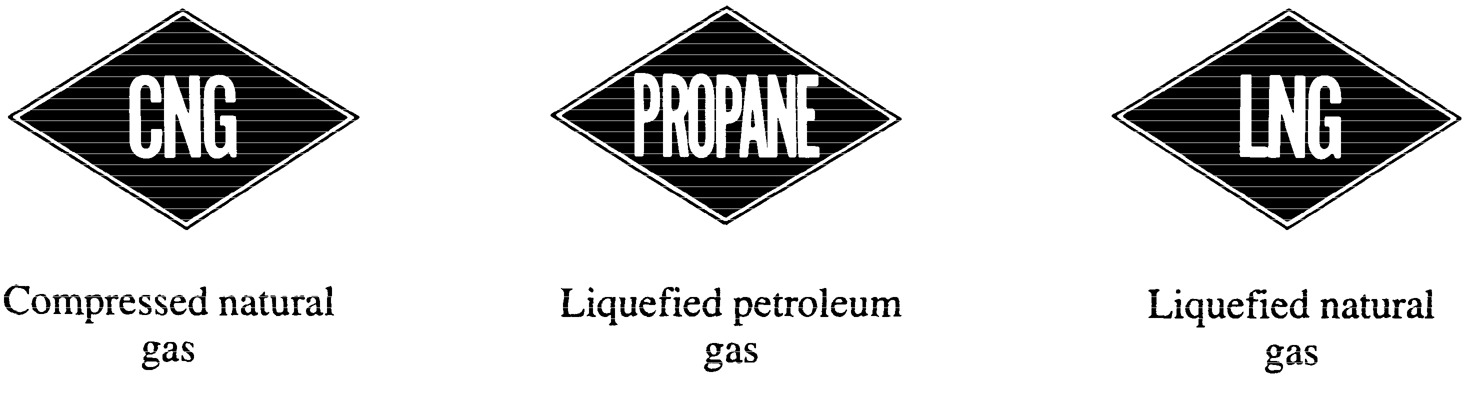
Subp. 2.
Specifications.
The following specifications apply to each of the warning symbols:
A.
The symbol must be diamond-shaped, 2-1/2 inches in height, and four inches in width at its highest and widest points respectively.
E.
The entire symbol, including letters, background, and border, must be made of reflectorized material and not fade or wash away when exposed to weather or other adverse elements.
History:
32 SR 10; 40 SR 1437
Published Electronically:
October 23, 2020
7511.8440 SYMBOL PLACEMENT.
A minimum of two warning symbols is required to be displayed. The warning symbols must be displayed in the places specified in item A. If the symbols cannot be clearly displayed or effectively applied to those locations they may be displayed in the places specified in item B. Display at least two symbols as follows:
A.
one warning symbol on the extreme left (driver's) side of the rear-facing portion of the rear bumper, and one warning symbol on the extreme right (passenger) side of the front-facing portion of the front bumper; or
B.
one warning symbol at least 12 inches but not more than 30 inches above the ground on the rear of the vehicle near the left (driver's) side and one warning symbol at least 12 inches but not more than 30 inches above the ground on the front of the vehicle near the right (passenger) side.
History:
32 SR 10; 40 SR 1437
Published Electronically:
May 12, 2016
7511.8500
[Repealed, 36 SR 1479]
Published Electronically:
June 12, 2012
7511.8510
[Repealed, 36 SR 1479]
Published Electronically:
June 12, 2012
7511.8520
[Repealed, 36 SR 1479]
Published Electronically:
June 12, 2012
7511.8530
[Repealed, 36 SR 1479]
Published Electronically:
June 12, 2012
7511.8540
[Repealed, 36 SR 1479]
Published Electronically:
June 12, 2012
7511.8550
[Repealed, 36 SR 1479]
Published Electronically:
June 12, 2012
7511.8560
[Repealed, 36 SR 1479]
Published Electronically:
June 12, 2012
7511.8570
[Repealed, 36 SR 1479]
Published Electronically:
June 12, 2012
Official Publication of the State of Minnesota
Revisor of Statutes